Overview
Shadows are a natural, daily demonstration of the Sun’s motion across the sky. As the Sun rises, climbs, and sets, the angle of sunlight on any upright object changes, making the object’s shadow longer, shorter, and then longer again. This observation activity lets children record those changes with everyday items, turn the data into a simple graph, and connect the pattern to the Earth‑Sun geometry.
Materials
- One straight stick, dowel, or ruler about 30–50 cm long (a wooden chopstick works well).
- A sheet of sturdy paper or a piece of cardboard (the “ground” on which the shadow will be traced).
- Pencil or marker for tracing.
- Measuring tape, ruler, or a piece of string with centimeter markings.
- Optional: a compass to note direction (helps older students link shadow direction to cardinal points).
- Notebook or printable observation journal (provided below).
Before You Begin
Choose a flat, open area that receives direct sunlight for most of the day – a backyard, school playground, or a clear spot on a roof works well. Avoid places where trees, buildings, or clouds will cast additional shadows on your paper, as they can confuse the measurements. The activity works best in the Northern Hemisphere where midday shadows point roughly north; the opposite holds in the Southern Hemisphere [2].
Procedure (Steps)
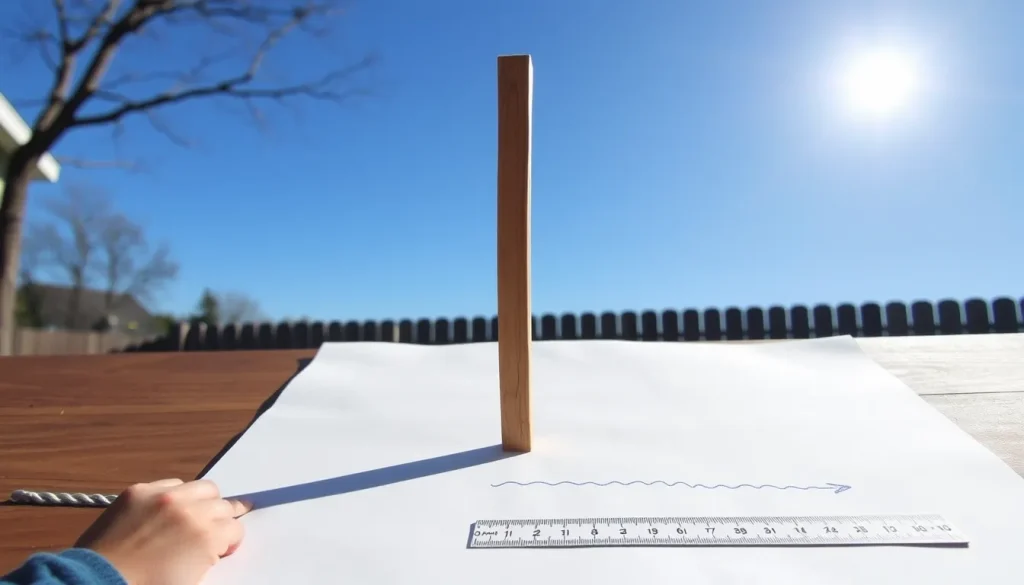
- Set up the ground: Lay the paper or cardboard flat on the ground. Mark a small dot in the center – this will be the base of the stick.
- Place the stick: Stand the stick vertically on the dot. If the stick wobbles, use a small amount of modeling clay or a sandbag to keep it upright.
- Choose observation times: Plan to record the shadow at regular intervals – for example, every hour from sunrise to sunset. If the day is very long, you may record every 30 minutes around solar noon (the time when the Sun is highest).
- Record the shadow: At each scheduled time:
- Observe the shadow that the stick casts on the paper.
- Use the pencil to trace the outline of the shadow onto the paper.
- Measure the length of the shadow from the base of the stick to the tip of the trace with the ruler or tape measure. Write the length (in centimeters) in the observation journal.
- Note the time of day (e.g., 07:45 am) and, if you have a compass, the direction the shadow points (north, south, east, west, or an angle).
- Repeat: Continue the same steps for each time slot until the Sun sets and the shadow disappears.
- Clean up: When finished, collect the paper, stick, and tools. Store the paper with the traced shadows for later analysis.
What to Observe or Measure
The primary data are the shadow lengths (centimeters) and the times of day. Optional data include the direction the shadow points (useful for older learners) and cloud cover notes (clouds can make the Sun appear lower, lengthening shadows).
Observation Journal (Blank Template)
| Date | Time (24‑h) | Shadow Length (cm) | Direction (optional) | Cloud Cover (optional) |
|---|---|---|---|---|
Data Table (Blank for Recording)
| Time (hh:mm) | Shadow Length (cm) |
|---|---|
Graphing Your Results
When the day’s observations are complete, transfer the numbers to a simple line graph:
- X‑axis: Time of day (morning to evening). Use a consistent scale – for example, each square represents one hour.
- Y‑axis: Shadow length in centimeters.
- Plot each recorded point and connect them with a smooth line. The curve should show a “U‑shape”: long shadows at sunrise, decreasing to a minimum near noon, then increasing again toward sunset.
Students can compare their graph to a model curve based on the Sun’s altitude angle, but the observation itself already demonstrates the key pattern.
The Science Explained
The length of a shadow depends on the angle of sunlight relative to the ground. When the Sun is low on the horizon (just after sunrise or just before sunset), sunlight strikes the stick at a shallow angle, casting a long shadow. As the Sun climbs higher, the angle becomes steeper, and the shadow shortens. At solar noon – the moment the Sun reaches its highest point in the sky for that location – the shadow is at its shortest. After noon the Sun descends, the angle becomes shallow again, and the shadow lengthens.
Mathematically, shadow length (L) relates to the stick’s height (h) and the Sun’s elevation angle (θ) by the simple trigonometric relation:
L = h / tan θ
When θ is small (Sun low), tan θ is small, making L large. When θ approaches 90° (Sun directly overhead), tan θ becomes large, making L approach h. This explains why the shortest shadow is roughly the height of the stick itself at the Sun’s highest point.
Because Earth rotates eastward, the Sun appears to move westward across the sky. In the Northern Hemisphere, the Sun’s path is to the south, so midday shadows point north; in the Southern Hemisphere the opposite occurs [2]. Ancient sky‑watchers, such as the Babylonian priests, noted these regular changes and used them for early time‑keeping and calendars [1].
Troubleshooting
- Shadow is missing or very faint: Cloud cover can diffuse sunlight, making shadows weak. If the sky is overcast, postpone the observation to a clearer day.
- Stick wobbles or tilts: Secure the base with a small amount of clay, sand, or a weighted object so the stick stays perfectly vertical.
- Paper moves in wind: Anchor the paper with small stones or tape the corners to the ground.
- Inconsistent timing: Use a phone alarm or a kitchen timer to remind you of each observation slot.
Next Steps
Once students see the basic U‑shaped pattern, they can explore extensions:
- Repeat the activity in a different season and compare how the noon shadow length changes with the Sun’s declination.
- Perform the same observation at a location in the Southern Hemisphere (or use a compass to confirm direction) and note the opposite shadow direction.
- Use a longer stick or a vertical pole and calculate the Sun’s elevation angle at each time using the formula above.
- Combine multiple sticks of different heights on the same sheet to see how height influences shadow length.
These extensions turn the simple observation into a richer investigation of Earth‑Sun geometry and seasonal change.
Sources & references
- Why Do Shadows Change Over Time? | The Schools' Observatory, https://www.schoolsobservatory.org/things-to-do/why-do-shadows-change-over-time
- The Sky Above Us – NASA Goddard Space Flight Center, https://pwg.gsfc.nasa.gov/stargaze/Ssky.htm