Overview
When you stir a spoonful of sugar into a glass of tea, it disappears quickly if the tea is hot and more slowly if the tea is cold. This observation is a great entry point to learn how temperature affects the rate at which a solid dissolves in a liquid. In this experiment you will compare how fast a fixed amount of granulated sugar disappears in warm water versus cool water.
Before You Begin
- Choose a well‑ventilated workspace and a flat surface where cups will not tip.
- Gather an adult to help with heating water safely (microwave or stovetop) and to supervise younger children.
- Prepare a simple data‑recording sheet (printed or on a tablet) before starting.
Materials
- Two clear drinking glasses or plastic cups (same size)
- Tap water (enough for two 200 mL portions)
- Thermometer (digital or kitchen) – optional but recommended
- Measuring spoon (1 teaspoon) – use the same spoon for every trial
- Granulated white sugar
- Timer or stopwatch (phone works fine)
- Stirring spoon or stir stick (same for all trials)
- Paper towel for spills
Testable Question
Does warm water dissolve sugar faster than cool water?
Hypothesis
Because higher temperature gives molecules more kinetic energy, the water molecules will collide with sugar crystals more often and with greater force. Therefore the sugar should dissolve more quickly in warm water than in cool water.
Variables and Controls
| Variable | What It Is |
|---|---|
| Independent variable | Temperature of the water (e.g., ~20 °C vs. ~50 °C) |
| Dependent variable | Time (seconds) required for the sugar to disappear completely |
| Controlled variables | Amount of water (200 mL), amount of sugar (1 tsp), type of sugar, cup size, stirring speed and method, ambient room temperature |
| Control group | Neither temperature nor procedure is altered; the cool‑water trial serves as the baseline. |
Procedure (Steps)
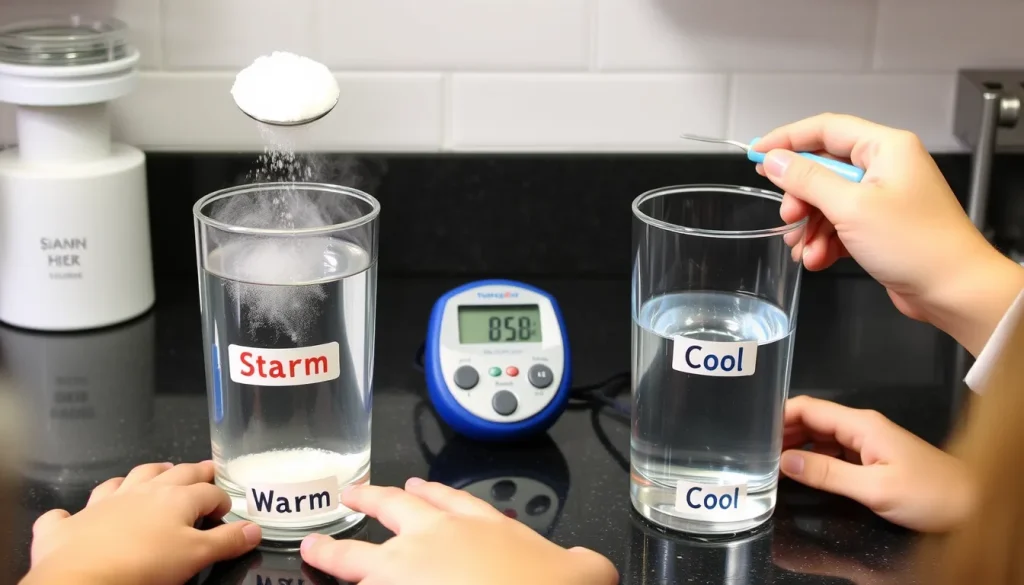
- Label the two cups “Warm” and “Cool.”
- Measure 200 mL of water into each cup.
- Heat the water for the “Warm” cup until it reaches about 50 °C (use the thermometer or feel the steam – it should be warm but not scalding). Leave the “Cool” cup at room temperature (around 20 °C).
- Record the exact temperature of each cup.
- Place a clean teaspoon of granulated sugar on the edge of the cup, then drop it in. Start the timer the moment the sugar contacts the water.
- Stir gently with the same spoon using a consistent motion (e.g., three slow circles per second). Continue stirring until no visible sugar remains.
- Stop the timer and record the time in seconds.
- Repeat steps 5‑7 for the second cup.
- Perform at least three trials for each temperature, cleaning the spoon between trials.
What to Observe or Measure
- Time (seconds) from the moment the sugar is added to the moment it is completely dissolved.
- Any undissolved granules after a set stirring period (optional qualitative note).
- Temperature of each cup before each trial (temperature may drop slightly as the sugar dissolves).
Data Table
| Trial | Temperature (°C) | Time to Dissolve (s) |
|---|---|---|
| 1 | ||
| 2 | ||
| 3 | ||
| 4 | ||
| 5 | ||
| 6 |
Repeated Trials
Repeating each temperature three times helps you see natural variation (e.g., slight differences in stirring speed or water temperature). Calculate the average time for the warm trials and the average for the cool trials; then compare the two averages.
Graphing Your Results
A simple bar graph works well. Place “Temperature” on the horizontal axis (two bars: Warm and Cool) and “Average Dissolution Time (seconds)” on the vertical axis. Adding error bars that show the range of your three trials gives a visual sense of consistency.
The Science Explained
Increasing temperature adds energy to the water molecules, causing them to move faster (greater molecular motion). Faster molecules collide with the sugar crystals more frequently and with higher energy, helping the crystal lattice break apart more quickly. In addition, heating creates convection currents that continually bring fresh, unsaturated water into contact with the sugar, further speeding the process. This is why most solid solutes, such as sugar and sodium chloride, dissolve faster in warm water. (See ACS lesson on temperature and dissolving [1] and UCSB Science Line discussion of molecular collisions [3]. LibreTexts also notes that “anything that can be done to increase the frequency of those collisions … will increase the rate of dissolution” [4].)
Troubleshooting
- Sugar doesn’t disappear: Make sure you used the same amount of water for both cups; too little water reduces the solvent capacity.
- Times vary widely: Keep stirring speed consistent. You can practice the stirring motion a few times before starting the timer.
- Temperature drops quickly: Measure temperature immediately before adding sugar. If the warm water cools too fast, re‑heat it to the target temperature.
Common Misconceptions
- All substances dissolve faster in warm water. Not true. Some gases are less soluble in warm water, and certain salts (e.g., calcium sulfate) have little temperature dependence.
- Stirring isn’t important. Stirring dramatically increases the contact between solvent and solute, so it is a key controlled variable.
Try Another Version
Replace sugar with table salt, powdered milk, or a small piece of chocolate. Compare how each solute’s dissolution rate responds to temperature. You can also test a range of temperatures (ice‑cold, room temperature, warm, near‑boiling) to see how the trend continues.
Cleanup and Disposal
Pour the sweet water down the sink with plenty of running water. Rinse the cups and spoon with clean water. Wipe any spills with a paper towel. No special hazardous waste handling is needed.
Next Steps
Use the same method to explore how other factors—such as stirring speed, surface area (use sugar cubes vs. granules), or the amount of solute—affect dissolution. Connecting these variables builds a deeper understanding of solution dynamics, a core concept in chemistry.
Frequently asked questions
Do all substances dissolve faster in warm water?
No. While many solid solutes (sugar, salt) dissolve more quickly in warm water, some gases are less soluble at higher temperatures, and a few salts show little temperature dependence.
Can I use a microwave to heat the water?
Yes, but heat the water in short bursts, stir, and check the temperature with a thermometer to avoid overheating.
What if I don’t have a thermometer?
You can estimate temperature by feel: warm water should feel comfortably warm to the touch (not hot), while cool water feels room temperature. Consistency between trials is more important than exact numbers.
Related terms
- Solubility
- The maximum amount of a substance that can dissolve in a solvent at a given temperature.
- Molecular motion
- The random movement of molecules; faster at higher temperatures.
- Collision theory
- A model that explains how reacting particles must collide with enough energy and proper orientation to cause a chemical change—in this case, the breaking apart of sugar crystals.
Sources & references
- Chapter 5, Lesson 6—Does Temperature Affect Dissolving? American Chemical Society. https://www.acs.org/content/dam/acsorg/msc/downloads/chapter-5/lesson-6/ch5-l6-lesson-plan.pdf
- UCSB Science Line answer on temperature and dissolution. https://scienceline.ucsb.edu/getkey.php?key=6019
- 16.2: Rate of Dissolving – Chemistry LibreTexts. https://chem.libretexts.org/Bookshelves/Introductory_Chemistry/Introductory_Chemistry_(CK-12)/16_Solutions/16.02_Rate_of_Dissolving