Overview
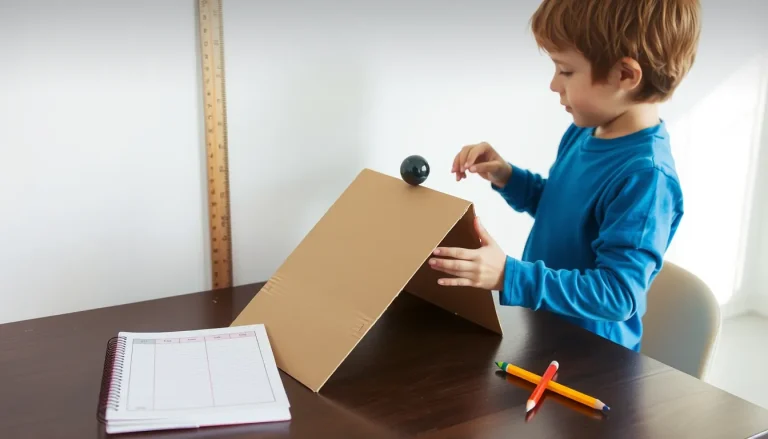
When a toy car rolls down a sloping surface, the height of the start point determines how much stored (potential) energy the car has. By letting the car travel down ramps of different heights and measuring how far it goes on the floor, children can see the direct link between height, energy, and distance. This activity is a classic physics experiment that is safe, inexpensive, and can be completed in an afternoon.
Before You Begin
- Choose a flat, smooth floor (hard‑wood, tile, or smooth carpet) where the car can roll without obstacles.
- Clear the area of toys, cords, and anything that could cause the car to stop prematurely.
- Make sure an adult is present to help with measuring and to supervise the use of books or blocks for raising the ramp.
Materials
- 1 toy car (plastic or wooden, wheels that spin freely)
- 1 piece of cardboard, at least 60 cm long and 15 cm wide (the ramp)
- Sheet of paper or masking tape for marking start/stop lines on the floor
- Stack of identical books, blocks, or sturdy boxes to raise the ramp (you will need heights of about 5 cm, 10 cm, 15 cm, 20 cm, and 25 cm)
- Ruler or measuring tape (centimetre scale)
- Pencil and a notebook for recording data
- Optional: a protractor to measure the ramp angle (helps connect height to slope)
Step‑by‑Step Procedure
- Lay the cardboard on the floor and make sure one end rests flat on the ground.
- Place a stack of books under the higher end of the cardboard to create the first ramp height (e.g., 5 cm). Use a ruler to verify the vertical height.
- Secure the ramp so it does not shift when the car is released (tape the bottom edge lightly to the floor if needed).
- Mark a start line at the bottom of the ramp and a series of stop marks on the floor at 10 cm intervals using paper or tape.
- Place the toy car at the top of the ramp, making sure it is facing down the slope.
- Release the car without pushing it. Let it roll freely until it stops.
- Measure the distance from the start line to the point where the front wheels stop. Record the value in centimetres.
- Return the car to the top, reset the ramp, and repeat the measurement two more times for the same height. Record all three values.
- Increase the ramp height to the next setting (10 cm) by adding more books. Repeat steps 3‑7.
- Continue the process for each height: 15 cm, 20 cm, and 25 cm.
- For each height, you will have three measurements, giving a total of 15 data points.
- When all trials are complete, calculate the average distance for each ramp height.
What to Observe or Measure
The primary measurement is the distance traveled on the floor (centimetres) after the car leaves the ramp. You should also note any irregularities, such as the car wobbling, the floor texture affecting roll, or the car stopping early because of a bump.
Variables and Controls
| Variable | Type | Details |
|---|---|---|
| Ramp height (vertical distance from floor to top of ramp) | Independent | 5 cm, 10 cm, 15 cm, 20 cm, 25 cm |
| Distance traveled on floor | Dependent | Measured in centimetres |
| Car model, wheel condition | Controlled | Same car used for every trial |
| Ramp surface material | Controlled | Same piece of cardboard for all heights |
| Floor surface | Controlled | Same spot on the floor for all trials |
| Release method | Controlled | Car is released without a push each time |
Repeated Trials
Repeating each height three times helps you see natural variation (e.g., tiny differences in how the car leaves the ramp). By averaging the three runs, you obtain a more reliable result and can discuss why the numbers are not exactly the same each time.
Data Table (Blank)
| Ramp Height (cm) | Trial 1 (cm) | Trial 2 (cm) | Trial 3 (cm) | Average (cm) |
|---|---|---|---|---|
| 5 | ||||
| 10 | ||||
| 15 | ||||
| 20 | ||||
| 25 |
Graphing Your Results
Plot a simple line graph:
- X‑axis: Ramp height (cm)
- Y‑axis: Average distance traveled (cm)
- Connect the points with a smooth line. The slope of the line shows how distance changes with height.
If you have access to spreadsheet software (Google Sheets, Excel) you can add a trendline and see whether the relationship looks linear, quadratic, or something else. Even a hand‑drawn graph on graph paper works well for classroom discussion.
The Science Explained
When the car sits at the top of the ramp it possesses gravitational potential energy (PE), which depends on its height above the floor: PE = m g h, where m is the car’s mass, g is the acceleration due to gravity (≈9.8 m/s²), and h is the vertical height. As the car rolls down, this stored energy transforms into kinetic energy (KE) of motion. The higher the start point, the larger the initial PE, and therefore the greater the KE the car has when it reaches the bottom of the ramp.
Once the car leaves the ramp, it continues to roll until friction and air resistance drain its kinetic energy. More initial KE means the car can overcome friction for a longer distance, so a higher ramp usually leads to a longer roll. This is the principle behind the classic toy‑car ramp experiment and matches the observations described in practical‑science resources that use heights of 5 cm to 25 cm to test the idea that “a higher ramp makes a toy car travel farther”【1】.
It is important to remember that the relationship is not perfectly linear. At very high ramps the car may become unstable, or the floor friction may become the dominant limiting factor. Discussing these limits introduces the idea of model limitations—the experiment is a simplified model of real‑world motion.
Troubleshooting Common Issues
- Car stops too early: Check that the ramp surface is smooth and that the wheels spin freely. A rough cardboard edge or debris can add extra friction.
- Inconsistent distances: Make sure the car is released without nudging. Use a gentle “hold‑then‑let‑go” technique each time.
- Ramp shifts during the run: Tape the bottom edge lightly to the floor or use a heavier base for the books.
- Measurements vary widely: Verify that the height measurements are accurate for each trial; a misplaced book can change the height by a centimetre or more.
Try Another Version
Once the basic pattern is clear, you can extend the investigation:
- Change the car’s weight: Add small washers or modelling clay to the car and see how added mass influences distance.
- Alter the surface: Test the same ramp on carpet, tile, and a smooth wooden floor to explore the role of friction.
- Vary the ramp material: Use a smooth plastic sheet instead of cardboard to reduce internal friction.
- Measure time: Use a stopwatch to record how long the car travels. Relate time to distance and kinetic energy.
Cleanup and Disposal
All materials are reusable. Store the cardboard ramp flat to avoid creasing, and keep the books or blocks together for future projects. Dispose of any used paper scraps in recycling.
Next Steps
Use the data you collected to write a short report: state the testable question, list the hypothesis, show the table and graph, explain the trend, and note any sources of error. This report can serve as a foundation for a science‑fair display or a classroom presentation.
Sources & references
- Ramp height and how far a toy car travels – Practical-Science.com, https://practical-science.com/primary/ramp-height-toy-car-distance/
- Testing Ramp Height – Lenny.com lesson, https://www.lenny.com/lesson/testing-ramp-height-82228