Overview
Paper towels are a staple in every kitchen, but not all brands perform the same when a spill occurs. Consumer Reports recently tested nine popular brands and ranked them by strength and absorbency, showing that even inexpensive store brands can rival premium options [1]. This project lets children discover the same principle at home: how the structure of a paper towel determines how much water it can hold.
Before You Begin
- Choose a well‑ventilated area with a flat, waterproof surface (a kitchen countertop or a large tray).
- Adult supervision is required when handling hot water, scales, or scissors.
- Gather all materials before starting so that each trial can be performed under the same conditions.
- Use room‑temperature water (about 20 °C) for consistency; record the temperature with a kitchen thermometer if available.
Materials
- Four different paper towel brands (e.g., Bounty, Brawny, Kirkland Signature, Up & Up). Choose brands you already have at home.
- Scissors
- Ruler or measuring tape
- Digital kitchen scale (to the nearest gram) or a balance that can weigh small objects.
- Measuring cup (100 mL capacity)
- Large shallow tray or baking sheet to catch overflow
- Timer or stopwatch
- Notebook or worksheet for recording data (a printable data table is provided below).
- Paper towels for cleanup
Steps
- Cut a square piece from each brand that measures exactly 10 cm × 10 cm (100 cm²). Use the ruler and scissors for accuracy.
- Label each square with a sticky note or a small piece of masking tape: Brand A, Brand B, etc.
- Place one square on the tray, making sure it lies flat and does not overlap the edge.
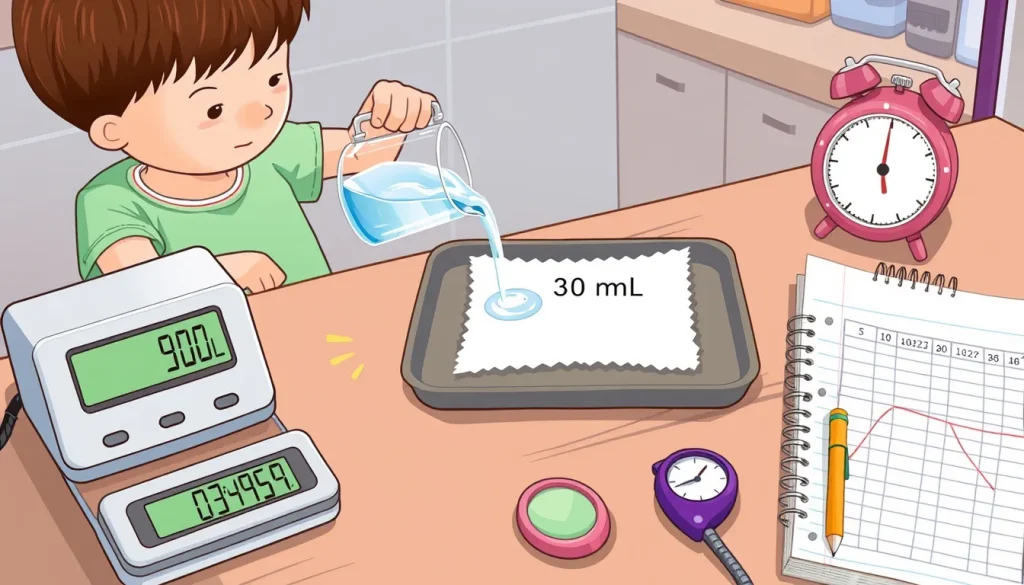
- Weigh the dry square on the scale and record the mass (in grams). This is the “dry weight.”
- Using the measuring cup, pour 30 mL of water onto the centre of the towel. Start the timer as soon as the water contacts the paper.
- Allow the towel to absorb the water for 60 seconds. Do not press or rub the towel; let capillary action do the work.
- After 60 seconds, gently lift the towel and place it back on the tray. Weigh the wet towel and record the mass. The difference between wet and dry weight is the amount of water absorbed.
- Return the towel to the tray, let it dry completely (or dispose of it if you prefer), and repeat steps 3‑7 two more times for the same brand (three trials total).
- Clean the tray, then repeat the entire procedure for the next brand, using a fresh set of squares each time.
What to Observe or Measure
The primary measurement is water absorbed (grams), calculated as:
Absorbed water = Wet weight – Dry weight
Because 1 mL of water weighs roughly 1 g at room temperature, the mass difference also represents the volume of water absorbed (in milliliters). Record each trial’s value in the data table.
Testable Question
Which paper towel brand absorbs the greatest amount of water per unit area when the same volume of water is applied?
Hypothesis
Students may predict that a thicker, multi‑ply brand such as Bounty will absorb more water than a single‑ply store brand because it contains more fibers and larger capillary pathways.
Variables and Controls
- Independent variable: Paper towel brand (type).
- Dependent variable: Amount of water absorbed (grams or milliliters).
- Controlled variables:
- Square size (10 cm × 10 cm for every sample).
- Water volume applied (30 mL).
- Absorption time (60 seconds).
- Water temperature (room temperature).
- Scale calibration.
Repeated Trials
Perform three trials for each brand. Repeating the test reduces random error (e.g., slight differences in towel placement) and lets students calculate an average and range.
Data Table
| Brand | Trial 1 (g) | Trial 2 (g) | Trial 3 (g) | Average (g) |
|---|---|---|---|---|
| Brand A | ||||
| Brand B | ||||
| Brand C | ||||
| Brand D |
Graphing Your Results
Create a simple bar graph:
- X‑axis: Paper towel brand.
- Y‑axis: Average water absorbed (grams or milliliters).
- Each bar should represent the mean of the three trials; error bars can show the range (maximum – minimum).
Bar graphs make it easy to see which brand performed best and to discuss why differences exist.
The Science Explained
Paper towels are made of cellulose fibers that form a network of tiny pores. When water contacts the paper, capillary action draws the liquid into these pores. The amount of water a towel can hold depends on:
- Pore size and distribution: Larger or more numerous pores allow more water to flow in.
- Fiber density: More fibers create a thicker matrix, increasing the total volume of void space.
- Surface treatment: Some brands add a thin polymer coating that can repel water, reducing absorption.
These factors vary between brands because manufacturers use different manufacturing processes (e.g., number of plies, embossing patterns). The experiment demonstrates how material structure influences a real‑world property—absorbency.
Troubleshooting
- Paper tears before the 60‑second timer ends: Use a slightly larger square (12 cm × 12 cm) to reduce edge stress.
- Water spills onto the tray: Pour slowly and keep the cup close to the towel’s centre.
- Scale reads inconsistent values: Zero the scale with a clean dish before each weighing.
- Large variation between trials: Ensure the towel is placed flat each time and that the water volume is exactly 30 mL.
Cleanup and Disposal
After the experiment, discard the used towels in the regular trash—they are not recyclable. Wipe the tray with a damp cloth and dry it. Store the scale and measuring cup for future projects.
Next Steps
Extend the investigation by:
- Testing different square sizes to see how area influences total absorption.
- Measuring how fast each towel absorbs water (record weight every 10 seconds).
- Comparing absorbency after the towel has been saturated and then wrung out.
These extensions deepen understanding of fluid dynamics and material science while keeping the activity firmly rooted in everyday materials.
Related terms
- Capillary action
- The ability of a liquid to flow in narrow spaces without the assistance of external forces, driven by surface tension.
- Absorbency
- A material’s capacity to take in and retain liquid, usually measured by the amount of liquid held per unit area.
Sources & references
- Consumer Reports, "3 Best Paper Towels, Tested and Reviewed," June 23, 2026, https://www.consumerreports.org/appliances/paper-towels/best-paper-towels-a1387073776/