Science demonstrations are great for sparking curiosity, but they often stop at “wow!” without showing how to answer a question scientifically. By adding a testable question, a hypothesis, and systematic data collection, any demonstration can become an experiment that teaches the full inquiry cycle.
Overview
This guide uses the well‑known “elephant toothpaste” reaction (hydrogen peroxide, dish soap, and a catalyst) as a concrete example. The steps, however, apply to any demonstration – from lava lamps to bouncing eggs. You will learn how to:
- Formulate a testable question and hypothesis
- Identify independent, dependent, and controlled variables
- Set up a control group
- Run repeated trials and record data
- Analyze results with a simple graph
- Reflect on the scientific process
Before You Begin
Gather all materials, read the safety notes, and decide who will take notes. Younger children (6‑8) should have an adult handle any measuring of chemicals and the disposal steps. Older children (9‑14) can take the lead on measuring, timing, and recording.
Materials
| Item | Typical Quantity |
|---|---|
| Hydrogen peroxide (3% solution, from pharmacy) | 1 cup (240 mL) |
| Dish soap (liquid) | 2 tablespoons |
| Food coloring (optional) | 1–2 drops |
| Dry yeast (as catalyst) | 1 packet (≈7 g) |
| Warm water (to activate yeast) | ½ cup (120 mL) |
| Clear graduated cylinder or tall plastic bottle | 1 |
| Measuring cup or kitchen scale | 1 set |
| Paper towel or cardboard tray (to catch foam) | 1 piece |
Step‑by‑Step Procedure
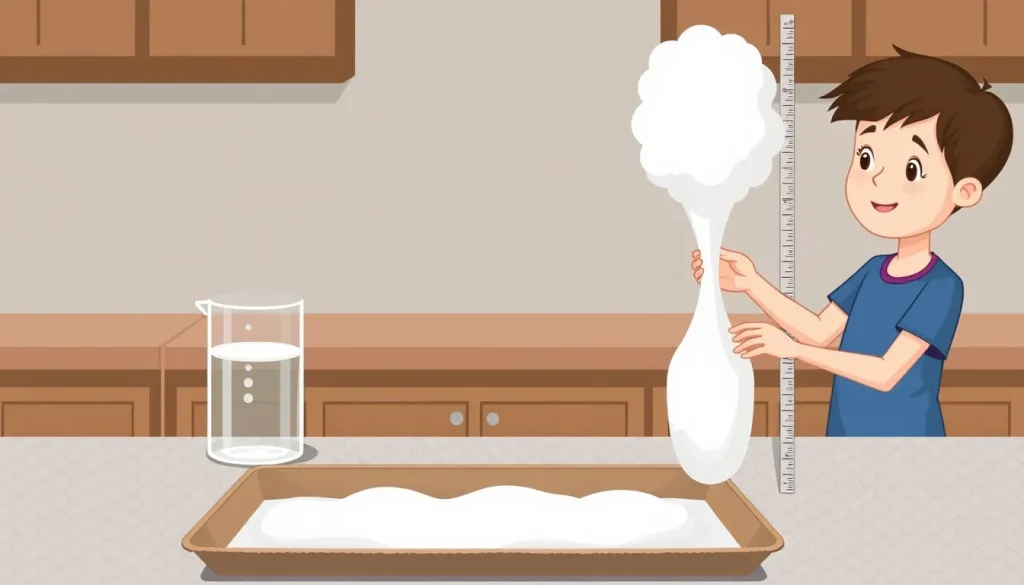
- Survey the demonstration: Perform the classic elephant toothpaste reaction exactly as shown in many videos. Observe the height of the foam column.
- Ask a question: For example, “How does the amount of hydrogen peroxide affect the height of the foam?”
- Form a hypothesis: Write a prediction, e.g., “If I double the volume of hydrogen peroxide, the foam will be roughly twice as high because more oxygen gas is produced.”
- Set up variables:
- Independent variable: Volume of hydrogen peroxide.
- Dependent variable: Height of the foam column (cm).
- Controlled variables: Amount of dish soap, amount of yeast, temperature of water, size of container, timing of measurements.
- Prepare a control: Run one trial using the standard 1‑cup hydrogen peroxide amount. This will serve as the baseline for comparison.
- Run repeated trials: For each chosen hydrogen peroxide volume (e.g., 0.5 cup, 1 cup, 1.5 cup), perform three independent trials. Keep all other factors identical.
- Record data: Measure the foam height 30 seconds after mixing and write the value in the data table.
- Clean up: Dilute the foam with water, dispose of the solution down the sink, and wash all reusable containers.
What to Observe or Measure
Use a ruler or a marked stick placed next to the container to measure the foam height in centimeters. Record the measurement in the data table for each trial. Also note any qualitative observations such as foam stability, color spread, or odor.
Data Table (blank for use)
| Trial | H₂O₂ volume (mL) | Dish soap (mL) | Foam height (cm) |
|---|---|---|---|
| 1 | |||
| 2 | |||
| 3 | |||
| 4 | |||
| 5 | |||
| 6 |
The Science Explained
Hydrogen peroxide (H₂O₂) decomposes into water and oxygen gas. The reaction is slow on its own but speeds up dramatically when a catalyst such as the enzyme catalase in yeast is added. The released oxygen gets trapped by the dish‑soap bubbles, creating a rapid expansion of foam. The amount of oxygen – and therefore the foam height – is proportional to the amount of hydrogen peroxide available, assuming the catalyst and soap are not limiting.1
Using the SQER3 Framework
The SQER3 instructional model (Survey, Question, Experiment, Recite, Reflect, Review) aligns perfectly with this conversion process. After surveying the demonstration, you pose a question, design the experiment, recite (record) the data, reflect on the outcome, and review the findings with peers or family members. This structure helps children see the full inquiry cycle in action.2
Troubleshooting Common Issues
- Foam height is lower than expected: Verify that the yeast is fresh and that the warm water is around 40 °C (104 °F) to activate the enzyme.
- Inconsistent measurements: Use the same ruler for every trial and measure at the same time point after mixing.
- Excessive bubbling spills over: Place the container on a larger cardboard tray to catch overflow.
Next Steps
After completing the experiment, try varying a different variable – such as the amount of dish soap or the temperature of the activating water – and repeat the SQER3 cycle. You can also graph the results (foam height vs. hydrogen peroxide volume) to practice interpreting linear relationships.
Cleanup and Disposal
The reaction produces water, oxygen, and a small amount of soap. Dilute the remaining mixture with plenty of water and pour it down the sink while running cold water. Wash the container, ruler, and any reusable tools with soap and rinse well. Store any leftover yeast in the refrigerator for future experiments.
Sources & references
- Brookshire, Bethany. “Level up your demonstration: Make it an experiment.” SN Explores, 27 Apr 2021, https://www.snexplores.org/article/convert-demonstration-into-experiment.
- Chamely‑Wiik, Donna M., and Jerome E. Haky. “SQER3: An Instructional Framework for Using Scientific Inquiry To Design Classroom Demonstrations.” Journal of Chemical Education, 22 Jan 2014, https://doi.org/10.1021/ed300689n.