Overview
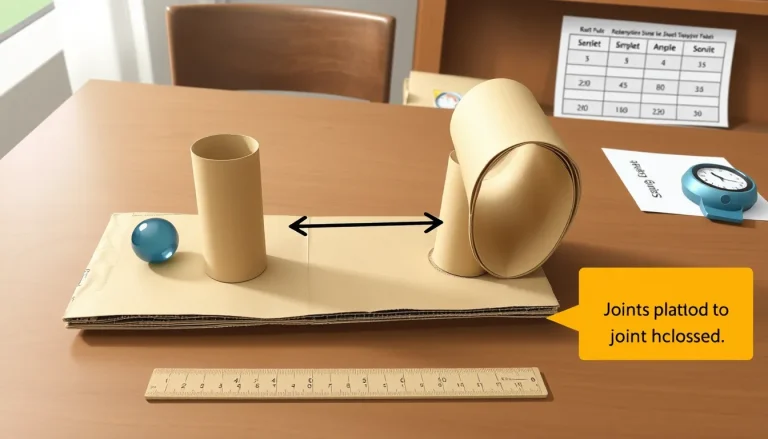
When you build a tower of blocks, you may notice that a tower with a broad footprint stays upright longer than a narrow one. Engineers call this property stability. In real structures such as power‑line transmission towers, the width of the base is a key design decision because it determines how much the tower will sway or collapse under wind and its own weight. This project lets children design, build, and test cardboard towers with different base widths, then compare how stable each design is.
Before You Begin
- Choose a flat, level surface – a kitchen table or a sturdy floor.
- Gather an adult to supervise cutting of cardboard and to help with any sharp tools.
- Set up a clear workspace where the towers can be knocked over safely without breaking anything.
Materials
- Heavy‑weight cardboard sheets (e.g., from a moving box) – at least 4 large pieces, 30 cm × 30 cm each.
- Scissors or a craft knife (adult use only).
- Ruler or measuring tape.
- Pencil and eraser.
- Masking tape or a hot‑glue gun (optional, for stronger joints).
- Two identical 1‑kg sandbags or small water bottles (to serve as a consistent wind‑load simulator).
- Stopwatch.
- Data recording sheet (provided in the blank table below).
Design Goal & Constraints
Goal: Build the tallest tower possible that can stay upright for at least 10 seconds when a 1‑kg weight is placed on the top and a gentle push is applied.
Constraints:
- All towers must be the same height (choose a target height, e.g., 30 cm, measured from base to top).
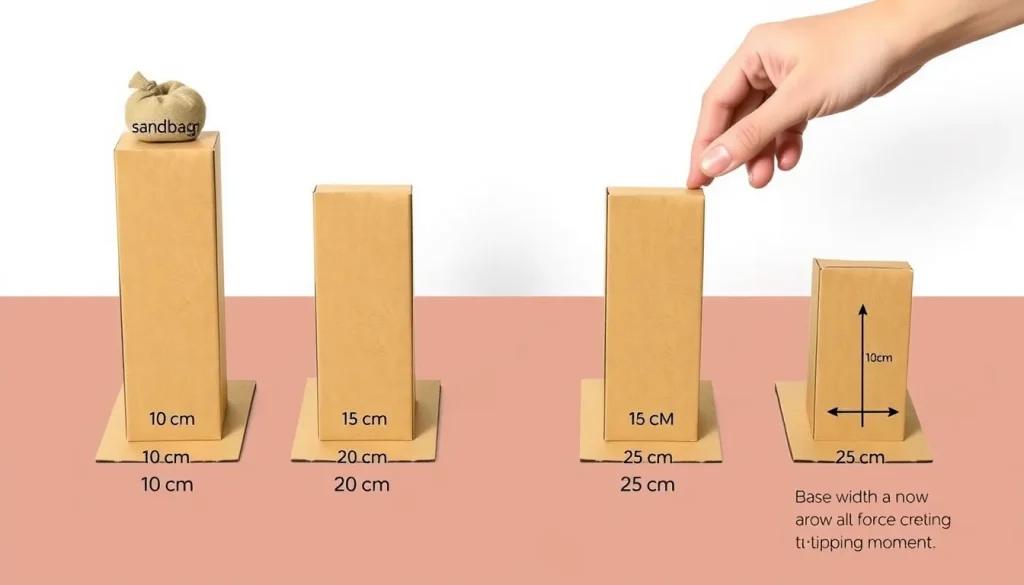
- Only the base width may vary. Use square bases of 10 cm, 15 cm, 20 cm, and 25 cm side length.
- All other dimensions (wall thickness, number of layers) must stay the same.
- No additional support materials (e.g., wooden dowels) may be added.
Procedure
- Draw four squares on the cardboard, each representing a different base width (10 cm, 15 cm, 20 cm, 25 cm). Cut them out.
- From the remaining cardboard, cut identical rectangular strips 5 cm wide and 30 cm long. These will become the vertical “legs” of the tower. You will need four legs per tower.
- Attach the four legs to each base square using tape or glue, making sure the legs are perpendicular to the base. Reinforce each corner with a small piece of tape.
- Stack the leg‑strip sections vertically, one on top of another, until the tower reaches the target height (≈30 cm). Secure each layer lightly with tape so the tower does not collapse during construction.
- Label each tower with its base width (e.g., “Base 10 cm”).
- Place the 1‑kg sandbag gently on the very top of the tower.
- Using a ruler as a guide, give the tower a gentle, consistent push from the side (about 0.5 N of force – you can estimate by pressing the ruler against the tower until it just begins to move).
- Start the stopwatch the moment the push is applied and record how long the tower remains standing before it tips over.
- Repeat steps 5‑8 three times for each base width, resetting the tower each trial.
- If a tower collapses during construction, rebuild it before testing.
- Record all times in the data table below.
What to Observe or Measure
- Stability time: seconds the tower stays upright after the push.
- Failure mode: does the tower tip over at the base, bend in the middle, or collapse from the top?
- Peak deflection (optional): if you have a ruler, note how far the top moves sideways before falling.
Variables and Controls
- Independent variable: base width (10 cm, 15 cm, 20 cm, 25 cm).
- Dependent variable: stability time (seconds).
- Controlled variables: tower height, material type, leg dimensions, weight on top, push force, and testing surface.
Data Table
| Base Width (cm) | Trial 1 (s) | Trial 2 (s) | Trial 3 (s) | Average (s) |
|---|---|---|---|---|
| 10 | ||||
| 15 | ||||
| 20 | ||||
| 25 |
Graphing Your Results (Optional)
Plot “Base Width” on the horizontal axis and “Average Stability Time” on the vertical axis. A rising curve shows that wider bases keep towers upright longer. If you have access to spreadsheet software, add a trend line to visualize the relationship.
The Science Explained
Real transmission towers are built from steel lattice structures that must survive wind, ice, and the weight of the conductors they carry. Engineers design the base width to balance material cost with stability. A recent comparative study of 132 kV transmission towers found that increasing the base width from 5.5 m to 8.5 m reduced the maximum compressive force in the leg members and lowered peak deflection under wind loads (source [2]). The same study showed that a square base performed better than a rectangular base of the same area, because the forces are distributed more evenly.
The principle behind these findings is simple geometry. The wider the base, the lower the tower’s center of gravity relative to the ground, and the larger the “lever arm” that resists tipping. When a lateral force (like wind or a push) acts on the tower, it creates a moment (torque) equal to the force multiplied by the height at which it acts. A broader base increases the distance over which the structure can spread that moment to the ground, reducing the stress on any single leg.
In our cardboard model, the same physics applies. The sandbag adds a vertical load at the top, and the push creates a horizontal load. By widening the footprint, the cardboard legs experience less compressive stress, allowing the tower to stay upright longer. This mirrors the real‑world observation that transmission towers with larger base widths are more economical in the long run because they need less steel in each leg to achieve the same safety factor.
Troubleshooting
- Tower collapses during construction: Check that the legs are truly perpendicular to the base. Use a right‑angle ruler to verify.
- All towers fall immediately after the push: Reduce the push force. Practice the push on a single tower until you can apply a consistent, gentle tap.
- Very little difference between base widths: Verify that the base squares are measured accurately. Small measurement errors can mask the effect.
Try Another Version
Once the basic experiment is complete, extend it in one of these ways:
- Use rectangular bases (e.g., 10 cm × 20 cm) to test the claim that square bases are more efficient (source [2]).
- Vary the tower height while keeping base width constant to see how height influences stability.
- Replace the sandbag with a small fan blowing on the tower to simulate wind pressure.
- Build towers from paper rolls or thin wooden sticks to explore material effects.
Next Steps
After analyzing the data, discuss with kids how engineers decide on the optimal base width for real infrastructure. You can connect the activity to a larger unit on forces, energy, or civil engineering careers. For a deeper dive, explore the cited research papers or visit a local utility’s visitor center to see real transmission towers up close.
Related terms
- Base width
- The horizontal distance across the footprint of a tower; a wider base gives a larger area of support.
- Stability
- The ability of a structure to remain upright when subjected to external forces such as wind or a push.
- Compressive force
- A force that pushes inward on a structural member, trying to shorten or crush it.
- Center of gravity
- The point in a body where its mass is evenly balanced; lower centers of gravity improve stability.
Sources & references
- Science Buddies. “Building Block Towers.” https://www.sciencebuddies.org/stem-activities/block-towers
- Comparative Study of 132 kV Transmission Towers with Different Base Widths Across Various Wind Zones. https://pratibodh.org/index.php/pratibodh/article/view/441
- Determination of Economic Base Width of Transmission Tower. https://www.ijres.org/papers/Volume-9/Issue-8/Series-3/O09088089.pdf