Overview
Light‑blocking (or light‑absorbing) materials are important in many technologies – from solar‑thermal collectors to the black coatings used on telescopes. Everyday items like black construction paper, charcoal‑filled cardboard, or even a sheet of aluminum foil each absorb a different amount of visible light. This experiment lets you and your child discover which material blocks the most light, and why the differences exist.
Before You Begin
- Safety: Use a low‑power LED flashlight or a desk lamp with a dimmer. Do not look directly into the light source.
- Environment: Perform the test in a dim room so ambient light does not overwhelm the measurements.
- Adult supervision: Needed for handling the smartphone app, cutting cardboard, and ensuring the light source stays steady.
Materials
- LED flashlight or desk lamp (steady, no flicker)
- Smartphone with a free light‑meter app (e.g., “Lux Light Meter” for iOS or Android)
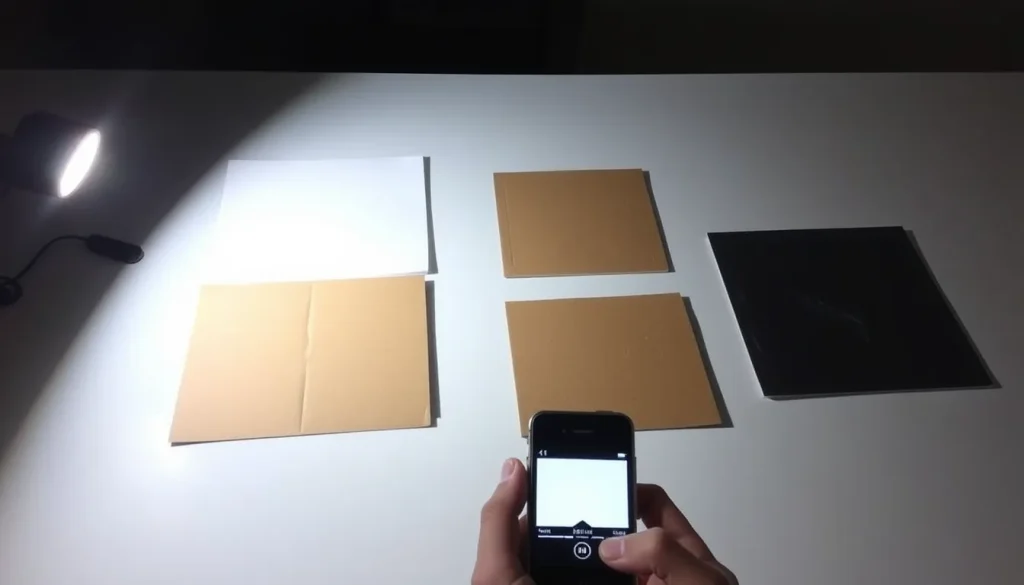
- Four sample sheets (approximately 10 cm × 10 cm each):
- White printer paper (baseline reflectance)
- Plain brown cardboard (uncoated)
- Black construction paper (commercial black pigment)
- Charcoal‑coated cardboard (drawn with a thick layer of charcoal powder mixed with a little water and dried)
- Ruler or measuring tape
- Masking tape (to hold samples in place)
- Notebook or worksheet for recording data
Testable Question
Which of the four everyday materials—white paper, brown cardboard, black construction paper, or charcoal‑coated cardboard—absorbs the highest percentage of visible light?
Hypothesis
Because black pigments absorb more light than lighter colors, the charcoal‑coated cardboard is expected to block the most light, followed by black construction paper, brown cardboard, and finally white paper.
Variables and Controls
| Variable | What It Is |
|---|---|
| Independent variable | Type of material covering the sample (white paper, brown cardboard, black paper, charcoal‑coated cardboard) |
| Dependent variable | Light intensity measured by the smartphone app (lux) after passing through the material |
| Controlled variables | Distance between light source and sample (30 cm), flashlight brightness setting, ambient lighting, size of each sample, and orientation of the smartphone sensor |
Procedure (Steps)
- Set up a flat table in a dim room. Place the LED flashlight on a sturdy stand or stack of books so the beam points straight down.
- Measure and mark a distance of 30 cm from the light source using the ruler. This will be the position for each sample.
- Secure the first sample (white paper) on a piece of cardboard using a small piece of masking tape so it lies flat and does not move.
- Turn on the flashlight at its lowest setting and let it warm up for 30 seconds (to stabilize output).
- Open the light‑meter app on the smartphone. Hold the phone directly under the center of the sample, with the sensor (usually the rear camera) facing up.
- Record the reading displayed (in lux) as Baseline Lux.
- Replace the white paper with the next material (brown cardboard) while keeping the 30 cm distance and orientation identical.
- Record the new lux reading as Sample Lux.
- Repeat step 6 for black construction paper and then for charcoal‑coated cardboard, recording each reading.
- For each material, calculate the percentage of light blocked using the formula:
Percent Blocked = 100 × (Baseline – Sample) / Baseline - Perform three full cycles (all four materials) to obtain repeated trials. Randomize the order of materials in each cycle to reduce systematic bias.
What to Observe or Measure
- Lux values: Numeric readings from the app (e.g., 1200 lux for white paper, 30 lux for charcoal cardboard).
- Percent blocked: Calculated from the formula above.
- Qualitative notes: Any visible glow, uneven coating, or surface texture that might affect the reading.
Data Table
| Trial | Material | Baseline Lux (white paper) | Sample Lux | Percent Blocked |
|---|---|---|---|---|
| 1 | White paper | |||
| 1 | Brown cardboard | |||
| 1 | Black construction paper | |||
| 1 | Charcoal‑coated cardboard | |||
| 2 | White paper | |||
| 2 | Brown cardboard | |||
| 2 | Black construction paper | |||
| 2 | Charcoal‑coated cardboard | |||
| 3 | White paper | |||
| 3 | Brown cardboard | |||
| 3 | Black construction paper | |||
| 3 | Charcoal‑coated cardboard |
Graphing Your Results
Create a simple bar graph with “Material” on the horizontal axis and “Percent of Light Blocked” on the vertical axis. Each bar should represent the average percent blocked across the three trials. This visual makes it easy to compare which material performed best.
The Science Explained
When visible light strikes a surface, three things can happen: it is reflected, transmitted (passes through), or absorbed. Dark pigments contain carbon‑based particles that convert light energy into heat, reducing the amount reflected. Commercial “super black” coatings push this effect to the extreme. For example, the National Physical Laboratory’s Super Black absorbs about 99.6 % of visible light at normal incidence, while the carbon‑nanotube material Vantablack absorbs 99.965 % and a newer MIT formulation reaches 99.995 % across all angles [2][4]. These engineered materials use nanostructures that trap light, but ordinary black paper or charcoal works on the same principle at a much lower efficiency.
In our experiment, the white paper reflects most of the light, so the smartphone sensor reads a high lux value. Each darker sample reduces the reflected light, lowering the lux reading. The calculated “percent blocked” is a simple way to express how much of the incident light is being absorbed rather than reflected.
Repeated Trials and Accuracy
Repeating the full set of samples three times helps smooth out random variations such as tiny changes in flashlight output, slight differences in how the smartphone is held, or uneven coating of charcoal. Averaging the results gives a more reliable picture of each material’s true light‑blocking ability.
Troubleshooting
- Inconsistent lux readings: Ensure the smartphone stays at the same height and angle for every measurement. Use a small piece of tape to mark the phone’s position.
- Ambient light leaking in: Perform the test in a darkened room and cover the sides of the sample with black cardboard to prevent stray light.
- Charcoal coating flakes: Let the charcoal‑water mixture dry completely before measuring. If it cracks, re‑apply a thin, even layer.
- Smartphone app shows “0 lux”: The sensor may be saturated or too far from the sample. Move the phone closer (still keeping the sensor flat) or reduce the flashlight brightness.
Next Steps
After identifying the darkest material, you can explore extensions such as:
- Testing the effect of thickness – stack two sheets of the same material and see how much more light is blocked.
- Comparing other everyday items (e.g., matte black spray paint, fabric, or foil).
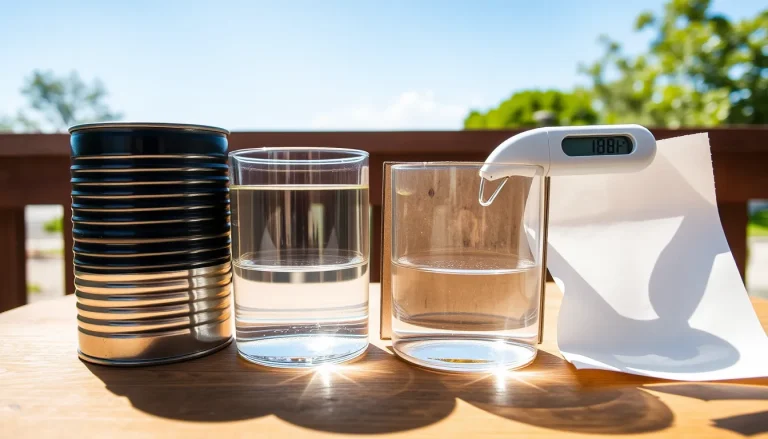
- Measuring temperature rise on the back of each material to connect absorbed light to heat.
These follow‑up activities deepen the link between light absorption and real‑world applications like solar collectors or telescope baffles.
Related terms
- Absorbance
- The fraction of light energy taken up by a material and converted to other forms, usually heat.
- Reflectance
- The portion of incident light that bounces off a surface and reaches the observer.
- Albedo
- A measure of how much light a surface reflects; low albedo means the surface is dark and absorbs most light.