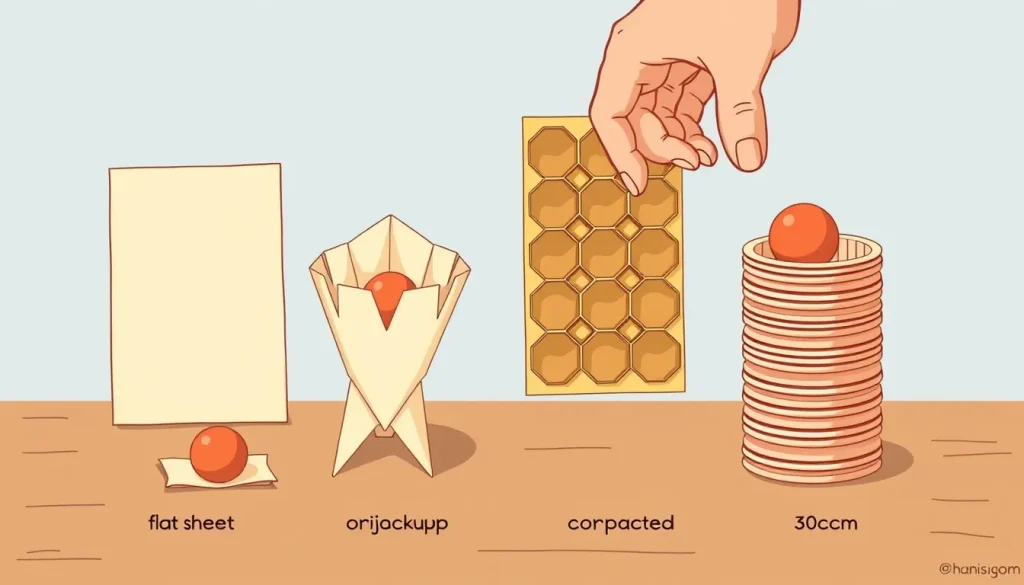
In this experiment children compare four common paper constructions— a flat sheet, an origami cup, a honey‑comb panel, and a corrugated tube— to see which one best cushions a small clay ball dropped from a low height. By measuring whether the ball stays intact and noting how the paper deforms, kids learn how shape and internal structure influence impact energy absorption.
Before you begin
- Choose a safe, flat work surface such as a table or floor covered with a soft cloth.
- Gather all materials before starting; the experiment works best with adult supervision for cutting and measuring.
- Set a fixed drop height (e.g., 30 cm) using a ruler or a piece of string marked with the height.
Materials
- Standard printer paper (A4 or Letter, 80 gsm) – enough for at least 10 sheets.
- Scissors.
- Clear tape (or glue).
- Modeling clay (soft, non‑drying) – roll into a ball about 2 cm diameter.
- Ruler or measuring tape.
- Marker for labeling.
- Notebook or worksheet for recording data.
- Optional: kitchen scale to measure impact force (by weighing paper before/after) or a simple spring scale.
Testable question
Which paper structure—flat sheet, origami cup, honey‑comb panel, or corrugated tube—absorbs the most impact energy and keeps a clay ball intact when dropped from 30 cm?
Hypothesis
Because honey‑comb panels and corrugated tubes have internal air cells that can compress, they will absorb more energy than a flat sheet or a simple origami cup, so the clay ball will be most likely to stay intact with those two structures.
Variables and controls
- Independent variable: the paper structure (four types).
- Dependent variables: whether the clay ball remains intact, and the observable deformation of the paper.
- Controlled variables: drop height (30 cm), clay ball size and material, paper type and thickness, and the surface onto which the ball lands (hard tabletop).
Steps
- Label four small cardboard bases (or sections of a sturdy cardboard) as “Flat”, “Cup”, “Honey‑comb”, and “Tube”.
- Prepare each structure:
- Flat sheet: Cut a 12 cm × 12 cm piece of paper and tape it to the base so it lies flat.
- Origami cup: Fold a 12 cm × 12 cm sheet into a simple cup (fold the four corners up and tape the seams). The cup should hold the clay ball without crushing it.
- Honey‑comb panel: Stack three sheets of paper, cut a 2 cm × 2 cm square grid of 5 mm spacing, and fold the squares upward to create a small honey‑comb “pillow”. Tape the edges to the base.
- Corrugated tube: Roll a sheet of paper into a tight cylinder, secure the seam with tape, then cut the cylinder into a 5 cm length. The tube should be open at both ends.
- Place the clay ball gently in the center of each structure.
- Measure 30 cm from the tabletop using the ruler; hold the ball at that height directly above the structure (use a piece of string with a knot at 30 cm as a guide).
- Release the ball without pushing it. Observe what happens:
- Does the ball stay whole?
- Does the paper deform, buckle, or collapse?
- Is the ball still inside the structure after impact?
- Record the outcome in the data table (see below). Reset the structure to its original shape before the next trial.
- Repeat steps 3‑6 for each structure three times (or more) to see consistency.
What to observe or measure
- Binary result: “Intact” or “Broken”.
- Qualitative notes on paper deformation (e.g., “smooth buckling”, “sharp crease”, “tube collapsed”).
- If a scale is available, you can weigh the paper before and after the drop to estimate how much kinetic energy was transferred into deformation (the difference is tiny but illustrates the concept).
Data table
| Trial | Structure | Outcome | Notes (deformation) |
|---|---|---|---|
| 1 | Flat | ||
| 2 | Flat | ||
| 3 | Flat | ||
| 4 | Cup | ||
| 5 | Cup | ||
| 6 | Cup | ||
| 7 | Honey‑comb | ||
| 8 | Honey‑comb | ||
| 9 | Honey‑comb | ||
| 10 | Tube | ||
| 11 | Tube | ||
| 12 | Tube |
Repeated trials
Perform at least three trials per structure. Repeating helps you see whether a result is consistent or caused by a one‑off mishap (e.g., an uneven paper fold).
Graphing your results
Create a simple bar chart showing the number of “Intact” outcomes for each structure. The taller the bar, the better the structure protected the ball. You can also add a second bar for “Broken” outcomes to visualize the trade‑off.
The science explained
When a falling object hits a surface, its kinetic energy (½ mv²) must be dissipated. A stiff surface (like a hard tabletop) transfers most of that energy back to the object, causing it to break. A cushioning material can absorb energy by deforming—compressing, buckling, or folding—so less is returned to the object.
Research on multilayer paper honey‑comb panels shows that the internal cells compress in a controlled “accordion” mode, turning kinetic energy into strain energy within the walls of the cells, which greatly reduces the peak force transmitted to the payload1. Similarly, paper corrugation tubes deform by progressive buckling, a stable mode that also spreads the impact over time and space2. In contrast, a flat sheet has little ability to compress; it bends sharply, creating a high peak force that can crack the clay ball. An origami cup offers some three‑dimensional shape, but its walls are thin and tend to crease, offering less energy‑absorbing capacity than honey‑comb or corrugated designs.
These principles are why engineers use honey‑comb and corrugated structures in packaging for fragile items like electronics or eggs3. Even simple paper cups can protect lightweight objects, but their performance drops quickly when the impact energy rises.
Troubleshooting
- Ball breaks every time: Check that the drop height is truly 30 cm. Reduce the height or use a softer clay.
- Paper tears before impact: Ensure folds are crisp and tape is secure. Use a second layer of tape on high‑stress edges.
- Inconsistent results: Make sure each trial uses the same ball placement and that the paper returns to its original shape before the next drop.
Cleanup and disposal
Collect all paper pieces and recycle them. The clay ball can be reshaped for future trials or stored in a sealed container. Wash hands if any dust or glue residue is present.
Next steps
- Vary the drop height (e.g., 10 cm, 50 cm) to see how each structure performs under different impact energies.
- Try other paper thicknesses (cardstock, newspaper) or combine materials (cardboard base plus paper honey‑comb).
- Measure the force directly with a simple spring scale placed under the structure to quantify how much load each design carries.
- Explore real‑world packaging by designing a protective “box” for a small toy using the best‑performing structure.
Related terms
- Impact energy
- The kinetic energy an object has because of its motion, which must be absorbed or redirected when it hits another surface.
- Honeycomb structure
- A pattern of hexagonal cells that can compress like an accordion, spreading and absorbing force.
- Corrugation
- A series of parallel ridges and valleys in a sheet that gives it stiffness and the ability to buckle in a controlled way.
Sources & references
- Impact energy absorption mechanism and packaging cushioning application of multilayer paper honeycomb structure, https://www.sciopen.com/article/10.11883/bzycj-2026-0005
- Cushioning energy absorption of regular polygonal paper corrugation tubes under axial drop impact, https://www.degruyterbrill.com/document/doi/10.1515/secm-2020-0051/html
- Development of Paper-Based Structural Egg Packaging Designs and Experimental Studies on Their Protective Properties, https://doi.org/10.18555/kicpd.2026.84.008