Orientation
Experiments sometimes give unexpected results. Rather than abandoning the project, you can turn a “failure” into a learning opportunity by following a systematic troubleshooting process. This guide uses a very simple capillary‑action experiment—rising water in a paper strip—to illustrate each step. The activity uses everyday materials, needs only a few minutes of active work, and is appropriate for children ages 6‑14.
Before you begin
- Choose a dry, well‑lit workspace where spills can be cleaned easily.
- Gather all materials before starting; missing items are a common source of error.
- Adult supervision is recommended for handling scissors and for measuring water temperature.
Materials
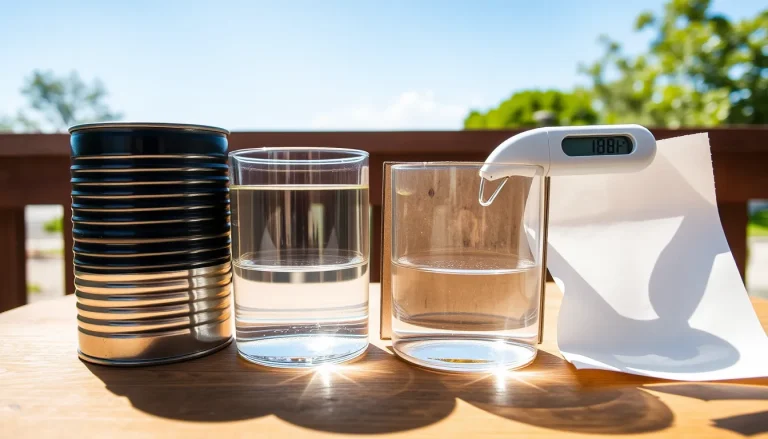
- Plain white printer paper or coffee‑filter paper (cut into 2‑inch‑wide strips, about 6‑inch long).
- Cardboard piece (approximately 8 × 8 in) to serve as a stable base.
- Room‑temperature water (about 20 °C). A kitchen thermometer can be used to record temperature.
- Clear plastic cup or shallow dish (at least 2 in deep).
- Ruler or measuring tape (millimeter markings are helpful).
- Paper towel (for cleaning spills).
Steps
- Cut three paper strips of equal size (2 in × 6 in). Label them A, B, and C.
- Place the cardboard on a flat surface and tape the top edge of each strip to the cardboard so the strips hang vertically, spaced a few centimeters apart.
- Fill the plastic cup with water to a depth of about 1 inch. Record the water temperature.
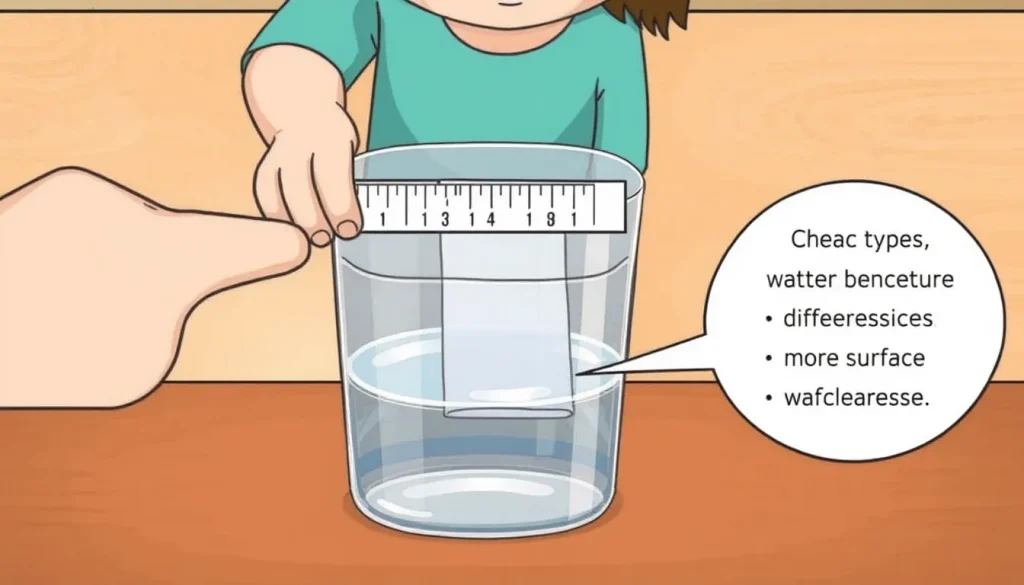
- Slowly lower the bottom ends of the paper strips into the water, ensuring that each strip touches the water surface but does not rest on the cup’s bottom.
- Allow the water to rise for one minute. Using the ruler, measure the height of the water column along each strip from the water surface to the top of the wet region. Record the measurements.
- Remove the strips, dry the cardboard, and repeat the trial two more times, changing only one variable at a time if you wish to explore its effect (e.g., use a different paper type or warm the water).
What to observe or measure
The key measurable outcome is the height that water climbs up the paper strip (capillary rise). Record the data in a table like the one below.
| Trial | Paper type | Water temperature (°C) | Height risen (mm) |
|---|---|---|---|
| 1 | |||
| 2 | |||
| 3 |
The science explained
Capillary action occurs when the adhesive force between water molecules and the fibers of the paper is stronger than the cohesive force pulling the water back down. The narrow spaces between the fibers act like tiny tubes, pulling water upward. The height reached depends on three main factors:
- Paper porosity: More porous paper provides larger capillary pathways, usually producing a higher rise.
- Water temperature: Warm water has lower surface tension, which can reduce the rise.
- Surface cleanliness: Oils or dust on the paper block adhesion and lower the rise.
This simple system lets children see a quantitative result (height) and relate it to material properties.
Repeated trials
Running the experiment several times helps you see natural variation and assess whether a change you made (different paper, temperature, etc.) truly affects the result. If the measured heights differ by only a few millimetres, the change may be within experimental uncertainty.
Troubleshooting
If the water does not rise, or the measured heights seem inconsistent, work through the checklist below. Each symptom is paired with a likely cause and a concrete check.
- Symptom: No visible water rise on any strip.
- Possible cause: Paper is coated with oil or grease (e.g., from handling with dirty hands).
- Check: Smell the paper for a greasy feel; wipe with a dry paper towel and try again.
- Symptom: Water rises only a few millimetres, far less than expected.
- Possible cause: Paper is too thick or non‑porous (e.g., glossy magazine paper).
- Check: Switch to plain printer paper or coffee‑filter paper and repeat.
- Symptom: Height measurements vary wildly between trials.
- Possible cause: Inconsistent water temperature or measurement error.
- Check: Use a thermometer to keep temperature within ±1 °C and measure height at the same time point (e.g., exactly 60 seconds after immersion).
- Symptom: Water climbs but then recedes after a short time.
- Possible cause: Air bubbles trapped at the paper‑water interface.
- Check: Gently tap the strip to release bubbles or lower the strip more slowly.
These steps echo the three common explanations for a non‑working experiment identified by physics educators: a simple mistake, an unreasonable uncertainty estimate, or an unrecognized variable [1]. Systematically ruling out each possibility builds confidence and reinforces the scientific method.
Next steps
Once the experiment works reliably, children can extend it by:
- Comparing different paper grades (e.g., newspaper vs. tissue).
- Testing the effect of adding a tiny amount of dish‑soap to the water (reduces surface tension).
- Graphing height versus temperature to see trends.
Each extension provides a new testable question and an opportunity to practice the troubleshooting cycle again.
Related terms
- Capillary action
- The movement of liquid within narrow spaces caused by adhesive and surface‑tension forces.
- Surface tension
- A property of liquid surfaces that makes them behave like a stretched elastic sheet.
- Uncertainty
- A quantitative estimate of how much a measured value could vary due to limitations in the method or instruments.
Sources & references
- When Experiments “Don’t Work” – Three basic explanations for unexpected results. Washington University in St. Louis. https://web.physics.wustl.edu/introphys/Summer2/Documents/08_WhenExperimentsDon'tWork.pdf
- Troubleshooting a Science Project That Isn’t Working – Five‑step guide for STEM projects. Science Buddies Blog, 27 Oct 2025. https://www.sciencebuddies.org/blog/troubleshoot-science-project-student-stem
- What to Do If Your Experiment Does Not Work – Reeko’s practical five‑step troubleshooting checklist. Reeko’s Mad Scientist Lab, 2014. https://www.reekoscience.com/in-the-lab/what-to-do-if-your-experiment-does-not-work