When you place a penny on a flat surface and carefully add drops of water, the drops cling together and form a dome until the surface tension can no longer hold them. This simple “drops on a coin” demonstration lets children see the invisible forces that keep water together and discover how everyday objects affect those forces.
Before you begin
- Choose a quiet, level workspace where the coin will not roll.
- Gather adult supervision for children under 12, especially when handling the eye‑dropper.
- Make sure the coin is clean; wipe it with a dry paper towel to remove oil or dust that could change the result.
Materials
- One clean coin (U.S. penny works well, but any flat metal coin is fine).
- Clear water at room temperature.
- An eye‑dropper or small pipette (the kind used for eye drops or science labs).
- Paper towel or napkin for cleaning the coin.
- Optional: a small amount of liquid dish soap and a separate cup of water for the “soap” variation.
Steps
- Place the coin flat‑side up on a piece of paper towel.
- Fill the eye‑dropper with water.
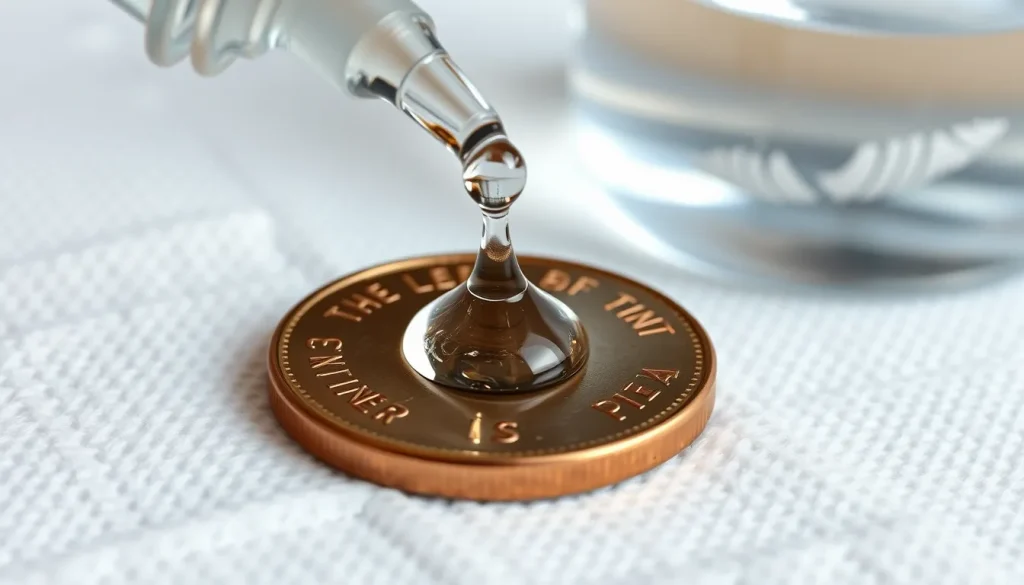
- Gently squeeze the dropper to release one drop onto the center of the coin. Count the drop.
- Continue adding drops one at a time, keeping the dropper steady and aiming for the same spot.
- Watch the water grow into a rounded dome. When the water spills over the edge, stop counting.
- Record the total number of drops that stayed on the coin before spilling.
- Repeat the whole procedure two more times with the same coin to see natural variation.
- If you want to explore the effect of surfactants, add a teaspoon of dish soap to a fresh cup of water, stir gently, and repeat steps 1‑6. Compare the number of drops that stay on the coin with plain water.
What to observe or measure
- Number of water drops that remain on the coin before spilling (the main quantitative result).
- Shape of the water dome – does it look more “flattened” or more “rounded” as you add drops?
- Any difference when you use soap‑water versus plain water.
Use the table below to record your data.
| Trial | Coin type (if varied) | Water or Soap‑water | Number of drops before spill |
|---|---|---|---|
| 1 | |||
| 2 | |||
| 3 |
The science explained
Water molecules attract each other through a force called cohesion. At the surface of a liquid, molecules are pulled inward by their neighbors, creating a sort of “skin” that resists being stretched. This skin is what we call surface tension. When a drop lands on a smooth, non‑wetting surface such as a clean metal coin, the water tries to keep the smallest possible surface area, so it forms a rounded dome.
Three forces are at work:
- Gravity pulls the water downward, trying to flatten the drop.
- Cohesion holds water molecules together, pulling the surface into a dome.
- Adhesion is the attraction between water and the coin’s surface. A clean metal surface is only weakly adhesive, so the water prefers to stay together rather than spread out.
When the dome gets too large, gravity overcomes surface tension and the water spills over the edge. Adding a surfactant such as dish soap lowers the cohesive forces between water molecules, which reduces surface tension. Consequently, fewer drops can stay on the coin before spilling, illustrating how soaps make water “softer” and help it spread on dirty dishes.
Because the experiment uses everyday items, it is an excellent visual gateway to concepts like intermolecular forces, capillary action, and why insects can walk on water.
Troubleshooting
- Water spreads instead of forming a dome. The coin may be oily or dirty. Wipe it with a dry paper towel or clean it with a little alcohol and let it dry.
- Drops fall off the coin immediately. The dropper may be releasing too much water at once. Use a calibrated pipette or practice delivering a single, small drop on a separate surface first.
- Different trials give very different counts. Ensure the drop size is consistent; practice adding drops slowly and keep the dropper at the same height each time.
- Soap‑water behaves the same as plain water. Make sure the soap is fully mixed into the water and that you are using a fresh cup of the mixture for each trial.
Try another version
Once the basic demonstration is mastered, you can turn it into a simple experiment by comparing different coins (penny, nickel, dime, foreign coins) or by varying the temperature of the water (cold vs. warm). Warmer water generally has lower surface tension, so you may observe fewer drops before spilling.
Cleanup and disposal
Water can be poured down the sink. Dispose of any soap‑water mixture the same way. Dry the coin and store it for future use. Wash the eye‑dropper with warm soapy water and rinse well.
Next steps
Use the observation of surface tension as a springboard to explore related phenomena such as capillary action in plants, the ability of small insects to walk on water, or how detergents help remove grease by breaking surface tension.
Related terms
- Surface tension
- The tendency of liquid molecules at the surface to be pulled together, creating a thin elastic ‘skin’ that resists deformation.
- Cohesion
- The attractive force between molecules of the same substance, such as water molecules pulling on each other.
- Adhesion
- The attractive force between molecules of different substances, for example water molecules and a metal surface.
Sources & references
- Test Surface Tension | Coin Classroom, https://kids.usmint.gov/resources/coin-activities/test-surface-tension
- Surface Tension and Surfactants | NSTA, https://www.nsta.org/science-scope/science-scope-february-2019/surface-tension-and-surfactants
- Bill Nye | Penny Droplets, https://www.billnye.com/home-demos/penny-droplets
- How many drops of water can you rest on one coin? - Let's Talk Science, https://letstalkscience.ca/educational-resources/hands-on-activities/how-many-drops-water-can-you-rest-on-one-coin