Orientation – Why This Demonstration Matters
Most of us have been told to “add a pinch of salt to the water” when cooking pasta or vegetables. The advice is not just about flavor; it also changes a physical property of the water – its boiling point. In this demonstration you will see that adding common table salt (sodium chloride, NaCl) makes water boil at a slightly higher temperature. The change is small, but it provides a concrete example of a colligative property – a property that depends on the number of dissolved particles, not on their identity.
Before You Begin
- Read the entire procedure before starting.
- Make sure an adult is present for any step that involves a hot stove or boiling water.
- Check that you have a reliable kitchen thermometer that can read at least 90 °C (194 °F) with a precision of ±0.5 °C.
- Clear the work area of unnecessary items to avoid spills.
Materials
- 1 L (or a 1‑quart) clear glass or metal pot with a lid.
- Cold tap water (about 1 L).
- Table salt (sodium chloride), measured with a kitchen spoon.
- Two metal or silicone spoons – one for stirring, one for measuring salt.
- Digital or mercury‑free kitchen thermometer (probe or dial).
- Stove or hot‑plate that can bring water to a rolling boil.
- Heat‑proof gloves or mitts.
- Notebook or worksheet for recording temperatures.
Optional: a second identical pot for a side‑by‑side comparison (if you want to show a control without salt).
Steps – Conducting the Demonstration
- Measure the water. Pour exactly 1 L of cold tap water into the pot. Note the starting temperature if you wish (room‑temperature water is usually around 20 °C).
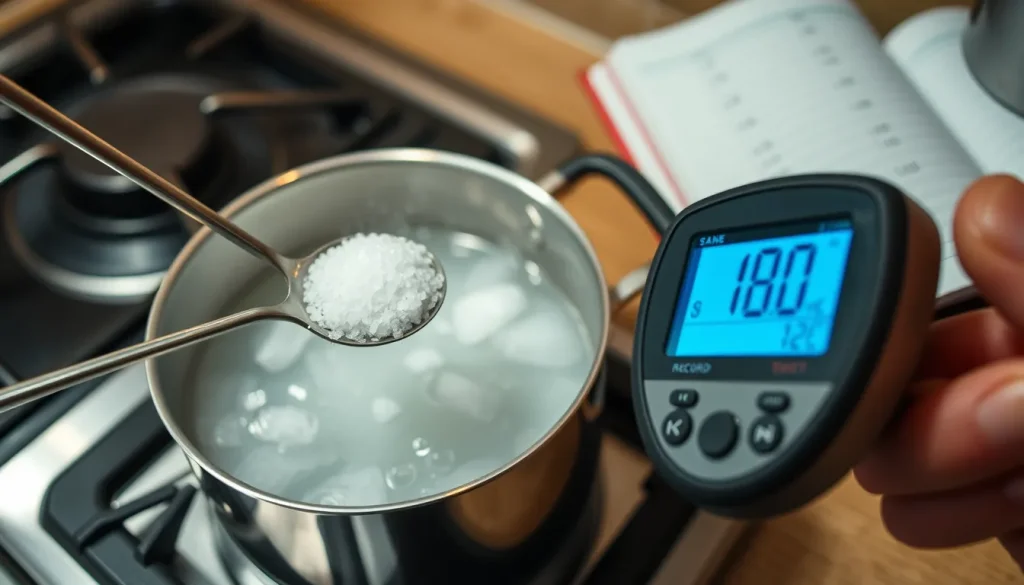
- Insert the thermometer. Place the thermometer probe in the water, making sure it does not touch the bottom of the pot (which would read the hotter metal).
- Heat the water. Turn the stove to medium‑high and cover the pot with the lid. Watch the thermometer as the temperature rises.
- Record the boiling point of plain water. When you see a steady stream of bubbles rapidly rising (a rolling boil), note the temperature shown on the thermometer. This is the boiling point of pure water at your local atmospheric pressure. Write the value in your notebook.
- Turn off the heat. Carefully remove the pot from the burner using gloves. Keep the lid on for safety.
- Add salt. Measure 1 tablespoon (≈ 18 g) of table salt and sprinkle it evenly over the surface of the hot water. Stir gently for 10 seconds to dissolve the salt completely.
- Re‑heat the water. Return the pot to the stove, keep the lid on, and bring the water back to a boil. Again, watch the thermometer.
- If the thermometer reading climbs higher than the previous boiling point, record the new temperature as the “boiling point of salted water.”
- If the temperature does not rise noticeably, you may repeat the salt addition with another tablespoon and observe any further change.
- Discuss the result. Compare the two temperatures. Even a small increase (often 0.3‑0.5 °C for a tablespoon of salt in a litre of water) illustrates the principle of boiling‑point elevation.
What to Observe or Measure
- Temperature values. Record the exact temperature at which the water begins a rolling boil before and after salt is added.
- Time to boil. Note how many minutes it takes to reach the first boiling point versus the second. The salted water may take slightly longer because the boiling point is higher.
- Visual cues. Observe the size and frequency of bubbles. After salt is added, the bubbles may look a little smaller initially because the water is hotter before they form.
All observations can be entered into a simple table like the one below (leave the result cells blank for your own use):
| Trial | Condition | Boiling Temperature (°C) | Time to Boil (min) |
|---|---|---|---|
| 1 | Plain water | ||
| 2 | +1 tbsp salt | ||
| 3 | +2 tbsp salt (optional) |
The Science Explained
When a solute such as sodium chloride dissolves in water, it separates into positively charged sodium ions (Na⁺) and negatively charged chloride ions (Cl⁻). These ions interfere with the ability of water molecules to escape into the gas phase. Because the water‑molecule‑to‑water‑molecule attractions are slightly disrupted, more heat energy is required to give each molecule enough kinetic energy to become vapor.

This phenomenon is called boiling‑point elevation, a type of colligative property. Colligative properties depend only on the number of dissolved particles, not on their chemical nature. The quantitative relationship is given by the formula:
ΔT_b = i·K_b·m
where:
- ΔT_b is the increase in boiling temperature.
- i is the van t Hoff factor (for NaCl, i ≈ 2 because it splits into two ions).
- K_b is the ebullioscopic constant of the solvent (for water, K_b ≈ 0.512 °C·kg mol⁻¹).
- m is the molality of the solution (moles of solute per kilogram of water).
Using a typical kitchen amount – 1 tablespoon of salt (~0.3 mol) in 1 kg of water – the expected rise is about 0.3 °C. This small change is why the effect is often imperceptible without a precise thermometer, yet it is scientifically real and measurable. The Royal Society of Chemistry notes that “adding salt to water raises its boiling point only slightly” and that the increase is “generally less than a degree for the amounts used in cooking”[1].
Because the boiling point is higher, the water must absorb a little more heat before it turns to steam. In everyday cooking this extra heat is usually not enough to make a noticeable difference in cooking time, but the principle is important in industrial processes (e.g., making seawater desalination more energy‑intensive) and in understanding how solutions behave.
Troubleshooting
- No temperature rise observed. Check that the salt fully dissolved. Undissolved crystals can settle at the bottom and not contribute to the colligative effect.
- Thermometer reads erratically. Make sure the probe does not touch the pot’s metal side and that it is calibrated (you can test it in ice water (0 °C) and boiling water (100 °C) before the experiment).
- Water boils at the same temperature but takes longer. This is normal – the higher boiling point means more heat is needed, so the time to reach it can increase.
- Too much salt makes the water taste very salty. Use the minimum amount needed to see a measurable change (1 tablespoon in 1 L). For a visual demonstration you can also dissolve the salt in a separate cup of water first, then add the solution to the pot.
Try Another Version
To deepen understanding, repeat the demonstration using a different solute, such as sugar (sucrose). Sugar also raises the boiling point, but because it does not dissociate into ions, its van t Hoff factor i = 1. Comparing the temperature increase from an equal mass of sugar versus salt lets children see how the number of particles (ions vs. molecules) influences the effect.
Cleanup and Disposal
- Turn off the stove and allow the pot to cool completely before handling.
- Dispose of the salty water down the sink; it is safe for household plumbing.
- Rinse the thermometer with warm water and store it safely.
- Wipe down the work surface and put away all utensils.
Next Steps
Now that you have seen boiling‑point elevation in action, you can explore other colligative properties such as freezing‑point depression (why adding salt to icy roads melts ice) or vapor‑pressure lowering. Simple kitchen experiments with sugar, alcohol, or different concentrations of salt can extend the investigation and reinforce the idea that dissolved particles change the physical behavior of water.
Related terms
- Colligative property
- A property of solutions that depends on the number of dissolved particles, not on their chemical identity.
- Van t Hoff factor (i)
- The number of particles a solute produces in solution; for NaCl, i ≈ 2 because it splits into Na⁺ and Cl⁻.
- Ebullioscopic constant (K_b)
- A constant that relates the boiling‑point elevation to the molality of a solution; for water K_b ≈ 0.512 °C·kg mol⁻¹.