Overview
Friction is the force that resists sliding motion between two surfaces. In everyday life we often hear that only the type of materials and the pressing force matter, but research shows that surface temperature can also change the coefficient of kinetic friction. A 2005 study found that for some material pairs the coefficient of kinetic friction increases as one surface gets hotter [1]. This experiment lets children explore that idea with everyday items: a sheet of paper, a simple heat source, and a rolling toy car.
Before You Begin
- Adult supervision: Heating paper can cause scorching or fire. An adult should set up the heat source, monitor temperature, and ensure the workspace is clear of flammable items.
- Workspace: Use a sturdy table near a power outlet. Lay down a protective mat or a piece of cardboard to catch any hot paper.
- Safety gear: Adults wear heat‑resistant gloves; children can wear safety glasses if they wish.
Materials
- Standard printer paper (A4 or Letter size) – at least 4 sheets
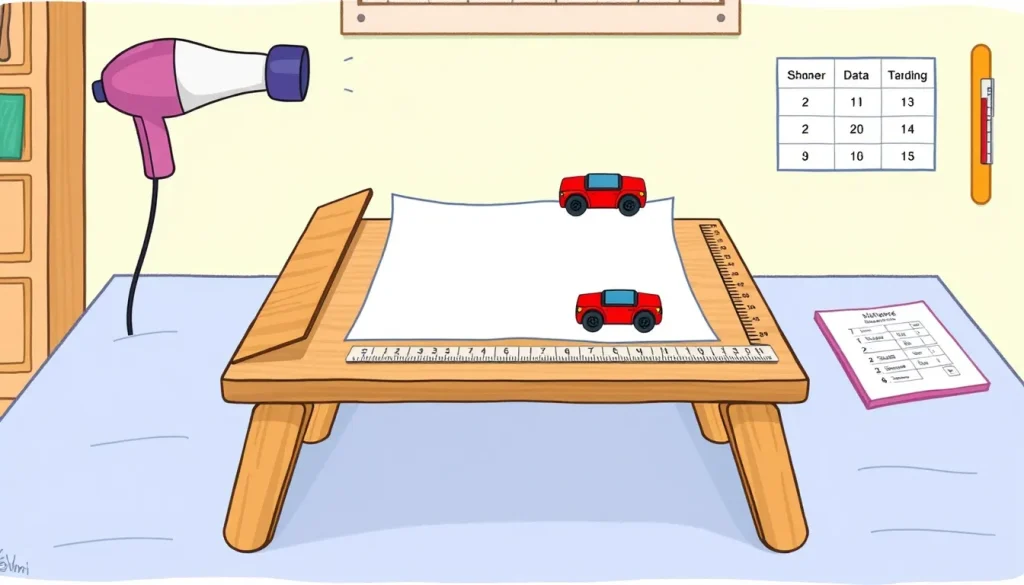
- Hair dryer, hot plate, or electric kettle (any device that can heat a small area to 50‑100 °C) – adult‑operated
- Infrared thermometer or regular kitchen thermometer (to read surface temperature)
- Toy car with smooth wheels (e.g., a Hot Wheels car)
- Wooden or plastic ramp about 30 cm long, set at a gentle, repeatable angle (≈15°)
- Ruler or tape measure (centimetre scale)
- Stopwatch (optional, for measuring time instead of distance)
- Marker and notebook for recording data
- Paper towels or a damp cloth (for cooling the heated paper quickly)
Substitutions: Any similarly sized thin cardboard can replace printer paper, and a small electric soldering iron tip can be used for localized heating if a hair dryer is unavailable.
Procedure (Steps)
- Place the ramp on a flat surface and secure it so it does not shift during trials.
- Lay one sheet of paper flat on the floor directly after the ramp’s lower end. This is the test surface.
- Turn on the heat source and gently heat the centre of the paper for about 30 seconds. Use the thermometer to record the surface temperature at the spot where the car will travel. Aim for three target temperatures: room temperature (≈20 °C), warm (≈50 °C), and hot (≈80 °C). Allow the paper to cool to the next target temperature before proceeding.
- Position the toy car at the top of the ramp, making sure its wheels face down the ramp.
- Release the car without pushing it; let gravity provide the launch speed. The car will roll down the ramp, onto the heated paper, and eventually stop.
- Immediately measure the distance from the point where the car first touches the paper to the point where it stops. Record the value in centimetres.
- Repeat steps 3‑6 three times for each temperature, returning the paper to the same spot each time. Between trials, use a damp cloth to bring the paper back to the desired temperature if needed.
- When all trials are complete, turn off and unplug the heat source.
Variables and Controls
- Independent variable: Surface temperature of the paper (°C).
- Dependent variable: Rolling distance of the toy car on the paper (cm) – or stopping time if you choose to time the motion.
- Controlled variables:
- Same toy car for every trial (same mass, wheel condition, and tread).
- Same ramp angle and height.
- Same release point and method (gravity‑only release).
- Ambient room temperature and humidity (keep windows closed).
- Paper type and size (use a fresh sheet for each temperature set).
Repeated Trials
Perform three independent trials at each temperature. Repeating reduces random error caused by slight variations in launch speed or surface unevenness. After the three trials, calculate the average distance for each temperature; this average is used for analysis.
Data Table
| Trial | Temperature (°C) | Distance (cm) |
|---|---|---|
| 1 | ||
| 2 | ||
| 3 | ||
| Average |
What to Observe or Measure
- Temperature reading before each release.
- Exact distance the car travels on the paper.
- Any visual changes in the paper (discoloration, warping) that might affect smoothness.
- If using a stopwatch, note the time from first contact to stop.
The Science Explained
When a car rolls across a surface, kinetic friction opposes its motion. The kinetic friction force is given by Fk = μk N, where μk is the coefficient of kinetic friction and N is the normal force (the weight component pressing the wheels onto the paper). While many textbooks present μk as a constant for a given pair of materials, experiments have shown that temperature can change this coefficient. In the 2005 study, researchers heated one surface and observed a measurable increase in the coefficient of kinetic friction for certain material combinations [1]. The likely mechanisms are:

- Surface softening: Heat can make the fibers in paper more pliable, allowing the wheels to sink slightly and create a larger real‑area contact.
- Micro‑adhesion: Warmer surfaces may increase molecular attraction at the interface, raising friction.
- Air layer changes: Heating can alter the thin layer of air or moisture between wheel and paper, affecting lubrication.
Because the normal force stays the same (the car’s weight does not change), any change in rolling distance is attributed to a change in μk. If the distance gets shorter as temperature rises, the experiment supports the idea that heating the paper increases kinetic friction.
Troubleshooting
- Paper burns or chars: Keep the temperature below 100 °C and never leave the heat source unattended.
- Uneven heating: Move the thermometer across the paper surface before each trial; aim for a uniform reading within ±2 °C.
- Inconsistent launch speed: Use a fixed‑height ramp and release the car from the same spot each time. If variations persist, consider a simple spring‑loaded launcher (adult‑built) to standardize speed.
- Car wheels wobble: Check that the wheels spin freely on a flat surface before each set of trials.
Cleanup and Disposal
Allow the heated paper to cool completely before handling. If any paper is discolored or slightly charred, discard it in regular waste. Store the toy car and ramp in a dry place. Wipe the thermometer and heat source with a dry cloth.
Next Steps and Extensions
- Graph the average distance (y‑axis) against temperature (x‑axis) to visualise the trend.
- Repeat the experiment with a different surface material (e.g., cardboard, aluminium foil) to compare temperature effects.
- Swap the toy car for one with rubber tires and see whether the temperature effect is stronger or weaker.
- Measure stopping time instead of distance; the two methods should give consistent conclusions.
- Explore how humidity interacts with temperature by lightly misting the paper before heating.
These extensions turn the simple investigation into a richer inquiry suitable for a school science fair.
Related terms
- Friction
- The force that resists relative motion between two touching surfaces.
- Kinetic friction
- Friction that acts when two surfaces slide past each other, expressed as Fk = μk N.
- Coefficient of kinetic friction (μk)
- A dimensionless number that describes how much friction exists between specific materials.
- Normal force
- The component of a contact force that acts perpendicular to the surface, equal to the object's weight on a horizontal surface.
Sources & references
- The Effect Surface Temperature Has on Kinetic Friction, The Physics Teacher, 2005-02-23, https://doi.org/10.1119/1.1869429
- Surface Friction Car Test Experiment for Kids | Southfolk, https://southfolk.com.au/activity/surface-friction-car-test/
- Hotwheels Friction Investigation PDF, https://my3ml.org/couch/uploads/file/home-education/hotwheels-friction.pdf