Overview
Yeast ( Saccharomyces cerevisiae) gets its energy by converting sugar into carbon‑dioxide (CO₂) and ethanol. The CO₂ is the gas that makes bread rise and gives beer its fizz. Like every chemical reaction, the speed of fermentation depends on temperature. Warm water speeds up the enzymes that drive the reaction, while cold water slows them down. In this experiment you will compare how much CO₂ is produced at three different water temperatures and learn why the pattern matches what scientists have measured.
Before You Begin
- Choose a well‑ventilated workspace and a flat surface that can hold a water‑bath container.
- Adult supervision is required for handling hot water (above 40 °C) and for cleaning up any spills.
- Gather all materials before starting so that the timing of each temperature trial is consistent.
- Label three small bottles or jars with the temperature you plan to test (e.g., 20 °C, 30 °C, 35 °C).
Materials
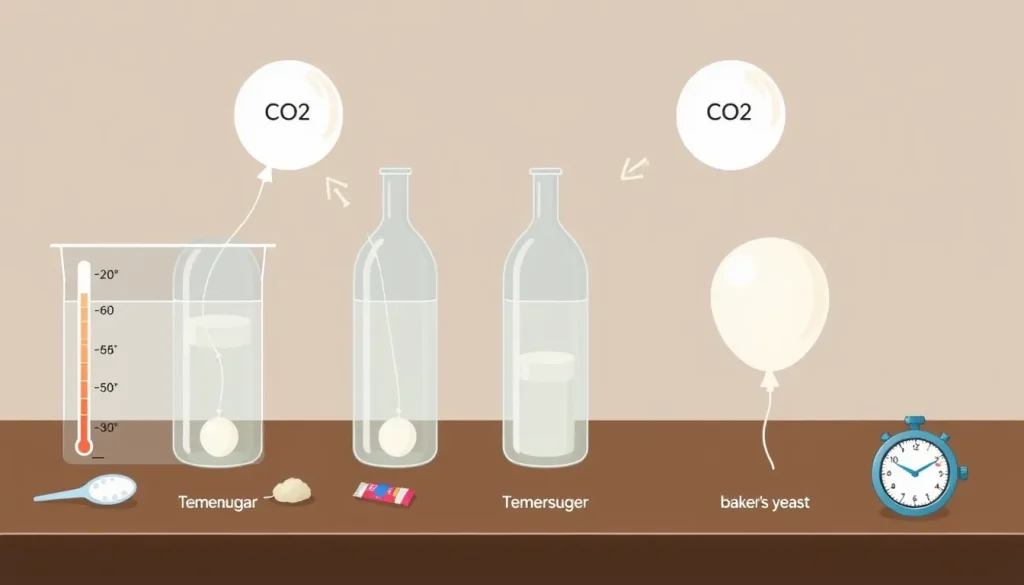
- Active dry baker’s yeast (1 packet ≈ 7 g)
- Granulated sugar – 3 tablespoons
- Warm water – enough to fill three 250 mL clear plastic bottles (about 600 mL total)
- Thermometer (digital or glass, range 0‑100 °C)
- Three small balloons (same size, uninflated)
- Three clear plastic bottles with screw caps (250 mL)
- Timer or stopwatch
- Measuring cup or graduated cylinder
- Rubber bands (optional, to secure balloons)
- Paper and pen for recording data
All of these items are common in a kitchen or classroom. If a thermometer is not available, use a phone app that measures temperature with the camera sensor, but verify its accuracy with a known reference (e.g., room‑temperature water at ~22 °C).
Procedure (Steps)
- Prepare the sugar‑yeast mixture. In a small bowl, dissolve 3 tablespoons of sugar in 50 mL of lukewarm water (about 30 °C). Sprinkle the entire packet of yeast over the solution, stir gently, and let it sit for 5 minutes. The mixture should become slightly foamy – this means the yeast is active.
- Set up the water‑bath temperatures. Fill a larger container (e.g., a saucepan) with enough water to submerge the three plastic bottles up to their necks. Heat the water to the highest temperature you will test (e.g., 35 °C). Use the thermometer to confirm.
- For the lowest temperature (e.g., 20 °C), place a bottle in a bowl of ice water or let it sit at room temperature.
- For the middle temperature (e.g., 30 °C), let the water cool naturally or add a small amount of cold water.
- Assemble each trial. For each temperature bottle:
- Fill the bottle with the pre‑measured water at the target temperature (about 200 mL), leaving enough headspace for the balloon.
- Add the same 5‑mL portion of the foamy yeast‑sugar mixture to each bottle.
- Quickly stretch an uninflated balloon over the bottle’s mouth, securing it with the screw cap or a rubber band.
- Start timing. As soon as the balloon is on the bottle, start the stopwatch. Record the time it takes for the balloon to become visibly inflated (first bubbles) and the total time until the balloon appears fully expanded (no more noticeable increase).
- Measure the gas volume. After 10 minutes, carefully remove the balloon and measure its volume by water displacement (fill a large bowl with water, submerge the balloon, and collect the displaced water in a graduated cylinder). Record the volume in milliliters.
- Repeat. Perform the same steps for each temperature, keeping the amount of yeast‑sugar mixture, water volume, and observation time identical.
- Clean up. Discard the yeast solution down the sink with plenty of running water. Rinse all bottles and balloons, and store them for future use.
Variables and Controls
- Independent variable: Water temperature (e.g., 20 °C, 30 °C, 35 °C).
- Dependent variable: Amount of CO₂ produced, measured as balloon volume (mL) or time to full inflation.
- Controlled variables: Amount of yeast, sugar, water volume, balloon size, and observation period (10 minutes). Keeping these constant ensures that any difference in gas production is due to temperature alone.
- Control group: The middle temperature (often 20 °C or room temperature) serves as a baseline for comparison.
Repeated Trials
To assess natural variation in biological systems, repeat each temperature at least three times, cleaning the bottle and balloon between runs. Record each trial separately in the data table. Averaging the three values will give a more reliable estimate of the temperature effect.
What to Observe or Measure
- Time (seconds) from balloon placement to first visible bubbles.
- Time (seconds) to full balloon expansion.
- Final balloon volume (mL) using water displacement.
- Any unusual observations (e.g., foam overflow, balloon burst).
Write the numbers in the data table provided below. Qualitative notes belong in a separate column titled “Observations.”

Data Table (blank)
| Trial # | Temperature (°C) | Time to First Bubbles (s) | Time to Full Inflation (s) | Balloon Volume (mL) | Observations |
|---|---|---|---|---|---|
| 1 | |||||
| 2 | |||||
| 3 |
Graphing Your Results
Plot the average balloon volume (y‑axis, mL) against water temperature (x‑axis, °C). A line or bar graph works well. If you also recorded time to full inflation, you can add a second series on the same graph (use a secondary y‑axis). Look for a trend: the volume should increase as temperature rises, up to an optimum around 35 °C, after which it may level off or drop if the yeast becomes stressed.
The Science Explained
Yeast cells contain enzymes that break down sugar through a process called glycolysis, ultimately producing CO₂ and ethanol when oxygen is scarce. Enzyme activity follows the Arrhenius equation: reaction rates roughly double for every 10 °C increase in temperature, up to a point where the protein structure begins to denature.
Research with the same species of yeast showed a clear temperature dependence. In a 2020 study, balloons captured the most CO₂ at 35 °C, indicating that this temperature is near the optimum for rapid fermentation [1]. Another experiment that spanned a broader range (0 °C to 100 °C) found statistically significant differences across all temperatures (p < 0.0001) [2]. These findings match the biochemical expectation that warmer water speeds up the enzymes, but extreme heat eventually harms the cells.
In practical terms, the balloon’s volume is a proxy for how fast the yeast is converting sugar into gas. A larger balloon means more CO₂ was produced in the same time, showing a higher reaction rate. By keeping everything else constant, the experiment isolates temperature as the driving factor.
Troubleshooting
- Balloon does not inflate: The yeast may be dead. Check the “foamy” stage after mixing sugar and yeast; if no bubbles appear, the yeast is likely inactive. Use fresh yeast.
- Very slow inflation at low temperature: Cold water can slow enzyme activity dramatically. Extend the observation period or increase the sugar amount slightly (no more than 5 %).
- Balloon bursts: Over‑inflation can happen at high temperatures. Stop the timer when the balloon looks full and measure volume immediately.
- Inconsistent water temperature: Use a thermometer for each bottle. If the water cools during the trial, add a small amount of hot or cold water to bring it back to target.
Try Another Version
Once the basic temperature effect is clear, children can explore related questions:
- How does changing the amount of sugar affect the rate at each temperature?
- What happens if you use a different type of yeast (e.g., brewer’s yeast) [4]?
- Compare the effect of temperature on CO₂ production in a liquid medium versus a solid dough (bread‑making simulation).
Each variation introduces a new independent variable while keeping the original temperature series as a control.
Cleanup and Disposal
Rinse all bottles and balloons with warm water and soap. Yeast slurry can be poured down the sink with plenty of water – it is non‑pathogenic and biodegradable. Dispose of used paper towels in regular trash. Store any reusable balloons in a cool, dry place for future projects.
Next Steps
Use the data you collected to write a short report: state the testable question, hypothesis, method, results (with graph), and conclusion. Compare your findings to the published results (optimal CO₂ at 35 °C) and discuss any differences you observed. This report can serve as a science‑fair entry or a classroom presentation.
Sources & references
- The Effects of Water Temperature on CO2 Production of Saccharomyces Cerevisiae, https://ojs.library.ubc.ca/index.php/expedition/article/view/196129
- Change in the Rate of Yeast Metabolism Based on the Temperature Change, https://ojs.library.ubc.ca/index.php/expedition/article/view/195657
- The effect of type of yeast and temperature on CO2 production, https://ojs.library.ubc.ca/index.php/expedition/article/view/201338