Orientation
Mulch is a layer of material—such as shredded newspaper, straw, or wood chips—placed on top of soil. Gardeners use mulch to keep soil cool, suppress weeds, and most importantly for this activity, to hold water in the ground. Some people wonder whether adding seeds directly to the mulch changes how well the mulch retains moisture. This experiment lets children investigate that question with everyday items.
Before you begin
- Choose a sunny or lightly shaded spot outdoors where the containers will stay undisturbed for a week.
- Gather a small digital soil‑moisture sensor (available at garden stores) or be prepared to weigh soil samples before and after watering (a kitchen scale works).
- Adult supervision is needed for handling the watering can and any sharp tools.
- Make sure the containers are placed on a flat surface so water does not run off unevenly.
Materials
- Three identical plastic or cardboard plant pots (≈10 cm diameter, 12 cm deep).
- Potting soil (about 1 kg total).
- Mulch material – shredded newspaper or plain brown paper strips (about 200 g per pot).
- Seeds – choose a fast‑germinating species such as radish or lettuce (≈10 g per pot).
- Watering can or a small jug.
- Soil moisture sensor with read‑out (or a kitchen scale for the weigh‑method).
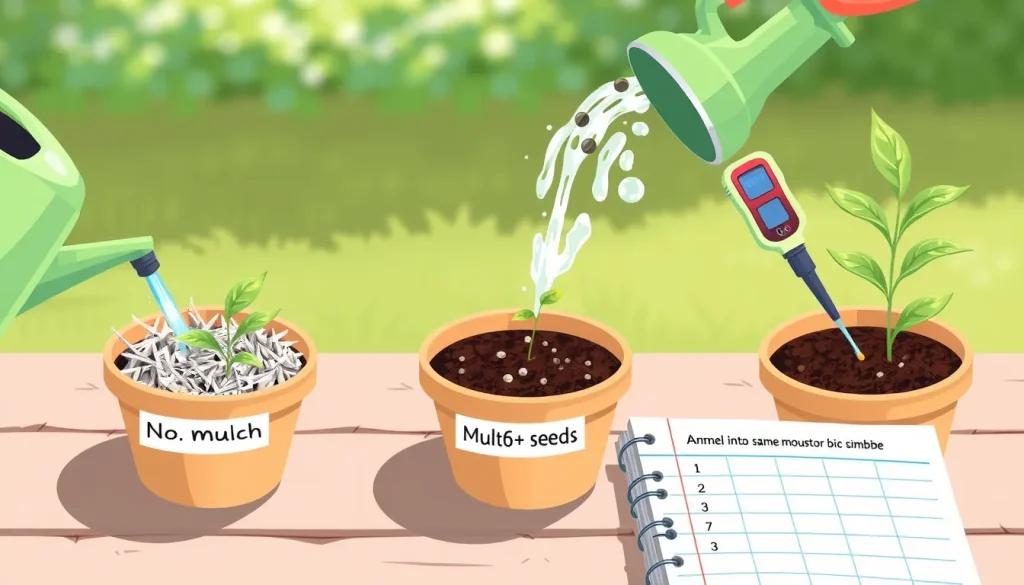
- Permanent marker and three labels: “No mulch”, “Mulch only”, “Mulch + seeds”.
- Ruler or measuring tape (to record water depth).
- Notebook or worksheet for recording data.
Testable question
Does mixing seeds into mulch change the amount of water the soil retains after a watering event compared with mulch alone or no mulch?
Hypothesis
Because seeds and their seed coats add tiny solid particles, they may slightly reduce the size of the pores in the mulch layer, allowing the soil to hold a bit more water. Therefore, the “Mulch + seeds” treatment is expected to retain more moisture than “Mulch only”, and both mulched treatments should retain more than “No mulch”.
Variables and controls
- Independent variable: Mulch treatment (none, mulch only, mulch + seeds).
- Dependent variable: Soil moisture content measured 24 hours after watering (percentage or grams of water per gram of soil).
- Controlled variables: Pot size, soil type and amount, amount of water applied, ambient temperature, sunlight exposure, and measurement timing.
- Control group: The “No mulch” pot provides a baseline without any cover.
Steps
- Label the three pots with the treatment names.
- Fill each pot with the same amount of potting soil (e.g., 800 g). Lightly tamp the soil so the surface is even.
- Prepare the mulch: shred newspaper into strips about 1 cm wide. For the “Mulch only” pot, spread a 2‑cm‑deep layer of dry mulch evenly over the soil surface.
- For the “Mulch + seeds” pot, mix the same amount of mulch with the seeds (sprinkle the seeds onto the mulch and gently fold them together) and then spread the mixture as a 2‑cm layer.
- Leave the “No mulch” pot uncovered.
- Using the watering can, apply the same volume of water to each pot (e.g., 200 ml). Water slowly so it soaks into the soil rather than running off.
- Allow the water to infiltrate for 5 minutes, then gently wipe any surface water from the pot rims.
- Record the initial moisture reading (time = 0) with the sensor placed 2 cm below the surface. If using the weigh‑method, weigh the whole pot, then weigh again after watering and calculate water gain.
- After 24 hours, measure the moisture again in the same spot. Record the value.
- Repeat the 24‑hour measurement for a total of 5 days, noting any rainfall or additional watering (keep it consistent).
- Optional: After the observation period, note whether seedlings have emerged in the “Mulch + seeds” pot.
What to observe or measure
- Soil moisture reading: If using a sensor, note the percentage displayed. If weighing, subtract the dry pot weight (measured before the experiment) from the current weight; the difference is water mass.
- Record the data in a table (see below) for each day and each treatment.
- Qualitative notes: any visible runoff, crust formation, or seed germination.
Repeated trials
To see whether results are consistent, repeat the whole set‑up with a new set of three pots at least once more. More repetitions improve confidence, especially if weather conditions vary.

Data table
| Trial | Treatment | Day 0 (%) | Day 1 (%) | Day 2 (%) | Day 3 (%) | Day 4 (%) | Day 5 (%) |
|---|---|---|---|---|---|---|---|
| 1 | No mulch | ||||||
| 1 | Mulch only | ||||||
| 1 | Mulch + seeds |
Graphing your results
Create a line graph with “Days after watering” on the horizontal axis and “Soil moisture (%)” on the vertical axis. Plot a separate line for each treatment. The graph will show how quickly moisture evaporates from each surface. A slower decline indicates better water retention.
The science explained
Mulch works like a blanket. It reduces the direct impact of sunlight on the soil, slows evaporation, and can hold water within its fibers. Research on native‑sourced mulch in Mediterranean post‑mine soils showed that mulch increased soil water retention and helped seedlings survive better [3]. In contrast, a broader review of mulch applications found mixed results: some studies reported no clear benefit for plant height or survival [1]. The presence of seeds adds tiny solid particles and a thin coating of mucilage that can change the mulch’s pore structure. If the pores become slightly smaller, water moves more slowly through the mulch, which may increase the amount retained in the soil beneath.
However, the effect is not guaranteed. The 2018 ASHS study on mulch physical properties found that characteristics such as thickness and density influence weed emergence, showing that mulch behavior is sensitive to its makeup [2]. Likewise, a study using corn‑crop residues as mulch in arid soils reported improved soil moisture and better grass growth [4]. Your experiment will reveal whether the simple addition of seeds makes a measurable difference in your local conditions.
Troubleshooting
- Water runs off the pot edges: Add a saucer beneath each pot or lower the watering volume so the soil can absorb it.
- Moisture sensor gives erratic readings: Clean the probe between measurements and insert it at the same depth each time.
- No difference appears between treatments: Check that the mulch layer thickness is consistent; too thin a layer may not show an effect.
- Seeds sprout too early and cover the sensor: Record moisture before seedlings emerge or use a shallow sensor that stays just below the mulch.
Cleanup and disposal
After the experiment, you can compost the newspaper mulch and any germinated seedlings. The pots can be washed and reused for future gardening projects. Store the moisture sensor according to the manufacturer’s instructions.
Next steps
Try variations such as using different mulch materials (straw, wood chips, or leaf litter) or testing a range of seed densities. You could also extend the observation period to see how long the moisture‑retention benefit lasts as the mulch decomposes.
Sources & references
- Conservation Evidence – Add mulch to soil (alongside planting/seeding). https://www.conservationevidence.com/actions/1706
- Benigno, S. (2013). Increasing Soil Water Retention with Native‑Sourced Mulch Improves Seedling Establishment in Post‑mine Mediterranean Sandy Soils. Restoration Ecology. https://onlinelibrary.wiley.com/doi/10.1111/j.1526-100X.2012.00926.x
- Saha, D. et al. (2018). Influence of Physical Properties of Common Landscape Mulch on Emergence of Two Weed Species. ASHS Annual Conference. https://ashs.confex.com/ashs/2018/webprogramarchives/Paper28104.html
- Pedroza‑Parga, E. et al. (2020). Effect of soil cover on the growth and productivity of buffel grass (Cenchrus ciliaris L.) in degraded soils of arid zones. Revista Mexicana de Ciencias Pecuarias. https://cienciaspecuarias.inifap.gob.mx/index.php/Pecuarias/article/download/5963/4883/19039