Seedlings need enough light to turn sunlight into food through photosynthesis. In a shaded garden or under a greenhouse screen, the amount of light that reaches the plant can be limited. One easy way to increase the light that hits a seedling is to reflect light that would otherwise be lost. This project lets children compare the growth of seedlings grown on a plain tray with those grown on a tray lined with reflective paper (such as aluminum‑foil‑covered cardboard). The experiment demonstrates how simple, everyday materials can change a plant’s environment and affect its development.
Before You Begin
- Choose a sunny day or a bright indoor space where you can set up a 30% black shade screen (or any garden shade cloth). The screen provides a consistent low‑light condition for both groups.
- Gather all materials (list below) and set up a clean work surface.
- Adult supervision is needed for cutting cardboard, handling scissors, and any electrical equipment if you use a lamp.
- Plan to observe the seedlings for at least three weeks. Daily measurements are not required; measuring every 3–4 days works well for ages 6‑14.
Materials
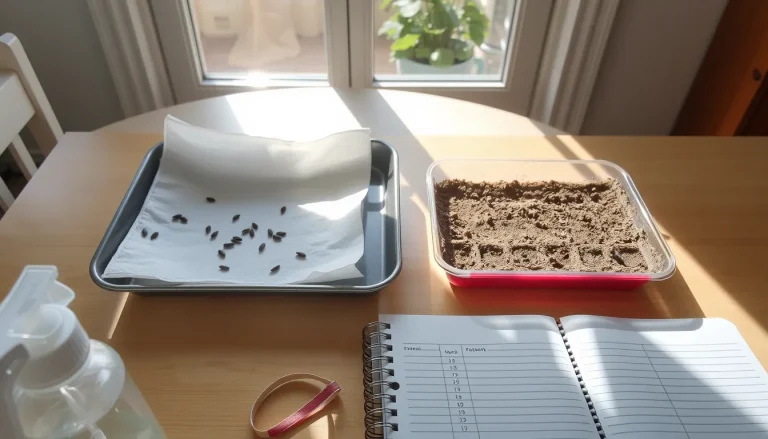
- Two shallow planting trays or shallow boxes (about 30 × 20 cm each).
- Cardboard sheet (same size as the trays) – serves as the base for the reflective surface.
- Reflective paper – ordinary aluminum foil or commercial reflective garden foil. If you use foil, tape it flat onto the cardboard.
- Potting mix suitable for seedlings (seed‑starting mix works well).
- Seeds of the same species (e.g., fast‑germinating beans, radish, or marigold). Use at least 10 seeds per tray.
- Watering can or spray bottle.
- Measuring ruler or tape measure (centimetre scale).
- Permanent marker for labeling trays.
- 30% black shade cloth (or any shade screen that reduces light by roughly one‑third).
- Notebook or printed data table (provided below).
Steps
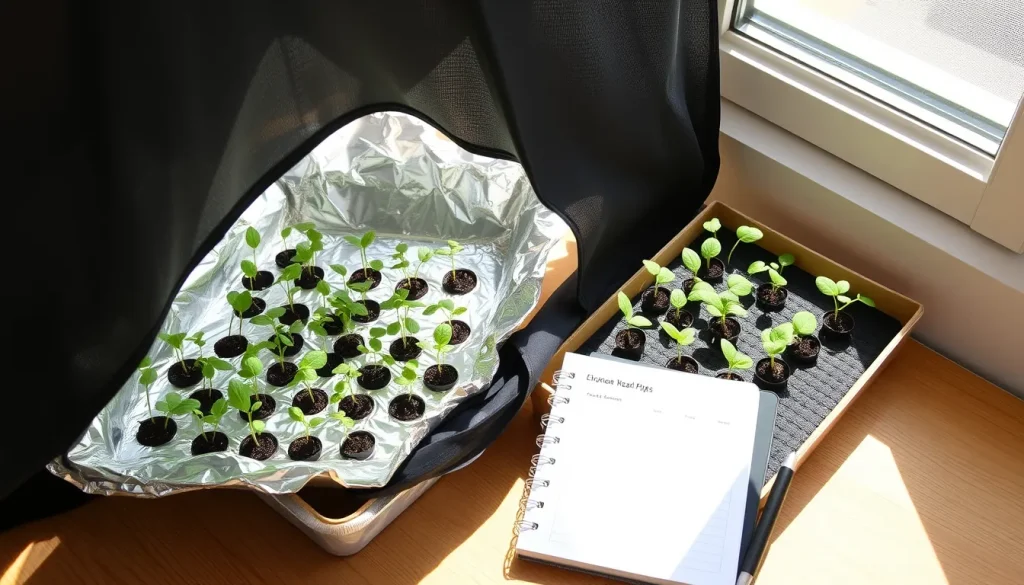
- Prepare the trays. Place the cardboard sheet inside one tray and cover it completely with the reflective foil, shiny side up. Label this tray “Reflective”. Leave the second tray plain and label it “Control”.
- Fill both trays with the same amount of potting mix. Pat the soil gently so the surface is even.
- Sow the seeds. Plant the same number of seeds (e.g., 10) at the same depth (about 1 cm) in each tray. Space them evenly.
- Water gently. Use the same amount of water for each tray (e.g., enough to moisten the soil but not flood). Record the amount if you wish.
- Cover with shade cloth. Stretch the 30% black shade cloth over both trays so they receive the same reduced light level. Secure the cloth with clips or weights.
- Place the trays in the same location. Keep temperature, airflow, and humidity as similar as possible for both trays.
- Observe and record. Every 3–4 days, measure the height of the tallest seedling in each tray (from soil surface to tip of the newest leaf) and count the number of visible leaves. Record the data in the table below.
- Water consistently. Give each tray the same amount of water each time you water (e.g., 50 ml). Try to water at the same time of day.
- Continue for at least three weeks. After this period, you should see a clear difference in growth if the reflective surface is effective.
- Cleanup. When the experiment ends, compost the soil, recycle the cardboard and foil, and wash any reusable tools.
What to Observe or Measure
- Seedling height (cm). Measure from the soil surface to the tip of the newest leaf.
- Leaf count. Count all fully opened leaves on the tallest seedling.
- General vigor. Note any wilting, yellowing, or abnormal growth.
- Time to emergence. Record the day each seedling first breaks the soil surface.
Variables and Controls
| Element | What It Is | How It Is Managed |
|---|---|---|
| Independent variable | Presence of reflective paper under the seedling tray | One tray has foil, the other does not |
| Dependent variable | Seedling growth (height, leaf number) | Measured repeatedly over three weeks |
| Controlled variables | Seed type, soil mix, water amount, shade level, temperature, tray size | Keep identical for both groups |
Testable Question
Does placing a reflective paper surface beneath a seedling tray increase the seedlings’ height after three weeks compared with a tray without a reflector under the same shade conditions?
Hypothesis
Because reflective paper sends additional light back onto the seedlings, the seedlings grown on the reflective surface will be taller and have more leaves than those grown on the plain tray.
Repeated Trials
To see whether the effect is consistent, repeat the whole set‑up at least three times (using new seeds each time). Each repeat is a “trial”. Record the average height for each trial and compare the averages.

Data Table (Blank)
| Day | Control Height (cm) | Reflective Height (cm) | Control Leaf Count | Reflective Leaf Count |
|---|---|---|---|---|
| 0 (planting) | ||||
| 4 | ||||
| 8 | ||||
| 12 | ||||
| 16 | ||||
| 20 | ||||
| 24 |
Graphing Your Results
Plot a line graph with Days on the horizontal axis and Height (cm) on the vertical axis. Use one line for the Control group and another for the Reflective group. The visual gap between the lines shows the effect of the reflector.
The Science Explained
Plants capture light in the chloroplasts of their leaves. When light is limited, growth slows because less energy is available for photosynthesis. Reflective surfaces bounce light that would otherwise be lost back onto the plant canopy, effectively increasing the amount of usable light. Studies on rubber‑tree rootstock seedlings found that benches lined with reflective material improved growth regardless of the shading screen used, indicating that reflected light is a key factor for plant development1. Similar benefits were reported for tropical forest seedlings where mirrors placed beneath the plants raised survival rates from 75 % to 88 % by providing extra reflected light2. Your experiment reproduces these findings on a small scale with common garden seeds.
Try Another Version
- Use different colours of reflective material (e.g., white, silver, or coloured Mylar) to see how colour influences growth.
- Test other shade levels (e.g., 50 % black screen vs. 30 % black screen) to explore the interaction between shade intensity and reflectivity.
- Replace the foil with a simple white poster board to compare a diffuse reflector with a specular (mirror‑like) one.
Cleanup and Disposal
- Dispose of used potting mix in a compost bin or garden beds.
- Recycle cardboard and foil according to local guidelines.
- Wash any tools with soap and water.
Next Steps
After analyzing your data, discuss why the reflective surface helped (or didn’t help) the seedlings. Connect the results to real‑world applications such as greenhouse design, vertical farming, or forest restoration projects that use reflective mulches to improve plant growth.
Related terms
- Photosynthesis
- The process by which plants use light energy to turn carbon dioxide and water into sugars and oxygen.
- Reflectivity
- The ability of a surface to bounce light back toward the source or surrounding area.
- Shade cloth
- A fabric that reduces the amount of sunlight reaching plants, used to control temperature and light intensity.