Overview
Light is more than illumination; plants sense specific wavelengths with tiny proteins called photoreceptors. Those signals can tell a seed when conditions are right to break dormancy and begin growing. Scientific studies have shown that red light (around 660 nm) often speeds germination, while far‑red or darkness can delay it [3]. This experiment lets children compare several narrow‑band light colors and see which one makes seeds sprout fastest.
Before You Begin
- Age range: 8–14 years. Younger children should handle only the non‑electrical parts; an adult must set up the LED lamps and electrical connections.
- Workspace: A flat table near a power outlet, away from direct sunlight. A small black‑out curtain or a cardboard box can be used to create a dark control.
- Safety: Use LED lamps that run on low voltage (e.g., 5 V USB power banks). Do not look directly into bright LEDs for long periods.
- Time commitment: About 30 minutes to set up, then daily observation for 7–14 days.
Materials
- Seeds of one species (e.g., radish, lettuce, or petunia) – 20 seeds per treatment.
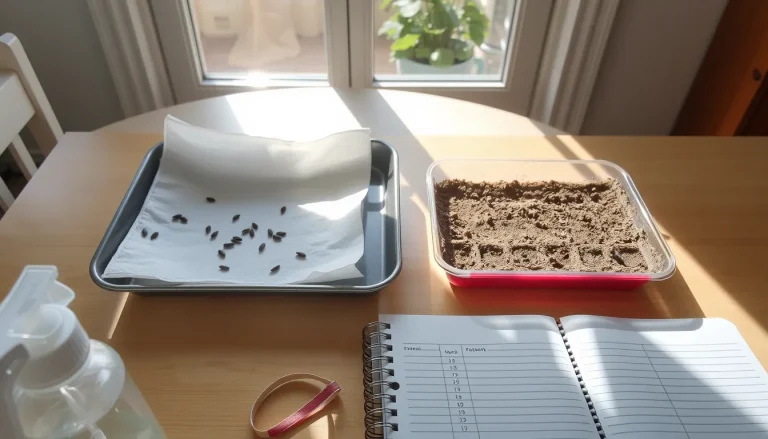
- Paper towels (plain, unbleached) – cut into 10 cm × 10 cm squares.
- Clear plastic cups or shallow trays (one per treatment).
- LED light modules in the following colors:
- Red (≈660 nm)
- Blue (≈450 nm)
- Green (≈525 nm)
- Far‑red (≈730 nm) – optional but useful for comparison
- White (full‑spectrum) – optional
- Power source for LEDs (USB power bank or wall adapter).
- Timer or phone alarm (to keep light exposure consistent, e.g., 12 h / 12 h).
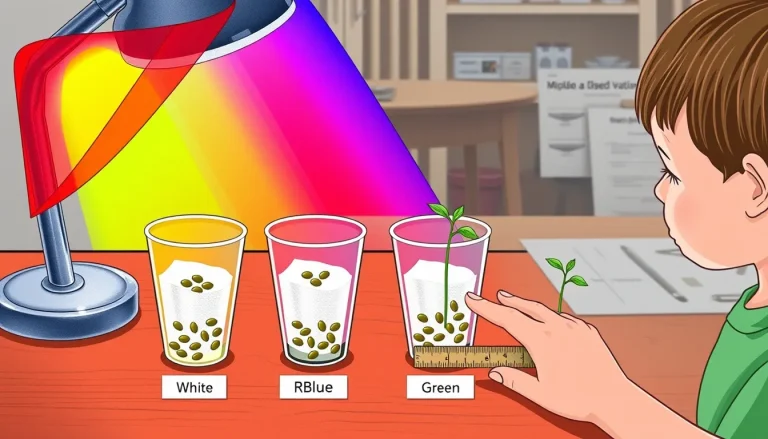
- Ruler or measuring tape (to note distance from lamp to seeds, ~5 cm).
- Notebook, pen, and a printed data table (provided below).
- Room‑temperature water in a spray bottle.
Steps
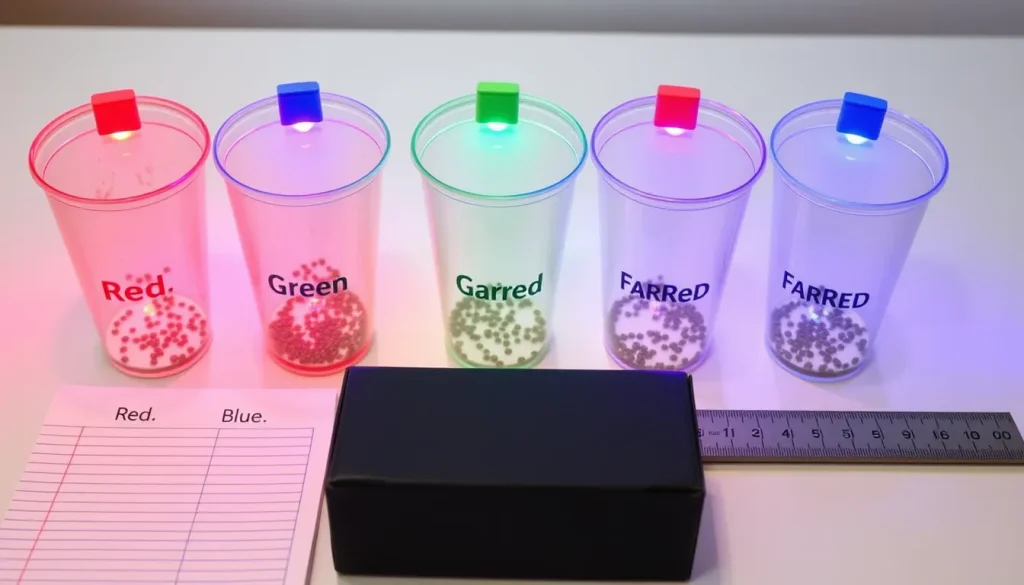
- Label the containers. Write “Red”, “Blue”, “Green”, “Far‑Red”, and “Dark” on the outside of five cups.
- Prepare the germination medium. Place one paper towel square in each cup, then add enough water to make the towel damp but not soggy. The towel should be moist enough that a squeeze releases a few drops.
- Plant the seeds. Spread 20 seeds evenly on each damp towel. Lightly press them onto the paper so they stick.
- Set the light treatments.
- Position each LED lamp directly above its cup, about 5 cm away.
- Cover the “Dark” cup with a piece of cardboard or place it inside a closed box to keep it in total darkness.
- Start the timer. Turn on all colored LEDs simultaneously and set a 12‑hour on / 12‑hour off cycle (or keep them on continuously if you prefer a constant‑light test). Record the start date and time.
- Observe daily. At the same time each day, count how many seeds have produced a visible radicle (the tiny root that pushes out). Record the number in the data table. Re‑moisten the paper towels with the spray bottle if they begin to dry.
- Continue until germination plateaus. When no new seeds appear for three consecutive days, the experiment is complete.
- Clean up. Turn off all LEDs, store them safely, and discard the paper towels in the compost or trash.
Testable Question
Does the color (wavelength) of light affect how quickly seeds germinate?
Hypothesis
Based on published research, red light (660 nm) will produce the fastest germination, while darkness will be the slowest. Blue, green, and far‑red lights are expected to fall in between.
Variables and Controls
- Independent variable: Light color (red, blue, green, far‑red, dark).
- Dependent variable: Number of days required for 50 % of the seeds to germinate (Mean Germination Time).
- Controlled variables: Seed species and lot, number of seeds per cup, moisture level of the paper towel, temperature of the room (keep around 20‑22 °C), distance from light source, and length of daily light exposure.
- Control group: The “Dark” treatment provides a baseline with no light.
Repeated Trials
To account for natural variation, repeat the whole set of five treatments at least three times (using fresh seeds and fresh paper towels each time). Treat each repeat as an independent trial and calculate an average Mean Germination Time for each color.

What to Observe or Measure
- Daily germination count: Number of seeds showing a radicle each day.
- Germination percentage: (Germinated seeds ÷ 20) × 100 %.
- Mean Germination Time (MGT): Σ (days × number germinated that day) ÷ total germinated seeds.
Record these values in the table provided below.
Data Table
| Day | Red (germinated) | Blue (germinated) | Green (germinated) | Far‑Red (germinated) | Dark (germinated) |
|---|---|---|---|---|---|
| 1 | |||||
| 2 | |||||
| 3 | |||||
| 4 | |||||
| 5 | |||||
| 6 | |||||
| 7 | |||||
| 8 | |||||
| 9 | |||||
| 10 |
Graphing Your Results
After calculating the Mean Germination Time for each color (average of the three trials), draw a simple bar graph:
- X‑axis: Light color (Red, Blue, Green, Far‑Red, Dark).
- Y‑axis: Mean Germination Time (days).
- Bars that are lower represent faster germination.
Visually compare the bars; the shortest bar should correspond to the color that most effectively breaks seed dormancy.
The Science Explained
Plants contain photoreceptors that absorb specific wavelengths:
- Phytochrome: Detects red (≈660 nm) and far‑red (≈730 nm) light. When a seed absorbs red light, phytochrome switches to its active form (Pfr), which triggers hormonal changes that promote germination. Far‑red light converts phytochrome back to the inactive form (Pr), often delaying germination.
- Cryptochrome and phototropin: Sense blue and ultraviolet‑A light. They can also influence germination, but their effect is usually weaker than phytochrome’s red/far‑red response.
Research on ornamental genotypes showed that narrow‑band red and blue LEDs significantly increased germination percentages compared with darkness [1]. A study on lettuce, cabbage, spinach, and arugula found that red light accelerated germination, while far‑red slowed it [2]. In stevia, red light (660 nm) produced the highest daily germination speed and total germinated seeds [3]. These findings support the hypothesis that red light will be the most effective treatment in our simple experiment.
It is important to remember that light is only one cue. Temperature, water availability, and seed age also affect germination. By keeping those factors constant, the experiment isolates the effect of light color.
Troubleshooting
- No seeds germinate: Check that the paper towel is consistently moist; dry paper inhibits germination. Verify that the LED lamps are actually on.
- Uneven germination within a treatment: Ensure seeds are spread evenly and not stacked on top of each other.
- Light leakage into the dark control: Use a completely sealed box or thick black cardboard. Even a small gap can let enough ambient light affect results.
- Temperature swings: Keep the experiment on a stable surface away from drafts, heaters, or windows.
Try Another Version
Once the basic experiment is mastered, families can explore variations:
- Test different seed species (e.g., beans, corn, or flower seeds) to see if the response is universal.
- Vary light intensity (use dimmer settings or place the lamp farther away) to investigate how brightness interacts with color.
- Extend the study to seedling growth: after germination, keep each group under the same colored light for a week and measure stem length.
Next Steps
After identifying the fastest‑germinating light color, transplant the seedlings into pots and continue growing them under the same light conditions. Compare leaf size, number of leaves, and overall vigor. This continuation links germination speed to later growth performance and deepens the investigation.
Sources & references
- Seed germination responses to low-level narrow-band light spectra for 14 ornamental plant genotypes, https://doi.org/10.1139/cjps-2020-0330
- The effect of different light wavelengths on the germination of lettuce, cabbage, spinach and arugula seeds in a controlled environment chamber, https://doi.org/10.1016/j.scienta.2024.113118
- Effects of Visible Light Wavelengths on Seed Germinability in Stevia Rebaudiana Bertoni, https://ccsenet.org/journal/index.php/ijb/article/view/11244