Overview
This activity lets children (ages 6‑14) discover why a solar oven gets hotter when the insulation is thicker. By building a simple pizza‑box oven, adding different layers of paper‑based insulation, and measuring the temperature inside, families can see the direct link between heat loss and insulation thickness.
Before You Begin
- Workspace: A sunny spot outdoors (or a south‑facing window) with a flat surface. Clear away leaves or debris that could shade the oven.
- Safety: The oven can reach 70 °C (158 °F). Young children should handle scissors and hot surfaces only with adult supervision.
- Timing: The build takes about 30 minutes. Each temperature test needs 20‑30 minutes of sunlight.
Materials
- One standard pizza delivery box (≈ 30 × 30 × 5 cm). Source: U.S. DOE pizza‑box oven guide [1]
- Black construction paper (for the interior base).
- Aluminum foil (to line the reflective flap).
- Clear polyethylene film or heavy clear plastic wrap (to seal the top).
- Plain copier paper, newspaper, or shredded paper – these will serve as the variable‑thickness insulation.
- Scissors, tape (packing or duct), ruler, pencil.
- Thermometer or temperature probe that records to 0.5 °C (digital kitchen thermometer works well).
- Notebook and pen for recording data.
Design Constraints and Success Criteria
Goal: Determine how the thickness of the paper insulation layer influences the maximum temperature reached inside the oven during a sunny period.
Constraints:
- Only the listed everyday materials may be used.
- The oven must retain the basic pizza‑box shape; no additional metal or rigid structures.
- All tests must be performed under similar sunlight conditions (same day, same time window, clear sky).
Success Criteria:

- Temperature rise of at least 15 °C above ambient for the thickest insulation configuration.
- Clear, repeatable temperature curves for each thickness.
Construction Steps
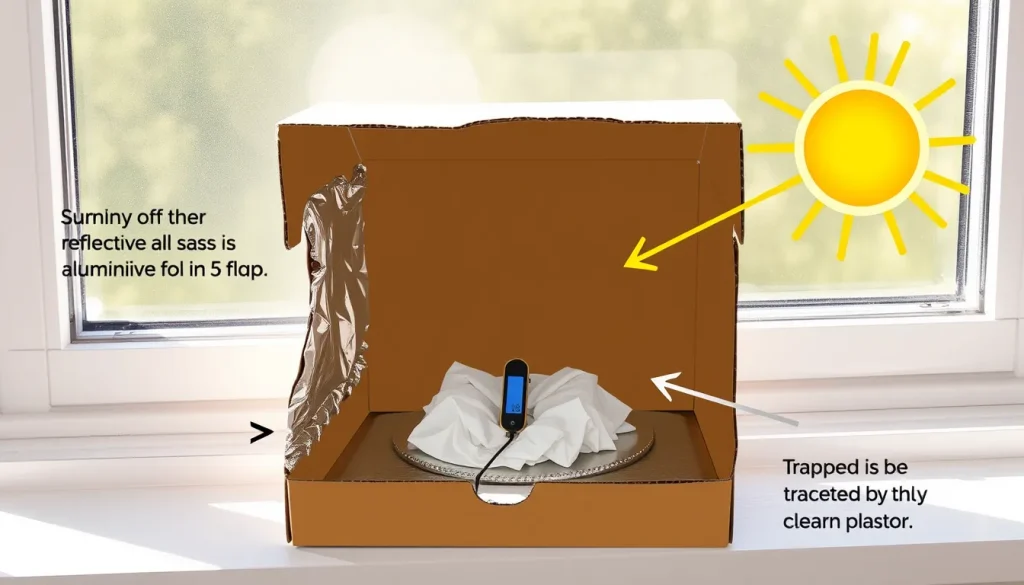
- Prepare the box. Using scissors, cut a 2‑inch (5 cm) square flap on the top lid’s lid edge, leaving a hinge. Fold the flap outward to create a reflective panel.
- Line the interior. Tape black construction paper to the bottom of the box. This absorbs solar radiation.
- Create the reflective flap. Cover the inside of the flap with aluminum foil, shiny side outward, and tape it flat.
(This mirrors sunlight into the box.) - Seal the top. Stretch clear plastic wrap over the opening and tape all edges tightly. This creates a greenhouse effect by trapping infrared radiation.
- Build the insulation stack. Cut sheets of plain paper to fit the interior floor (≈ 25 × 25 cm). Stack them to achieve the desired thicknesses:
- 0 mm (no extra paper – baseline).
- 5 mm (about 5 sheets).
- 10 mm (≈ 10 sheets).
- 15 mm (≈ 15 sheets).
Place the stack directly on the black base before each test, securing it with a small piece of tape so it does not shift.
- Position the oven. Place the box on a flat surface facing the sun. Tilt the reflective flap so that sunlight reflects onto the interior (about 45° angle is a good start).
- Insert the thermometer. Position the probe at the center of the insulation stack, avoiding contact with the foil or plastic.
- Start the test. Record the start time, ambient temperature, and cloud conditions. Every 5 minutes, note the internal temperature until it peaks or 30 minutes have passed.
- Repeat. Change the insulation thickness and repeat steps 4‑8. Perform at least three runs for each thickness to capture variability.
What to Observe or Measure
- Maximum interior temperature (°C) for each insulation thickness.
- Time to reach maximum temperature (minutes).
- Ambient temperature at the start of each run (helps compare days).
Record the data in the table provided below.
Variables and Controls
| Run # | Insulation Thickness (mm) | Ambient Temp (°C) | Max Oven Temp (°C) | Time to Max (min) |
|---|---|---|---|---|
| 1 | ||||
| 2 | ||||
| 3 |
Independent variable: Insulation thickness.
Dependent variable: Maximum interior temperature (and time to reach it).
Controlled variables: Box size, reflective foil, clear cover, sun angle, testing time of day, and thermometer placement.
Repeated Trials
Perform at least three trials for each thickness. Averaging the results reduces the effect of brief cloud passages or slight angle changes. Note any outliers and consider repeating the whole set on a different sunny day for confirmation.
The Science Explained
Heat moves in three ways: conduction (through solid material), convection (through moving air), and radiation (infrared energy). In a solar oven, the sun’s visible light passes through the clear plastic, is absorbed by the black base, and is re‑emitted as infrared radiation. The clear cover traps most of this infrared, creating a “greenhouse” effect.
Insulation slows heat loss by reducing conduction and convection. Paper, newspaper, or crumpled paper are low‑density materials that contain many tiny air pockets—air is a poor conductor of heat. As the insulation layer gets thicker, the path for heat to travel from the hot interior to the cooler outside becomes longer, so less heat escapes per unit time. This principle is confirmed in research on cavity‑walled solar ovens, where thicker or higher‑performance insulation (e.g., glass wool) produced higher steady‑state temperatures [3]. A 2008 dissertation comparing glass wool, crumpled paper, and other fabrics found glass wool (the most insulating) gave the greatest temperature rise, while plain paper performed modestly but still improved over no insulation [4]. Our experiment uses paper because it is safe, cheap, and readily available.
However, insulation cannot be infinitely thick. Beyond a certain point the added material adds weight and may block sunlight from reaching the absorber, or create a larger air gap that reduces the effectiveness of the reflective flap. The engineering challenge is to find the thickness that maximizes temperature without compromising other design aspects.
Troubleshooting
- Temperature stays low (< 30 °C): Check that the clear plastic is tight—any gaps let warm air escape. Ensure the reflective foil is smooth and angled correctly toward the sun.
- Thermometer reads the same as ambient: Verify the probe is not touching the metal foil or the box walls; it should sit in the middle of the insulation stack.
- Rapid temperature drop after peak: The oven may have been turned too quickly toward shade. Keep the box stationary during each run.
- Paper insulation shifts during the test: Secure the stack with a small piece of tape or a light weight (e.g., a small stone) placed on top of the stack.
Try Another Version
For a deeper investigation, replace the paper stack with other low‑cost insulators such as cotton batting, foam board, or a thin layer of aluminum foil sandwiched between paper. Compare how material type, not just thickness, influences temperature. This extension turns the activity into a full engineering design challenge.
Next Steps
Use the data to create a simple line graph (insulation thickness on the x‑axis, maximum temperature on the y‑axis). Discuss why the curve may level off or even decline at the thickest setting. Then brainstorm ways to improve the oven—perhaps adding a second reflective flap, using a darker absorber, or building a double‑wall cavity as described in advanced solar‑oven research [2].
Related terms
- Insulation
- Material that slows heat transfer by trapping air, reducing conduction and convection.
- Solar oven
- A device that concentrates sunlight to heat food or raise temperature inside a sealed container.
- Greenhouse effect
- Trapping of infrared radiation by a transparent cover, causing the interior to become hotter than the outside air.
Sources & references
- U.S. Department of Energy, “Build a Pizza Box Solar Oven”, https://www1.eere.energy.gov/education/pdfs/lesson298.pdf
- José Périto Leite Rodrigues da Silva et al., “A Case Study of a Solar Oven’s Efficiency: An Experimental Approach”, Sustainability, 2025, https://doi.org/10.3390/su17020428
- Steen Carlsen, “Considerations, design calculations, construction, test and evaluation of a cavity walled solar oven – Part 2: Evaluation of insulation materials”, 2025, https://practicalactionpublishing.com/book/3056/considerations-design-calculations-construction-test-and-evaluation-of-a-cavity-walled-solar-oven-part-2-evaluation-of-insulation-materials
- Optimizing Heat Insulation of a Solar Oven, Universiti Teknologi Petronas, 2008, http://utpedia.utp.edu.my/id/eprint/9962/1/2008-OptimizingHeatInsulationofaSolarOven.pdf