Overview
Capillary action is the ability of a liquid to flow through narrow spaces without the assistance of external forces. In everyday life you see it when a paper towel soaks up a spill or when a plant draws water up its stem. The key factors are the size of the pores, the liquid’s surface tension, and the material’s thickness. This experiment asks a simple question that children can test with only paper, water, and a ruler.
Testable Question
Does the thickness of a paper strip affect how high water climbs by capillary action?
Hypothesis
Because thinner paper usually has a higher density of small pores, we predict that a thin strip will allow water to rise farther than a thick strip of the same material.
Materials
- Three types of paper that differ mainly in thickness (e.g., standard printer paper, 2‑ply copy paper, and a heavyweight cardstock). If exact thickness values are unknown, you can use a ruler or caliper to measure approximate millimetre thickness.
- Clear drinking glass or small transparent container (≈200 ml capacity).
- Room‑temperature water.
- Food‑colouring (optional, to make the water easier to see).
- Ruler or metric measuring tape.
- Sticky notes or masking tape (to hold paper strips in place).
- Pen or pencil for recording data.
- Paper towels for cleanup.
Before You Begin
Choose a well‑lit workspace and lay out a sheet of newspaper or a plastic tray to catch drips. Younger children should be supervised when handling water and cutting paper.

Procedure
- Cut three strips of each paper type, each 10 cm long and 1 cm wide. Label the strips (e.g., “Thin”, “Medium”, “Thick”).
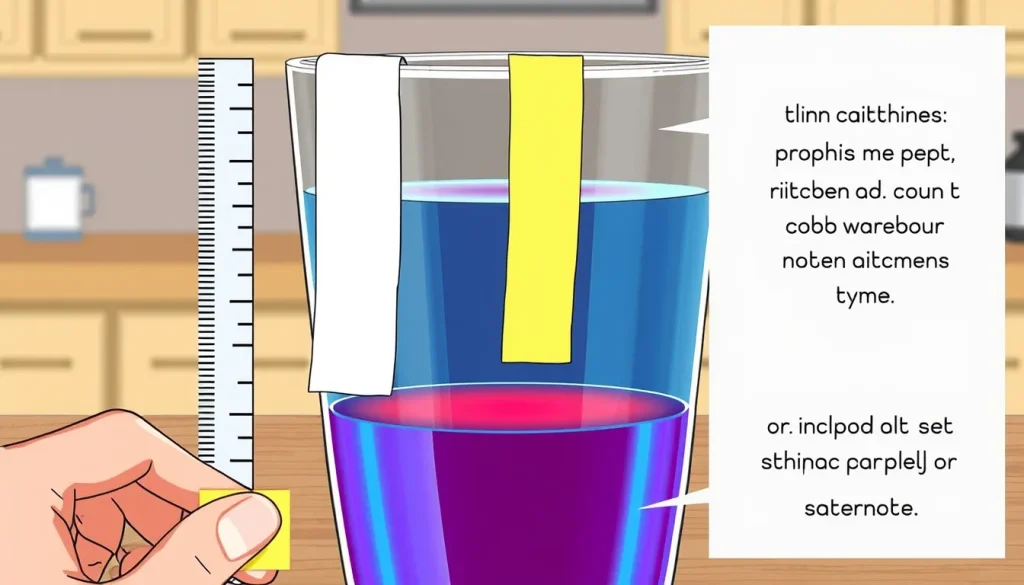
- Fill the glass with water to a depth of about 2 cm. Add a few drops of food‑colouring if desired.
- Secure the top end of a strip to a sticky note and place the note on the rim of the glass so the paper hangs vertically with its lower end just touching the water surface. Make sure the strip does not touch the glass walls.
- Start a timer and observe the water front as it climbs the paper. Record the height (in centimetres) after 30 seconds, 1 minute, and 2 minutes.
- Remove the strip, dry the outside, and repeat steps 3‑4 with the other two strips of the same paper type.
- When all strips of one paper type are tested, clean the glass, refill with fresh water, and repeat the entire series for the next paper type.
- Perform at least three full trials (i.e., one complete set of thin‑medium‑thick measurements) to see how consistent the results are.
Variables and Controls
- Independent variable: Paper thickness (thin, medium, thick).
- Dependent variable: Height of water rise (cm) after a fixed time.
- Controlled variables: Water temperature, colour, container size, strip dimensions (length and width), observation times, and ambient humidity.
Repeated Trials
Repeating the whole set three times helps you identify random variation (e.g., slight differences in paper flatness) and calculate an average height for each thickness.
What to Observe or Measure
For each strip record:
- Paper type and thickness (you may note the measured mm if you have a ruler).
- Time points (30 s, 60 s, 120 s).
- Water‑rise height at each time point.
- Any irregularities, such as uneven wicking or droplets forming on the side.
Data Table (Blank)
| Trial | Paper Type | Thickness (mm) | Time (s) | Rise Height (cm) |
|---|---|---|---|---|
| 1 | Thin | 30 | ||
| 1 | Thin | 60 | ||
| 1 | Thin | 120 | ||
| 1 | Medium | 30 | ||
| 1 | Medium | 60 | ||
| 1 | Medium | 120 | ||
| 1 | Thick | 30 | ||
| 1 | Thick | 60 | ||
| 1 | Thick | 120 |
Graphing Your Results
Plot a line graph with time (seconds) on the x‑axis and rise height (cm) on the y‑axis. Use a different coloured line for each paper thickness. The slope of each line gives a visual sense of how quickly water climbs; a steeper slope means faster capillary rise.
The Science Explained
Water moves up a porous material because of two opposing forces:
- Adhesion: water molecules are attracted to the fibres of the paper.
- Cohesion: water molecules stick to each other, pulling the column upward.
When the adhesive force between water and the paper surface exceeds the weight of the water column, the liquid climbs. Thin paper typically has more closely spaced fibres and smaller pores, which create a larger total surface area for adhesion. This is why a paper towel (highly porous) can draw water faster than a sheet of dense copy paper, as demonstrated in classroom activities that compare paper, paper towel, and facial tissue (Vernier). In contrast, a thick cardstock often has larger pores and a denser fibre packing, reducing the capillary pull and slowing the rise.
Capillary rise also depends on the liquid’s surface tension. Adding a tiny amount of soap would lower surface tension and therefore lower the height reached, a useful extension for older learners.
Troubleshooting
- Water does not rise at all: Check that the paper edge is actually touching the water surface. A thin air gap stops capillary action.
- Uneven wicking (one side climbs higher): The paper may be bent or have a crease. Use a ruler to ensure the strip is straight.
- Very slow rise: The water may be too warm or too cold; room temperature (≈20 °C) works best.
- Measurements jump erratically between trials: Make sure you use fresh water for each trial and dry the strip’s outside before re‑immersion.
Try Another Version
After mastering thickness, explore other factors that influence capillary action:
- Compare different liquids (salt water, vinegar, rubbing alcohol).
- Test the effect of paper surface treatment – gently rub one strip with a dry cloth to compress fibres, or lightly sand another to increase roughness.
- Use a thermal camera (if available) to visualize the temperature change as water climbs, similar to the FLIR demonstration described by Vernier (Vernier).
Cleanup and Disposal
Dispose of the used paper strips in the trash or recycling bin, depending on local rules. Wipe the glass with a paper towel and let it dry. No hazardous chemicals are involved.
Next Steps
Discuss with children how the same principle lets plants draw water from roots to leaves, linking the experiment to biology lessons. You can also turn the data into a simple report: state the hypothesis, show the graph, and write a conclusion about which paper thickness performed best.
Frequently asked questions
Do I need a ruler to measure paper thickness?
A ruler can estimate thickness, but the experiment works with any clearly different paper types (e.g., printer paper vs. cardstock).
Can I use colored markers instead of food‑colouring?
Yes, any safe, water‑soluble colour will make the rising front easier to see.
What if my water evaporates during the trial?
Keep the experiment under a cover (e.g., a shallow box) if you expect long observation times, or work in a cool room.
Related terms
- Capillary Action
- The ability of a liquid to flow in narrow spaces without external forces, driven by surface tension.
- Adhesion
- The attraction between different substances, such as water molecules and paper fibres.
- Cohesion
- The attraction between like molecules, such as water molecules pulling each other upward.
- Porosity
- The amount of empty space (pores) within a material that can hold liquid.
Sources & references
- Paper Towel Science Project: Capillarity | Education.com, https://www.education.com/activity/article/find-absorbent-brand-paper-towels/
- Capillary Action | Vernier, https://www.vernier.com/vernier-ideas/capillary-action/
- "The Quicker Wicker-Upper" PDF, https://www.wku.edu/gifted/project_gems/documents/capillary_action.pdf