Overview
Runoff – the water that flows over the surface of the ground after a rain – can wash soil, nutrients, and pollutants into streams. Even a thin layer of vegetation can intercept rain, let water soak into the soil, and slow the flow. This hands‑on experiment lets families see that principle in action using everyday items: cardboard, paper, seeds, and water.
Before you begin
- Choose a dry day or work indoors where you can pour water without making a mess.
- Adult supervision is required for handling scissors, hot glue (if used), and for cleaning up spilled water.
- Gather a clear container (e.g., a graduated cylinder or a measuring cup) to collect runoff.
- Plan to repeat the test at least three times for each condition so you can see natural variation.
Materials
- Sturdy cardboard (about 30 cm × 60 cm, 0.5 cm thick)
- Plain printer paper or lightweight cardstock (cut to fit the cardboard)
- Fast‑growing seeds (e.g., radish, lettuce, or grass seed) – about 1 tbsp per trial
- Potting soil or a mixture of sand and compost (enough to fill a 2‑cm‑deep layer on the cardboard)
- Water (room temperature)
- Measuring cup or graduated cylinder (capacity at least 500 mL)
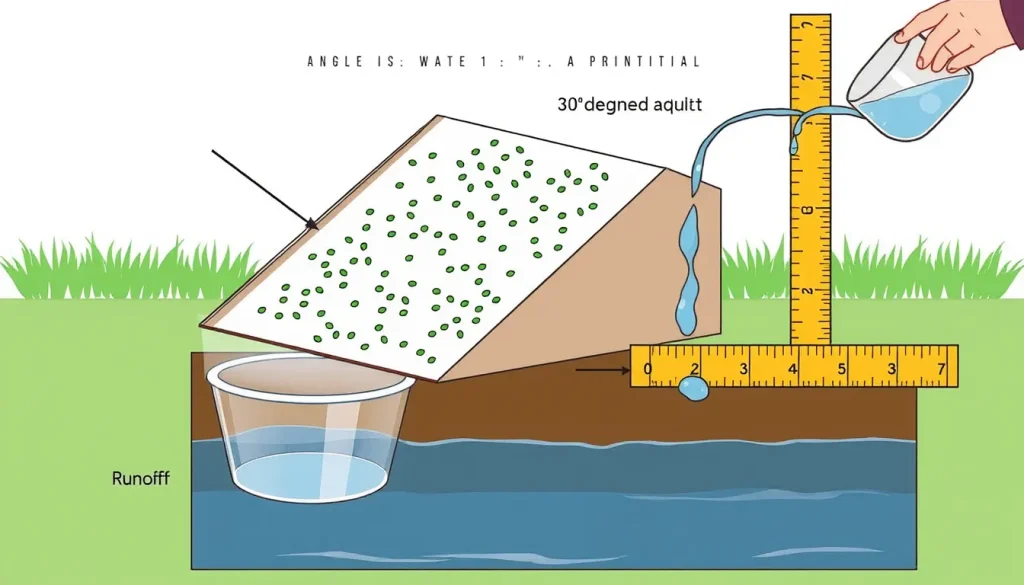
- Ruler or protractor (to set a consistent slope, e.g., 30°)
- Masking tape or small blocks to hold the cardboard at the chosen angle
- Pen and notebook for recording data
Testable question
Does covering a cardboard slope with a simple paper seedling mat reduce the volume of runoff compared with a bare slope?
Hypothesis
If a paper seedling mat is placed on the slope, then the runoff volume will be lower because the paper and growing roots will intercept water and increase infiltration.
Variables and controls
- Independent variable: Presence of a paper seedling mat (none, 50 % coverage, 100 % coverage).
- Dependent variable: Volume of water collected in the runoff container (milliliters).
- Controlled variables:
- Cardboard size and material.
- Slope angle (kept at 30° for every trial).
- Amount of water poured (e.g., 250 mL per trial).
- Soil depth and type.
- Seed type and amount.
- Ambient temperature and humidity (record if they differ noticeably).
Procedure (Steps)
- Cut the cardboard to the dimensions above and lay it on a flat surface.
- Place two small blocks or books at one end to create a 30° incline; verify with a protractor.
- Spread a uniform 2‑cm layer of soil across the entire cardboard surface.
- Control condition (no mat): Leave the soil bare.
- Place the runoff collection cup directly below the lowest edge of the slope.
- Pour 250 mL of water steadily from a small pitcher, simulating a brief rain.
- Record the amount of water that flows into the cup (it may be less than 250 mL if some soaks into the soil).
- For the partial‑mat condition: Cut a piece of paper to cover roughly half the slope (e.g., 30 cm × 30 cm). Place the paper on the soil, then sprinkle the seeds evenly over the paper and press lightly so they contact the soil.
- Repeat the water‑pouring step and record runoff.
- For the full‑mat condition: Cover the entire slope with paper, seed it, and repeat the water‑pouring step.
- After each trial, allow the soil to dry completely (or replace the cardboard with a fresh piece) before starting the next condition.
- Repeat each condition at least three times, randomising the order to minimise systematic bias.
Repeated trials
Running three or more trials per condition lets you see natural variation and calculate an average runoff volume. Record each trial separately; later you can compute the mean and standard deviation.

What to observe or measure
- Volume of runoff (mL) collected in the cup after each pour.
- Time it takes for the water to stop flowing (optional, for deeper analysis).
- After a week, note any seed germination – this shows the mat can also establish vegetation, which further improves runoff control.
Data table
| Trial | Condition | Runoff (mL) |
|---|---|---|
| 1 | None (bare) | |
| 2 | None (bare) | |
| 3 | None (bare) | |
| 1 | Partial mat (≈50 %) | |
| 2 | Partial mat (≈50 %) | |
| 3 | Partial mat (≈50 %) | |
| 1 | Full mat (100 %) | |
| 2 | Full mat (100 %) | |
| 3 | Full mat (100 %) |
Graphing your results
Create a simple bar graph: the x‑axis shows the three conditions (None, Partial, Full) and the y‑axis shows average runoff volume (mL). Error bars can display the range or standard deviation. A visual drop in the bars from “None” to “Full” supports the hypothesis.
The science explained
Vegetation slows runoff in three main ways:
- Interception: Leaves and stems catch raindrops, reducing the kinetic energy that reaches the soil.
- Infiltration enhancement: Plant roots create channels in the soil, allowing water to soak in more quickly. Studies of biotechnical slope stabilization note that “intertwining of roots maximizes seepage of runoff into soil by intercepting rainfall” and that vegetation can “deplete soil moisture, attenuating the depth of frost penetration”【4】.
- Physical barrier: Even a thin layer of paper acts like a geotextile – a synthetic fabric used in erosion control that “holds mulching and matting to the ground” and “helps establish vegetation”【2】. The 2002 sponge‑tray experiment showed that increasing “vegetation” (represented by sponges) reduced runoff volume compared with a bare tray【1】.
When seeds germinate, the emerging roots add the third effect, turning a simple paper mat into a living filter much like the mulch and netting described in geotextile best‑practice guides.
Troubleshooting
- Runoff volume is the same for all conditions: Check that the paper is lying flat and fully contacts the soil; air gaps let water bypass the mat.
- Water leaks around the edges: Seal the cardboard edges with tape or use a shallow tray to contain the flow.
- Seeds do not germinate: Ensure the soil stays moist after the test and that you are using a seed type suited to indoor growth.
- Inconsistent water pours: Use a measuring cup and pour at a steady rate; practice once before recording data.
Next steps
Once the basic test is complete, families can explore variations:
- Try different slope angles (15°, 45°) to see how steepness interacts with vegetation.
- Replace paper with natural mulches such as shredded leaves or coir matting, linking to the geotextile discussion in source [2].
- Measure how long the runoff takes to stop, adding a time‑based dimension.
- Observe the long‑term effect of a fully grown plant mat on runoff after several weeks.
These extensions turn the activity into a longer investigation suitable for a science fair or a classroom unit on water resources.
Sources & references
- KDE Santa Barbara Does Vegetation Help Prevent Runoff? https://kids.nceas.ucsb.edu/kdesb/2002chin.html
- EPA Geotextiles, Matting and Netting https://www.epa.gov/system/files/documents/2021-11/bmp-geotextiles-matting-and-netting.pdf
- Technical note Stabilization of soil slope using geosynthetic mulching mat https://www.sciencedirect.com/science/article/pii/S026611440200002X