Overview
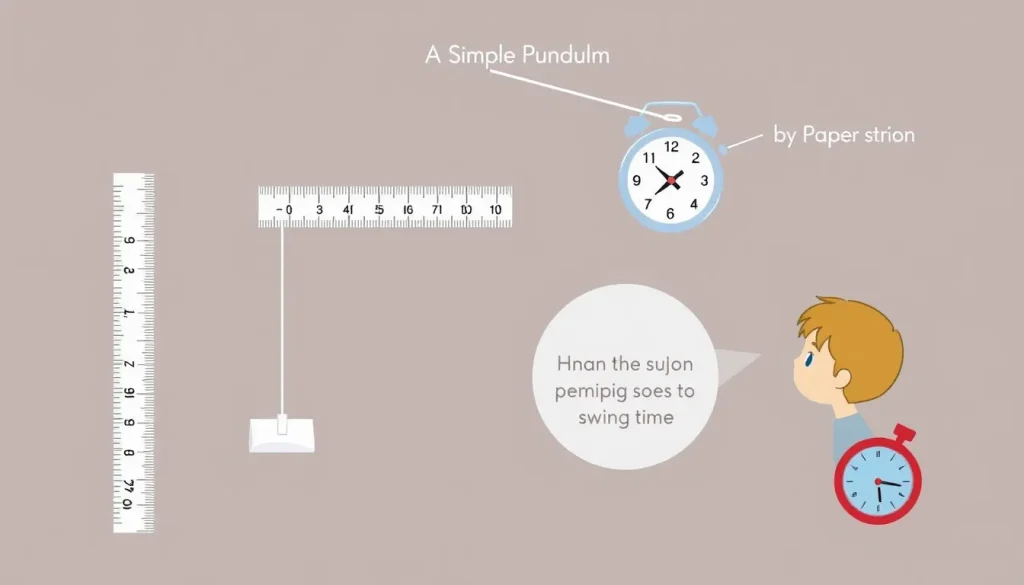
A pendulum is a classic example of simple harmonic motion. When a weight (the bob) hangs from a string and is displaced a little, it swings back and forth in a regular rhythm. The time it takes for one complete back‑and‑forth swing is called the period. In this experiment children will change one thing – the length of the string – and watch how the period changes. The activity is safe, uses everyday items, and produces data that can be graphed to reveal a simple mathematical pattern.
Materials
- Thin string, yarn, or fishing line (about 1 m total length)
- Paper (a sheet of cardstock or heavy printer paper) to make a bob
- Scissors
- Small metal washer, paper clip, or a piece of clay to add weight to the paper bob (optional but improves consistency)
- Ruler or measuring tape (centimetre scale)
- Stopwatch or a phone with a timer app
- Clamp, coat‑hanger, or a sturdy stand from which to hang the string
- Pen and notebook for recording data
Safety and Preparation
The activity uses only light objects and no electricity, but a supervising adult should make sure the string is securely fastened to the stand so the bob does not fall on anyone’s feet. If a metal washer is used, handle it gently to avoid pinching skin.
Testable Question
How does changing the length of a pendulum’s string affect the time it takes to complete one swing (the period)?
Hypothesis
Because the period of a simple pendulum is proportional to the square root of its length, we predict that a longer string will produce a longer period – the pendulum will swing more slowly.
Variables and Controls
- Independent variable: Length of the string (measured in centimetres).
- Dependent variable: Period of the pendulum (seconds per swing).
- Controlled variables: Mass of the bob, size of the bob, amplitude of the release (keep the initial angle small, less than 15°), air currents, and the acceleration due to gravity (which is constant on the Earth’s surface).
Procedure (Steps)
- Cut a piece of string about 10 cm long. Tie one end securely to the centre of the paper bob. If you add a small weight (washer or clay), attach it to the centre of the paper so the bob is balanced.
- Attach the free end of the string to the top of the stand (e.g., a coat‑hanger hooked over a door frame). Make sure the string can swing freely without touching anything.
- Use the ruler to measure the length of the string from the point of attachment on the stand to the centre of the bob. Record this length as L₁ in your notebook.
- Pull the bob gently to one side so that the string makes an angle of about 10° with the vertical. This small angle keeps the motion close to simple harmonic, as described in the physics of a simple pendulum.
- Release the bob and start the stopwatch as the bob passes the lowest point of its swing.
- Count 10 complete back‑and‑forth swings (10 periods) and then stop the timer.
- Divide the recorded time by 10 to obtain the average period for that length.
- Write the average period in the data table (see below) next to the corresponding string length.
- Repeat steps 3‑6 for at least three additional lengths (e.g., 20 cm, 30 cm, 40 cm). For each length, use a fresh piece of string or re‑measure the same string after adding more length.
- Perform at least two trials for each length to check consistency. Record each trial separately.
What to Observe and Measure
For each string length you will measure:
- The exact length of the string (centimetres).
- The total time for 10 swings (seconds).
- The calculated average period (seconds per swing = total time ÷ 10).
Note any irregularities, such as the bob wobbling, the string twisting, or drafts that disturb the swing.
Repeated Trials
Repeating the measurement for each length reduces random error and shows how precise your timing is. If the two trials for a given length differ by more than about 0.2 s, repeat the measurement until the results are close.
Data Table
| Trial | String Length (cm) | Time for 10 Swings (s) | Average Period (s) |
|---|---|---|---|
| 1 | |||
| 2 | |||
| 3 | |||
| 4 | |||
| 5 | |||
| 6 |
Graphing Your Results
Plot the average period (vertical axis) against the square root of the string length (horizontal axis). According to the pendulum formula, the points should lie on a straight line whose slope is 2π/√g. If you prefer a simpler graph, plot period versus length; the curve will look like a shallow square‑root shape, showing that period increases as length increases.
The Science Explained
For small angles (< 15°) a pendulum behaves like a simple harmonic oscillator. The restoring torque is proportional to the sine of the displacement angle, and for small angles sin θ ≈ θ, giving a linear relationship. The derived period T is
T = 2π√(L / g)
where L is the length of the string and g is the acceleration due to gravity (≈ 9.81 m s⁻²). This equation shows that the period grows with the square root of the length, not linearly. The mass of the bob does not appear in the formula, which is why keeping the bob’s weight constant is a control.[2] The relationship is a cornerstone of the study of simple harmonic motion, covered in introductory physics texts.[1]
Troubleshooting
- Bob does not swing smoothly: Make sure the string is not twisted and the bob is balanced. Trim excess paper or adjust the weight.
- Timing seems inconsistent: Use a digital timer and start/stop on the same point of the swing each time (the lowest point). Count more swings (e.g., 20) to reduce timing error.
- Air drafts affect the swing: Perform the experiment away from open windows or fans.
- String length changes during the trial: Measure the length after the bob is attached but before each trial, and do not stretch the string.
Common Misconceptions
- “A heavier bob swings slower.” In a simple pendulum the period does not depend on mass; only length matters (as long as the string mass is negligible).
- “Longer strings always swing faster because they travel a longer path.” The longer path is offset by a weaker restoring force, resulting in a longer period.
- “The period is the same for any angle.” The formula T = 2π√(L/g) is accurate only for small angles. Larger angles make the period slightly longer.
Try Another Version
Once the basic relationship is clear, try one of these extensions:
- Use different materials for the bob (plastic bead, metal nut) while keeping the length constant to confirm that mass does not affect period.
- Increase the release angle to 30° or 45° and observe how the period changes; compare with the small‑angle prediction.
- Replace the string with a thin rubber band that stretches slightly under the bob’s weight, and see how elasticity influences the period.
Cleanup and Disposal
Coil the string and store it for future use. Recycle the paper bob or discard it in the paper recycling bin. If a metal washer was used, rinse it and place it in the metal scrap container.
Next Steps
Use the measured period to calculate the local value of g by rearranging the pendulum formula: g = 4π²L / T². Compare your result with the standard 9.81 m s⁻² and discuss sources of error such as timing, angle size, and air resistance.
Frequently asked questions
Do I need a very precise stopwatch?
A phone timer or any digital stopwatch works well. Measuring the time for several swings (e.g., 10) and then dividing reduces timing error.
Can I use a string that is thicker or heavier?
Yes, but keep the string’s mass small compared with the bob’s mass. A heavy string adds extra tension and can slightly change the period.
Why must the release angle be small?
The formula T = 2π√(L/g) assumes the sine of the angle is approximately equal to the angle itself (in radians). This is true for angles under about 15°, keeping the motion simple harmonic.
Related terms
- Period
- The time required for one complete back‑and‑forth swing of a pendulum.
- Simple Harmonic Motion
- A type of periodic motion where the restoring force is proportional to the displacement.
- Amplitude
- The maximum distance the pendulum bob moves away from its resting (equilibrium) position.
Sources & references
- OpenStax, "15.4 Pendulums - University Physics Volume 1," https://openstax.org/books/university-physics-volume-1/pages/15-4-pendulums
- OpenStax, "5.5 Simple Harmonic Motion - Physics," https://openstax.org/books/physics/pages/5-5-simple-harmonic-motion