Paper towels are made of a network of tiny fibers that create pores. When water contacts the fibers, capillary forces pull the liquid into the pores, a process called wicking. The overall thickness of a towel changes the number of layers (plies) and the three‑dimensional pore volume, which can speed up or slow down how quickly water spreads.
Orientation / Overview
This experiment compares paper towels of different thicknesses—single‑ply, double‑ply, and triple‑ply—to determine how thickness influences the wicking speed of a small water drop. Children will measure how far the water travels in a set time (or how long it takes to travel a set distance) and plot the results.
Before you begin
- Choose a flat, non‑absorbent surface such as a piece of glass, acrylic, or a smooth countertop.
- Gather a timer (stopwatch or phone), a ruler or measuring tape, and a pipette or dropper that can deliver consistent 0.5 mL drops.
- Prepare a clean workspace and have paper towels of at least three different thicknesses ready. Commercial brands often label plies (e.g., “2‑ply”). If plies are not marked, you can create thicker samples by stacking identical single‑ply sheets and taping the edges together.
- Adult supervision is needed for handling scissors and for ensuring consistent drop size.
Materials
- Paper towels: single‑ply, double‑ply, and triple‑ply (or stacked single‑plies).
- Scissors.
- Ruler or metric tape measure (cm).
- Dropper or pipette (0.5 mL capacity).
- Timer (stopwatch or phone).
- Flat, non‑absorbent tray or plate.
- Pen and worksheet for recording data (see Data Table).
- Optional: digital camera to photograph each trial.
Steps
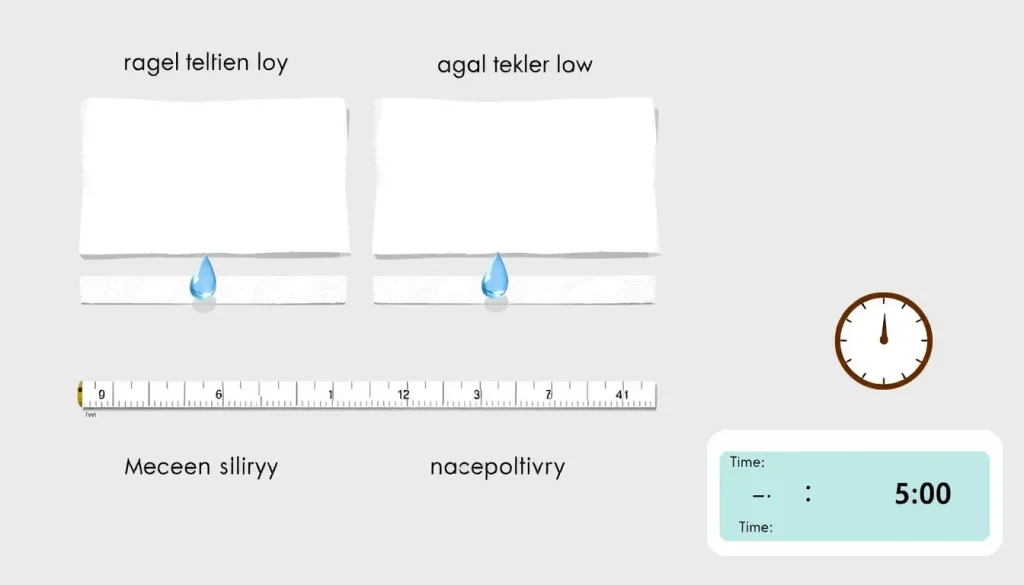
- Cut three strips of paper towel, each 10 cm long and 2 cm wide. Make one strip from single‑ply, one from double‑ply, and one from triple‑ply. Keep the width and length identical for every sample.
- Lay a strip flat on the non‑absorbent tray. Mark the left end as “Start” and the right end as “Finish.”
- Using the dropper, place a single 0.5 mL water drop at the “Start” line. Start the timer the instant the drop touches the paper.
- Observe the water front (the furthest point the wet area has reached). Every 5 seconds, record the distance from the start line to the wet front using the ruler. Continue until the water reaches the “Finish” line or 60 seconds have passed, whichever comes first.
- Repeat steps 2‑4 for the same strip two more times to obtain three trials for that thickness.
- Clean the tray, then repeat the entire procedure with the double‑ply strip, followed by the triple‑ply strip, recording all measurements.
- After all trials are complete, calculate the average distance traveled at each time point for each thickness.
What to observe or measure
- Wicking distance (cm) at each 5‑second interval.
- Time (seconds) when the water reaches a predefined distance (e.g., 5 cm). This can be used as “time to travel 5 cm.”
- Any irregularities such as uneven spreading, pooling, or tears in the paper.
Variables and controls
| Variable | Type | How it is set |
|---|---|---|
| Paper towel thickness (plies) | Independent | Single, double, triple ply (or stacked sheets) |
| Wicking distance or time | Dependent | Measured with ruler and timer |
| Drop volume | Controlled | Exactly 0.5 mL each trial |
| Strip width and length | Controlled | 2 cm × 10 cm for every sample |
| Surface material | Controlled | Same non‑absorbent tray for all trials |
| Room temperature & humidity | Controlled (as much as possible) | Conduct all trials in the same room, avoid drafts |
Repeated trials
Perform at least three repeats for each thickness. Repeating reduces random error caused by slight variations in drop placement or paper texture and lets you calculate an average and a simple range.
Data table
| Trial | Thickness (plies) | Time (s) | Distance traveled (cm) |
|---|---|---|---|
| 1 | |||
| 2 | |||
| 3 |
Graphing your results
Create a line graph for each thickness:

- X‑axis: Time (seconds).
- Y‑axis: Wicking distance (cm).
- Plot the average distance for each time point and connect the points. The slope of each line indicates the wicking speed; a steeper slope means faster wicking.
- Alternatively, plot “Time to reach 5 cm” on the Y‑axis against thickness on the X‑axis to see how many seconds each towel needs to travel the same distance.
The science explained
Wicking in paper towels is driven primarily by capillary action, which arises when the surface tension of water pulls the liquid into narrow pores. The driving pressure (capillary pressure) is inversely proportional to the pore radius; smaller pores generate higher suction.[1]
Thickness adds a third dimension (the Z‑direction) to the pore network. A thicker towel contains more layers of fibers, increasing the total pore volume and the number of parallel capillary pathways. Research shows that three‑dimensional absorbency is highly correlated with porosity, which grows with thickness, while two‑dimensional surface absorbency depends more on fiber width and length.[1] Consequently, a thicker towel can draw water faster because it offers more pathways for the liquid to travel, but only up to a point—excessive thickness can create larger pores that reduce capillary pressure.
Viscous resistance and gravity also play roles. In the early stage of wicking, capillary forces dominate, producing a rapid rise (the “capillary rise”). As the wet front moves farther, viscous drag inside the pores slows the advance, leading to a characteristic square‑root‑of‑time behavior described by the Lucas‑Washburn equation.[3] Measuring distance versus time lets students see this relationship and compare how thickness changes the effective coefficient.
Modern testing devices (horizontal gravimetric or radial wicking instruments) have shown that the number of plies and the papermaking process affect both the rate and total capacity of absorption more strongly than simple basis weight.[4] Our simple drop‑and‑measure method mirrors these professional tests, providing a hands‑on illustration of the same principles.
Troubleshooting
- Uneven drop size: Use a calibrated pipette and practice delivering the same drop before recording data.
- Paper tearing or folding: Handle strips gently and keep them flat on the tray. If a strip tears, discard it and cut a fresh one.
- Water pooling instead of wicking: Ensure the paper surface is dry before each trial. Excess water can saturate the surface and mask capillary flow.
- Inconsistent ambient conditions: Conduct all trials in the same room and avoid opening windows or turning on fans.
- Variations between brands: If you test different brands, note that fiber composition and manufacturing (through‑air‑dried vs. wet‑pressed) also affect absorbency.[4]
Next steps
After analyzing the data, children can explore other factors that influence wicking, such as:
- Changing the drop volume.
- Testing different paper towel textures (quilted vs. smooth).
- Adding a small amount of soap to the water to see how surface tension changes affect speed.
Each extension deepens understanding of capillary action and material science.
Sources & references
- Dimensional analysis of absorbency in paper towels: A study of three- and two-dimensional mechanisms. https://doi.org/10.15376/biores.20.1.683-697
- Experimental studies of capillary rise and moisture distribution in paper towels. https://doi.org/10.14288/1.0447587
- Paper Towel Absorptive Properties and Measurement using a Horizontal Gravimetric Device. https://www.tappi.org/content/events/11papercon/documents/291.549docx.pdf