Overview
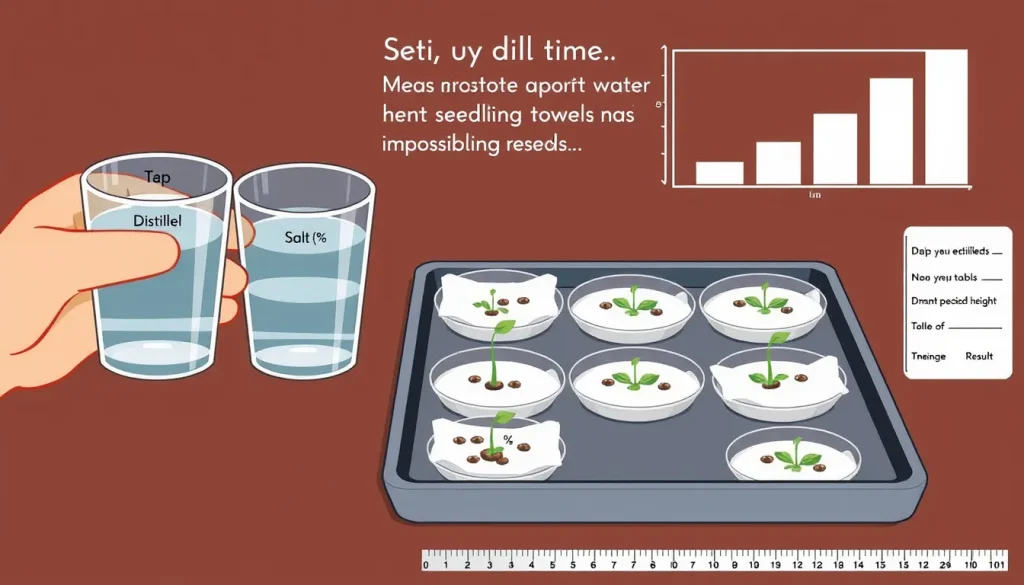
All plants need water, but the composition of that water can change how quickly a seed cracks open and begins to grow. This experiment compares three common water types—tap water, salt water, and distilled water—to see which best supports germination. The activity is designed for beginners (ages 6‑14) and uses everyday materials.
Testable Question
How does the type of water (tap, salt‑added, or distilled) affect the rate and success of seed germination?
Hypothesis
Because tap water often contains minerals that can help plants, while salt can inhibit water uptake, we predict that seeds watered with distilled water will germinate fastest, tap water will be intermediate, and salt water will produce the fewest sprouts.
Materials
- 20–30 fast‑germinating seeds (e.g., radish, lettuce, or grass seed)
- Petri dishes or shallow clear plastic trays (one per water type, plus one control)
- Paper towels (cut to fit the dishes)
- Tap water (room temperature)
- Distilled water (available at grocery stores or pharmacies)
- Salt (table salt) and a measuring spoon
- Measuring cup or graduated cylinder
- Labels or sticky notes
- Ruler or measuring tape (mm or cm)
- Notebook or printable data sheet (see table below)
All items are common household or school supplies. If petri dishes are unavailable, clean plastic lids work as substitutes.

Before You Begin
- Gather all materials and set up a clean workspace.
- Wash hands before handling seeds.
- Prepare the salt solution: dissolve 1 g of table salt in 100 mL of tap water (about 1 % w/v). This concentration is strong enough to show an effect without being hazardous.
- Label three dishes as “Tap”, “Distilled”, and “Salt”. If you want a control with no water, label a fourth dish “Dry”.
Procedure (Steps)
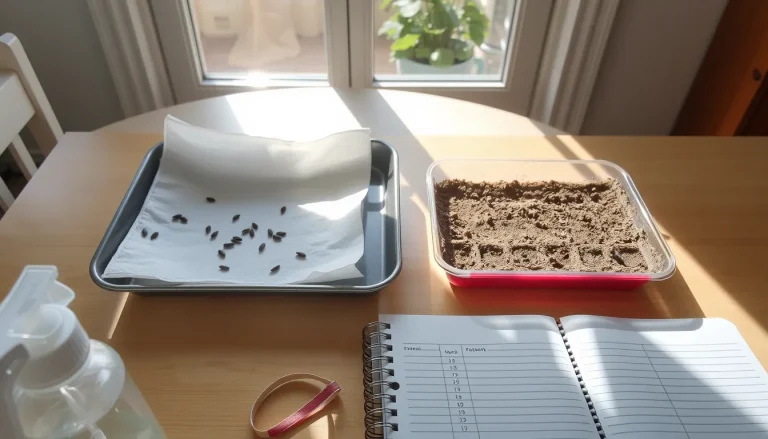
- Place a single layer of damp paper towel in each dish. Use 5 mL of the appropriate water type to moisten the towel; the towel should be wet but not pooling.
- Distribute an equal number of seeds (e.g., 5–7) on each towel, spacing them evenly.
- Cover each dish with its lid or a second tray to retain humidity.
- Place the dishes in a warm, bright location (e.g., a windowsill) but out of direct harsh sunlight.
- Check the dishes daily for 14 days. Each day, add a few drops of the same water type if the towel looks dry.
- Record observations in the data table (see below): note which seeds have emerged, the date of emergence, and seedling height.
- After 14 days, compare the total number of germinated seeds and average growth per water type.
What to Observe or Measure
Two primary outcomes are easy for children to track:
- Germination success: count how many seeds have produced a visible shoot.
- Growth rate: measure the length of the longest seedling in each dish (millimetres or centimetres).
Optional: note any mold or unusual discoloration, which can indicate contamination.
Variables and Controls
- Independent variable: type of water (tap, distilled, salt).
- Dependent variables: number of seeds that germinate, days to germination, seedling height.
- Controlled variables: seed species, number of seeds per dish, paper towel type, temperature, light exposure, amount of water added each day.
- Control group: the distilled‑water dish often serves as a baseline because it lacks added minerals or salts. Some educators also include a “dry” dish to show that water is essential.
Repeated Trials
To see natural variation, repeat the whole set‑up at least once (or use more seeds per dish). Consistent repeats help distinguish a real effect of water type from random differences between individual seeds.
Data Table (Blank)
| Dish | Water Type | # of Seeds | Seeds Germinated | Days to First Germination | Average Seedling Height (mm) |
|---|---|---|---|---|---|
| 1 | Tap | ||||
| 2 | Distilled | ||||
| 3 | Salt (1 %) | ||||
| 4 | Dry (optional control) |
Graphing Your Results
A simple bar graph works well. Plot water type on the horizontal axis and the number of germinated seeds (or average height) on the vertical axis. Color‑code each bar for visual clarity. Online tools such as Google Sheets or a free graphing app can create the chart quickly.
The Science Explained
Water supplies the solvent that carries nutrients into a seed and swells the seed coat so the embryo can emerge. Tap water often contains dissolved minerals like calcium, which can alter the permeability of the seed coat. A study of Hypericum perforatum found that calcium in tap water delayed germination compared with distilled water, suggesting that certain ions can slow the process (source 4).
Salt (sodium chloride) creates an osmotic gradient that pulls water out of the seed, effectively “drying” it and preventing the swelling needed for germination. This is why many experiments, including a classroom lab report, show reduced germination in salty solutions (source 2).
Distilled water lacks minerals and salts, providing a neutral environment that lets the seed absorb water freely. However, some plants benefit from trace minerals, so tap water is not always detrimental. The experiment lets children see these competing influences in real time.
Troubleshooting
- No seeds germinate: Check temperature (most seeds need 20‑25 °C) and ensure the paper towel stays moist but not soggy.
- Mold appears: Reduce excess moisture, improve airflow, or use a fresh paper towel.
- Unequal seed numbers: Count seeds carefully before starting; uneven numbers can skew results.
Next Steps
After analyzing the data, families can explore variations: try different seed species, test other water sources (bottled, rain), or adjust salt concentration. Connecting the findings to real‑world issues—such as why farmers monitor water quality—extends the learning experience.
Related terms
- Germination
- The process by which a seed absorbs water, swells, and begins to grow into a new plant.
- Osmosis
- Movement of water across a membrane from a region of lower solute concentration to higher concentration.
- Distilled water
- Water that has been boiled and condensed to remove minerals and impurities.
- Saline solution
- Water that contains dissolved salt; often used to study the effect of high solute concentration on plants.
Sources & references
- Bubbly Plants | Activity | Education.com, https://www.education.com/activity/article/water-effects-on-plants/
- Germination Lab Report, https://studylib.net/doc/27294870/germination-lab-report-2
- Plants Science Experiments & Teaching How Plants Grow, https://lessons4littleones.com/plants-science-experiments-teaching-how-plants-grow/
- Retarded Germination in the Seed of Hypericum Perforatum Caused by Calcium, http://www.journals.uchicago.edu/doi/10.1086/334636