Overview
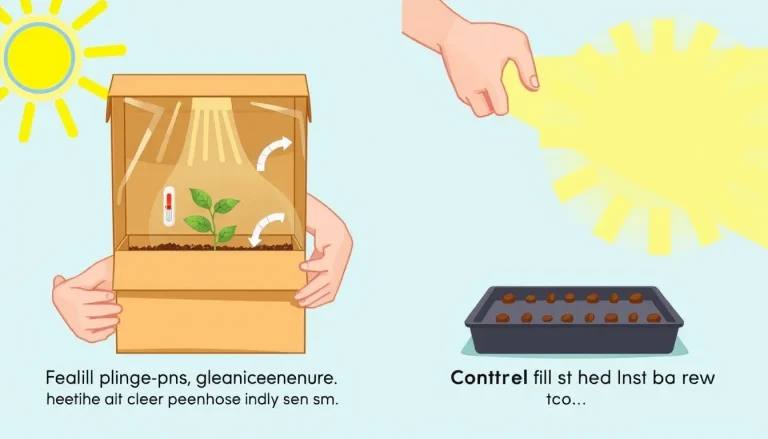
Plants constantly sense their environment and adjust growth accordingly. One of the most visible responses is phototropism – the bending of stems toward a light source. By placing seedlings under cardboard shades that let light in from specific directions, children can watch this response develop and learn why it happens.
Testable Question
Does the direction from which light reaches a seedling affect how much the stem bends and how fast it grows?
Hypothesis
Because auxin (a plant hormone) accumulates on the side of the stem that receives less light, the shaded side will grow faster, causing the stem to bend toward the light. Therefore, seedlings exposed to light from one side will show a measurable bend toward that side, while seedlings receiving light from directly above will grow more upright.
Materials
- 4 small plant containers (e.g., 100 ml plastic cups) with drainage holes
- Potting mix or seed‑starting soil
- Fast‑germinating seeds (e.g., radish, mustard, or bean) – at least 8 seeds per container
- Cardboard sheets (about 30 × 30 cm each)
- Colored construction paper or thin transparent colored plastic (red, blue, yellow – optional, for visual interest)
- Scissors, tape, and a ruler
- Watering bottle or spray bottle
- Notebook or worksheet for recording data
- Protractor (or a printable angle‑measurement sheet)
Before You Begin
- Choose a sunny windowsill or a location with a consistent overhead light source. Natural daylight works best, but a bright desk lamp can be used if sunlight is unavailable.
- Label each container with a letter (A‑D) to keep track of the light direction it will receive.
- Adult supervision is needed for cutting cardboard and handling any sharp tools.
Procedure (Steps)
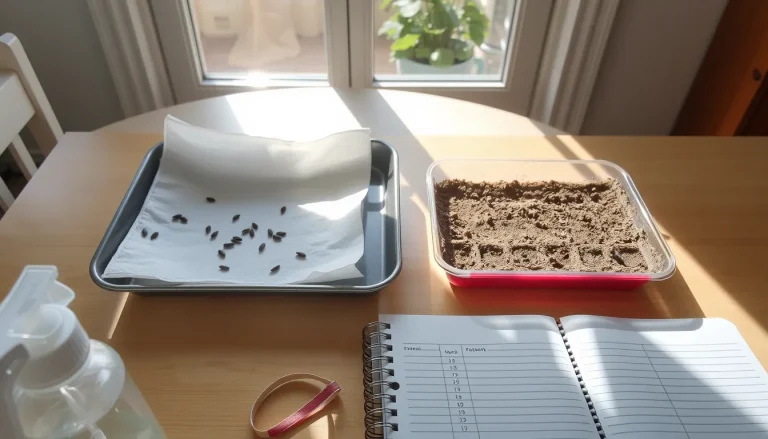
- Prepare the planting pots. Fill each cup with moist seed‑starting soil, leaving about 1 cm of space at the top.
- Sow the seeds. Place 8 seeds evenly on the soil surface of each cup, then cover lightly (≈5 mm) with more soil.
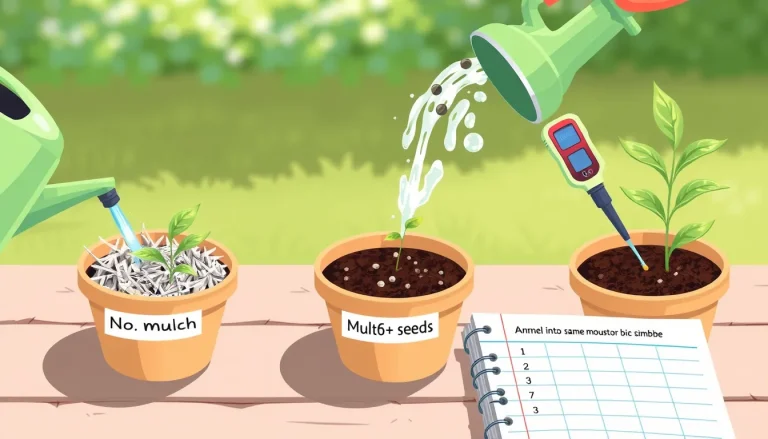
- Water gently. Mist until the soil feels evenly damp but not soggy. Keep soil moist throughout the experiment.
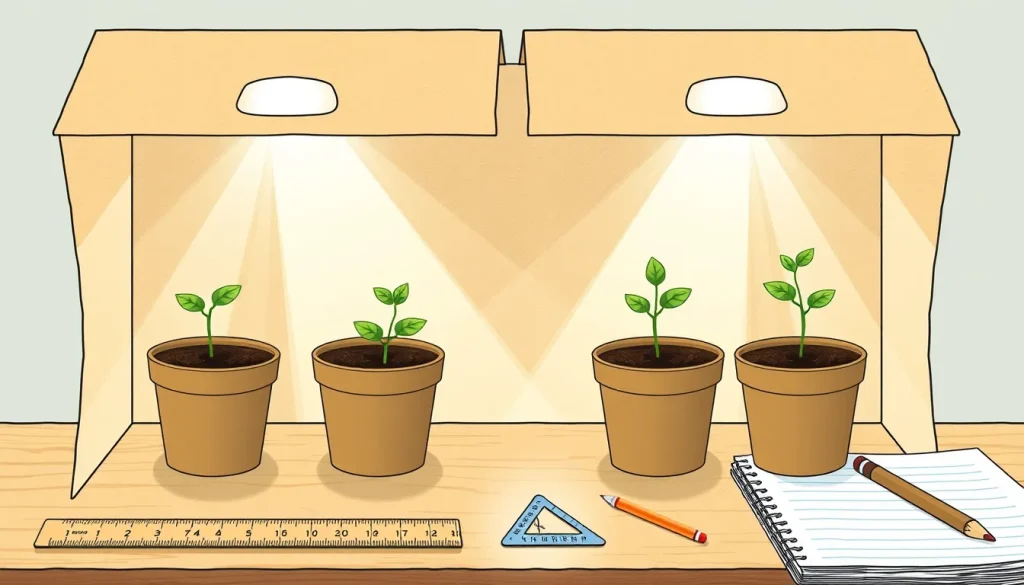
- Construct the cardboard shades. Cut four equal‑sized squares from cardboard. For each shade, cut a single 5‑cm opening on a different side:
- Shade A – opening on the top (light from above)
- Shade B – opening on the left side (light from the left)
- Shade C – opening on the right side (light from the right)
- Shade D – opening on the front (light from the viewer’s direction)
Optional: tape a piece of colored paper over each opening to see how colour influences intensity.
- Place the shades. Position each shade over its corresponding pot, ensuring the opening faces the intended light direction. The cardboard should be tall enough (≈10 cm) to block light from other angles.
- Start the observation period. Record the date and time. Keep the setup undisturbed for the next 5 days.
- Measure daily. Each day, measure:
- Stem length from soil surface to the tip (mm)
- Bending angle: place a ruler vertically next to the seedling and use a protractor to measure the angle between the stem and the vertical line (°). Zero degrees = perfectly upright.
Write the values in the data table (see below).
- Rotate the shades (optional extension). After the first 5 days, rotate each shade 90° and continue measuring for another 5 days to explore how seedlings re‑orient.
- Conclude. After 10 days, compare the final measurements across the four light‑direction groups.
Variables and Controls
- Independent variable: Direction from which light enters the shade (top, left, right, front).
- Dependent variables: Stem length (mm) and bending angle (°) measured each day.
- Controlled variables: Seed type, number of seeds per pot, soil type, watering schedule, ambient temperature, and overall light intensity (same window or lamp for all groups).
- Control group: Shade A (light from directly above) serves as the baseline for comparison because it mimics natural sunlight.
Repeated Trials
To ensure reliability, repeat the entire experiment at least once with a new set of seeds. Record the average of the two runs for each measurement; note any noticeable differences.

What to Observe or Measure
- Qualitative observations: Color of leaves, overall vigor, any wilting, and whether seedlings lean noticeably toward the light source.
- Quantitative measurements:
- Stem length (mm) – measured with a ruler.
- Bending angle (°) – measured with a protractor or printable angle sheet.
Data Table
| Day | Shade A (Top) – Length (mm) | Shade A – Angle (°) | Shade B (Left) – Length (mm) | Shade B – Angle (°) | Shade C (Right) – Length (mm) | Shade C – Angle (°) | Shade D (Front) – Length (mm) | Shade D – Angle (°) |
|---|---|---|---|---|---|---|---|---|
| 1 | ||||||||
| 2 | ||||||||
| 3 | ||||||||
| 4 | ||||||||
| 5 |
Graphing Your Results
Two simple graphs help visualise the data:
- Stem length over time: Plot “Day” on the x‑axis and “Stem length (mm)” on the y‑axis. Use a different coloured line for each shade.
- Bending angle after 5 days: Create a bar chart with “Shade” on the x‑axis and “Angle (°)” on the y‑axis. This directly shows which direction caused the strongest curvature.
Both graphs can be drawn on graph paper or created with a spreadsheet program.
The Science Explained
When a plant receives light from one side, the hormone auxin is redistributed to the darker side of the stem. Auxin promotes cell elongation, so cells on the shaded side grow faster, causing the stem to bend toward the light. This process is called phototropism and is a classic example of how plants use hormones to adapt to their environment [1].
The Oak National Academy curriculum explains that seedlings exhibit a rapid growth response toward bright directional light, driven by auxin gradients [2]. In the experiment, the cardboard shade creates a defined light direction, allowing the auxin‑mediated bending to be observed.
Research on lettuce shows that not only light intensity but also the direction of illumination can alter leaf morphology and stomatal traits [3]. While our seedlings are much younger, the same principle applies: direction influences growth patterns.
Key limits:
- Very low light may not trigger a strong phototropic response.
- Different species vary in sensitivity; fast‑germinating beans show a clear bend, while some shade‑tolerant plants may respond less.
- Temperature and water stress can mask or amplify the bending response.
Troubleshooting
- Seedlings do not bend. Check that the light source is strong enough. Move the setup closer to a sunny window or use a brighter lamp.
- Uneven watering causes wilting. Water just enough to keep soil moist; excess water can drown roots and suppress growth.
- Shades block too much light. Ensure the opening is at least 5 cm wide and not covered by the cardboard’s edge.
- Measurements vary wildly between trials. Keep the ruler and protractor positioned the same way each day; use the same person to measure if possible.
Cleanup and Disposal
After the experiment, compost the seedlings and soil if you have a garden bin, or discard them in the regular trash. Re‑use the cardboard shades for future projects or recycle them. Wash the pots with warm soapy water for later use.
Next Steps
- Test how different colours of the shade (red, blue, yellow) affect the strength of the phototropic response.
- Compare two species side‑by‑side to see which is more light‑sensitive.
- Introduce a second light source from the opposite side after day 5 to observe how seedlings re‑orient.
Sources & references
- Oak National Academy. ‘The effect of light on the growth of seedlings: practical GCSE.’ https://www.thenational.academy/teachers/programmes/biology-secondary-ks4-foundation-aqa/units/plant-growth-and-development/lessons/the-effect-of-light-on-the-growth-of-seedlings-practical
- International Journal of Molecular Sciences. ‘Lighting Direction Affects Leaf Morphology, Stomatal Characteristics, and Physiology of Head Lettuce (Lactuca sativa L.)’ https://pmc.ncbi.nlm.nih.gov/articles/PMC8003708/
- American Society of Plant Biologists. ‘Which Way to Grow? Plant growth and development are under the control of hormones and can be affected by external signals such as light.’ https://aspb.org/wp-content/uploads/2016/05/11_WHICH-WAY-TO-GROW-Growth.pdf