Overview
Plants need light for photosynthesis, but the amount of usable light they receive depends on how far they are from the source. In indoor seed‑starting, growers often keep the light only a few inches above the tray. Research shows that a light 12 inches above a sensor provides only about one‑quarter the light intensity of the same lamp just 2 inches away [1]. This experiment lets children explore the relationship between distance and seedling height.
Testable Question
How does the distance between a light source and a seedling affect the seedling’s height after one week of growth?
Hypothesis
Because light intensity drops sharply with distance, seedlings placed close to the lamp will receive more light, grow more slowly in height, and develop stockier stems. Seedlings farther away will receive less light, stretch upward, and become taller but thinner.
Materials
- Seeds – any fast‑growing variety such as radish, lettuce, or mustard (≈30 seeds)
- Paper plates or shallow trays (one per distance)
- Water (for moistening the paper)
- Cardboard pieces (to build simple risers that hold the lamp at different heights)
- One household lamp – a cool‑white fluorescent or a white LED fixture (the same lamp will be used for all distances)
- Ruler or measuring tape (centimeters or inches)
- Notebook or worksheet for recording data
Before You Begin
- Choose a well‑ventilated workspace with a flat surface.
- Adult supervision is needed for handling the lamp and for any electrical connections.
- Set the lamp on a stable surface and ensure the cord does not pose a tripping hazard.
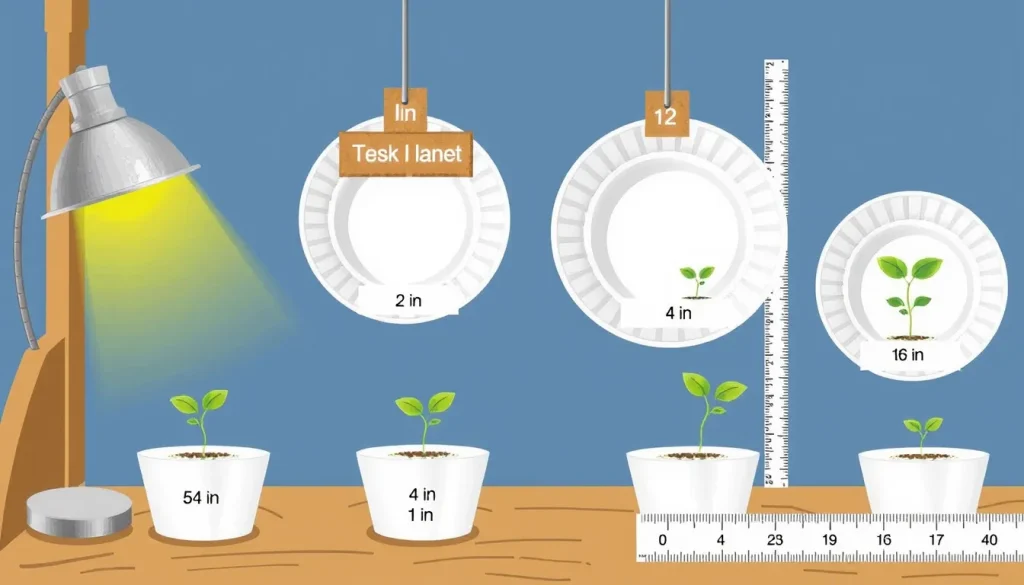
- Decide on the distances you will test. A good range is 2 in, 4 in, 8 in, and 12 in, matching the values discussed in the Purdue study.
Procedure
- Lay a paper plate on the work surface. Moisten the paper with a spray bottle or a few drops of water until it is damp but not soggy.
- Place 5–7 seeds evenly spaced on the damp paper. Cover lightly with a second piece of damp paper if you wish to keep the seeds from moving.
- Label the plate with the distance you will use (e.g., “2 in”).
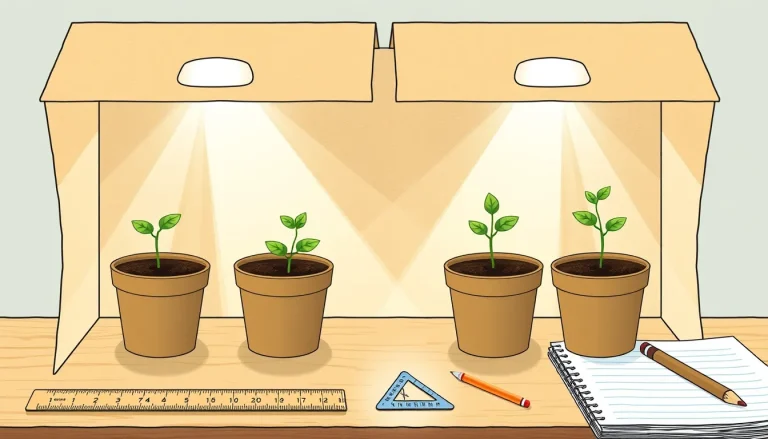
- Build a cardboard riser that positions the lamp at the chosen distance above the seeds. Measure from the top of the lamp to the surface of the paper to confirm the distance.
- Turn the lamp on and set a timer for 14–16 hours of light per day (most seed‑starting guides recommend this range [3]).
- Repeat steps 1‑5 for each distance, using separate plates so that all trays receive light simultaneously.
- Each day, check that the paper stays moist. Add a few drops of water if it begins to dry.
- After seven days, use a ruler to measure the length of each seedling from the base of the cotyledons to the tip of the newest true leaf. Record each measurement.
Variables and Controls
- Independent variable: Distance between the lamp and the seedlings (2 in, 4 in, 8 in, 12 in).
- Dependent variable: Seedling height (mm or cm) after seven days.
- Controlled variables: Seed type, number of seeds per plate, amount of water, lamp type and power, photoperiod (hours of light per day), ambient temperature, and air circulation.
What to Observe or Measure
For each seedling record:

- Date of sowing.
- Distance of the light source.
- Final height (mm or cm) after seven days.
- Qualitative notes – e.g., “stem is thin and weak” or “leaves are dark green.”
Repeated Trials
To reduce random variation, repeat the measurement for at least three seedlings at each distance. You can also repeat the whole set on a second day with a new batch of seeds for greater confidence.
Data Table
| Plate (Distance) | Seedling # | Height (cm) | Notes |
|---|---|---|---|
| 2 in | 1 | ||
| 2 in | 2 | ||
| 2 in | 3 | ||
| 4 in | 1 | ||
| 4 in | 2 | ||
| 4 in | 3 | ||
| 8 in | 1 | ||
| 8 in | 2 | ||
| 8 in | 3 | ||
| 12 in | 1 | ||
| 12 in | 2 | ||
| 12 in | 3 |
Graphing Your Results
Create a simple line graph:
- X‑axis: Light distance (inches).
- Y‑axis: Average seedling height (cm) for each distance.
- Plot a point for each distance and connect them to see the trend.
The graph will usually show height increasing as distance grows, illustrating the inverse relationship between light intensity and stem elongation.
The Science Explained
Light intensity follows the inverse‑square law: when you double the distance from a point source, the intensity falls to one‑quarter. In practice, a lamp 12 in away delivers about 25 % of the light that the same lamp gives at 2 in [1]. Plants use the portion of light called photosynthetically active radiation (PAR) to turn carbon dioxide and water into sugars. When PAR is low, seedlings stretch upward—a response called etiolation—to reach more light. The stretched stems are longer but weaker, and the leaves may be paler. When PAR is high, growth is more compact and stems are sturdier.
Recommended indoor seed‑starting distances echo these findings: fluorescent fixtures are usually placed 4–6 in from seedlings, while LED panels can sit 8–12 in away [3]. Adjusting distance is a quick way to control light intensity without changing lamp power.
Troubleshooting
- Seedlings are not sprouting: Ensure the paper stays moist and that the seeds are not older than one year.
- All seedlings look the same height: Check that the lamp really is at the intended distances; use a ruler to verify.
- Leaves are yellow or scorched: The light may be too close or too hot. Increase the distance or use a fan for air circulation.
- Very tall, thin seedlings at the closest distance: The lamp may be low‑intensity (e.g., a small desk lamp). Try a brighter fixture or move the lamp closer still (e.g., 1 in) to see if the trend reverses.
Next Steps
Once the basic distance‑height relationship is clear, families can extend the investigation:
- Test different light colours (red vs. blue LEDs) to see how spectrum influences height.
- Compare two species (e.g., radish vs. lettuce) to explore species‑specific responses.
- Measure other growth traits such as leaf number or root length.
- Try a reflective surface (aluminum foil) to boost light intensity without moving the lamp.
These follow‑up ideas turn a short experiment into a longer, inquiry‑based project suitable for a science fair.
Related terms
- Photosynthetically Active Radiation (PAR)
- The range of light wavelengths (400–700 nm) that plants can use for photosynthesis.
- Etiolation
- A growth response where a plant becomes elongated and pale when it receives insufficient light.
- Inverse‑square law
- A principle stating that light intensity decreases proportionally to the square of the distance from the source.