Understanding why a plant thrives in one spot but struggles in another is a core question in botany. One of the biggest factors is the type of soil the seedling grows in. This experiment lets children compare three common soil textures—sand, loam (garden soil), and clay—using everyday items. By measuring height, leaf number, and overall vigor, they will see firsthand how soil physical properties shape plant development.
Overview
Plants need water, air, nutrients, and a stable anchorage point. Soil provides these, but not all soils are equal. Sandy soils drain quickly and hold less water, loam offers a balance of drainage and nutrient holding capacity, while clay retains water but can become compacted, limiting root growth. Scientific studies have shown that seedlings of pine, oak, and tropical trees grow differently depending on soil texture and drainage [1], [2], [3], and [4]. This project brings that research into the home or classroom.
Before You Begin
- Choose a sunny window or outdoor spot that receives at least 4–6 hours of direct light each day.
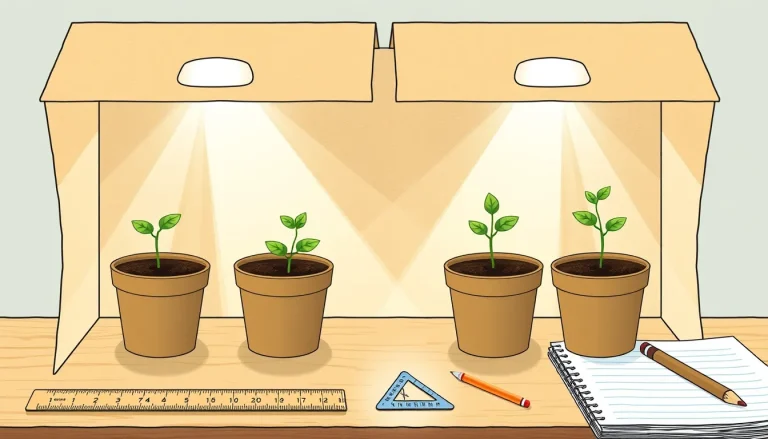
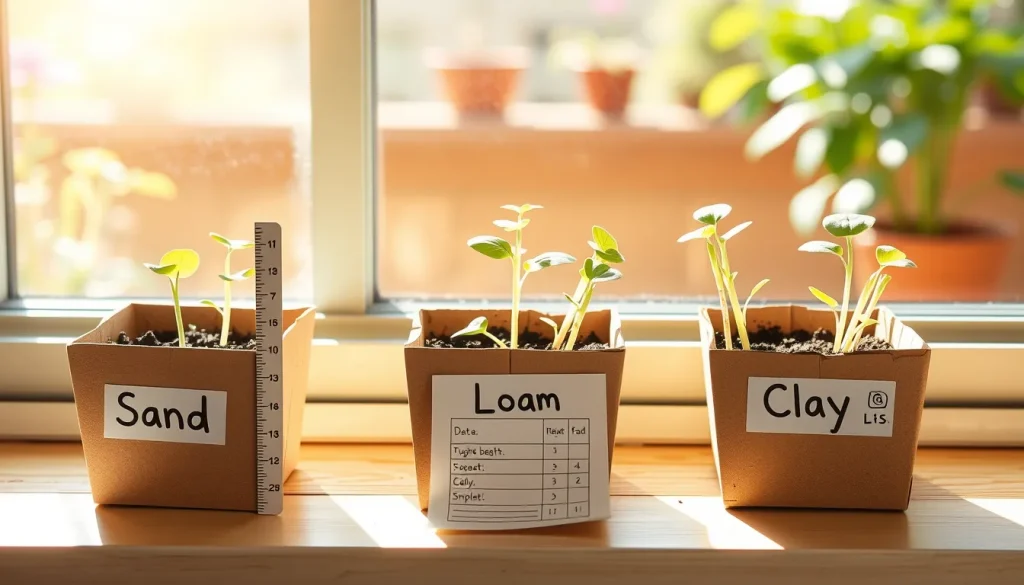
- Gather three identical cardboard containers (e.g., recycled cereal boxes) and cut them into 4‑inch‑deep pots. Make drainage holes in the bottom of each pot.
- Label each pot with a piece of paper: “Sand,” “Loam,” and “Clay.”
- Collect soil samples:
- Sand – from a sandbox, beach, or a bag of horticultural sand.
- Loam – typical garden topsoil from a backyard or a potting mix.
- Clay – heavy garden clay or a commercial clay soil amendment.
- Gather 12–15 fast‑germinating seeds (e.g., radish, beans, or grass). All seeds should be from the same species to keep genetics constant.
- Prepare a small notebook or a printed data table (see below) for daily observations.
Materials
- Cardboard pots (3) – cut to equal size.
- Paper for labels and data table.
- Seeds (same species, 12‑15).
- Sand, loam, and clay (about 2 L each).
- Watering can or spray bottle.
- Ruler or measuring tape (centimeters).
- Optional: kitchen scale to weigh 50 g of each soil type for consistency.
Testable Question
How does soil texture (sand, loam, clay) affect the growth rate of Radish (Raphanus sativus) seedlings over a four‑week period?
Hypothesis
Because loam balances water retention and aeration, seedlings grown in loam will be taller and have more leaves than those in sand (which drains quickly) or clay (which can become water‑logged and compacted).

Variables and Controls
- Independent variable: Soil type (sand, loam, clay).
- Dependent variables: Seedling height (cm), number of true leaves, visual health score (1–5).
- Controlled variables: Seed species, seed quantity per pot, amount of water given each day, light exposure, pot size, and ambient temperature.
- Control group: If desired, a fourth pot filled with a commercial seed‑starting mix can serve as a benchmark, but the experiment works without it.
Steps (Procedure)
- Prepare the pots: Place a layer of small stones or broken pottery (about 1 cm) at the bottom of each cardboard pot for drainage.
- Fill with soil: Add 200 g (≈½ cup) of the designated soil to each pot, gently tamping to a uniform depth. Record the exact weight if using a scale.
- Sow seeds: Make three shallow furrows (≈1 cm deep) in each pot. Place two seeds in each furrow, then cover lightly with the same soil type.
- Water: Moisten each pot with 30 mL of water using a spray bottle to avoid displacing seeds. Allow excess water to drain.
- Label: Attach the paper label to the outside of each pot.
- Place pots: Arrange the three pots side‑by‑side in the chosen sunny location.
- Daily care: Check moisture each morning. If the top 1 cm of soil feels dry, add 10 mL of water. Record the amount added.
- Observe and record: Starting on Day 7, measure seedling height from soil surface to the tip of the highest leaf. Count the number of true leaves (the second set of leaves after cotyledons). Assign a health score: 1 = wilting/dead, 5 = vigorous, green, upright.
- Repeat measurements every 7 days (Day 7, 14, 21, 28). Continue watering as needed.
- Analyze the data after four weeks. Compare average height, leaf count, and health scores across soil types.
What to Observe or Measure
- Height (cm): Use a ruler; record to the nearest millimeter.
- Leaf count: Count only true leaves, not the first cotyledons.
- Health score: Subjective but useful for quick visual comparison.
- Soil moisture (optional): Touch the soil surface; note if it feels dry, moist, or soggy.
Repeated Trials
To account for natural variation, repeat the whole set of three pots at least once (total of six pots). This provides a simple replication and lets children see how results can vary even with the same procedure.
Data Table
| Pot (Soil) | Day | Height (cm) | True Leaves | Health Score (1‑5) |
|---|---|---|---|---|
| Sand | 7 | |||
| Sand | 14 | |||
| Sand | 21 | |||
| Sand | 28 | |||
| Loam | 7 | |||
| Loam | 14 | |||
| Loam | 21 | |||
| Loam | 28 | |||
| Clay | 7 | |||
| Clay | 14 | |||
| Clay | 21 | |||
| Clay | 28 |
Graphing Your Results
Create a simple bar graph for each measurement (height, leaf count, health score). The x‑axis lists the soil types; the y‑axis shows the average value across trials. Bar graphs make it easy to see which soil supported the tallest seedlings. Spreadsheet programs or free online graph tools work well.
Why Soil Type Matters – The Science Explained
Soil texture determines two key physical properties:
- Water holding capacity: Clay particles are tiny and hold water tightly, while sand particles are large and let water drain quickly. Too much water (clay) can suffocate roots; too little (sand) can dry them out.
- Aeration and root penetration: Roots need air spaces to breathe. Very compacted clay reduces air pockets, whereas sand provides more pore space but less stability.
These properties affect nutrient availability because nutrients dissolve in water. In sand, nutrients can leach away; in clay, they may stay bound but become inaccessible if roots cannot grow.
Research on Pinus ponderosa seedlings showed that sand‑rich soils limited growth under simulated drought, while loam‑like mixtures supported better height and biomass [1]. A study of swamp chestnut oak seedlings found that both soil type and drainage influenced first‑year height, with poorly drained soils reducing growth [2]. Even subtle differences in organic matter, calcium, and magnesium—often linked to texture—correlate with “good” versus “poor” seedling performance in tropical forests [4]. Your experiment mirrors these findings on a small scale.
Troubleshooting
- Seeds not germinating: Verify seed viability by doing a quick germination test on a damp paper towel. If few sprout, try fresh seeds.
- Potatoes become soggy: Clay soils may retain excess water; reduce watering volume or increase drainage holes.
- Seedlings tip over: Ensure pots are stable and not placed on a slanted surface. Adding a light stake (e.g., a thin wooden skewer) can help.
- Unequal lighting: Rotate pots weekly so each side receives similar sun exposure.
Next Steps and Extensions
- Test the effect of adding organic compost to each soil type.
- Measure root length by gently washing seedlings out of the pot at the end of the experiment.
- Compare two different plant species (e.g., beans vs. radish) to see if species‑specific preferences exist.
- Investigate how soil pH influences growth by adding a small amount of garden lime (to raise pH) or sulfur (to lower pH) to separate pots.
Cleanup
Dispose of used soil in the garden or compost bin. Cardboard pots can be recycled. Store any remaining seeds in a dry, sealed container for future projects.
Sources & references
- Lindsey AJ, Kilgore JS. Soil type affects Pinus ponderosa var. scopulorum seedling growth in simulated drought experiments. Applied Plant Science. 2013;1(8):apps.1300031. https://pmc.ncbi.nlm.nih.gov/articles/PMC4103451/
- Hook DD. Influence of Soil Type and Drainage on Growth of Swamp Chestnut Oak (Quercus michauxii) Seedlings. US Forest Service Research Note SE-106. 1969. https://research.fs.usda.gov/treesearch/2768
- Smith DS, Schweitzer JA, Turk P, et al. Soil-mediated local adaptation alters seedling survival and performance. Plant Soil. 2011. https://jan.ucc.nau.edu/~shuster/isopod/Pubs/SmithetalPlantSoildoi.pdf
- Anonymous. Soil factors affecting growth of seedlings in logged-over tropical lowland forest in Pasoh, Negeri Sembilan, Malaysia. CGSpace. 2001. https://hdl.handle.net/10568/18405