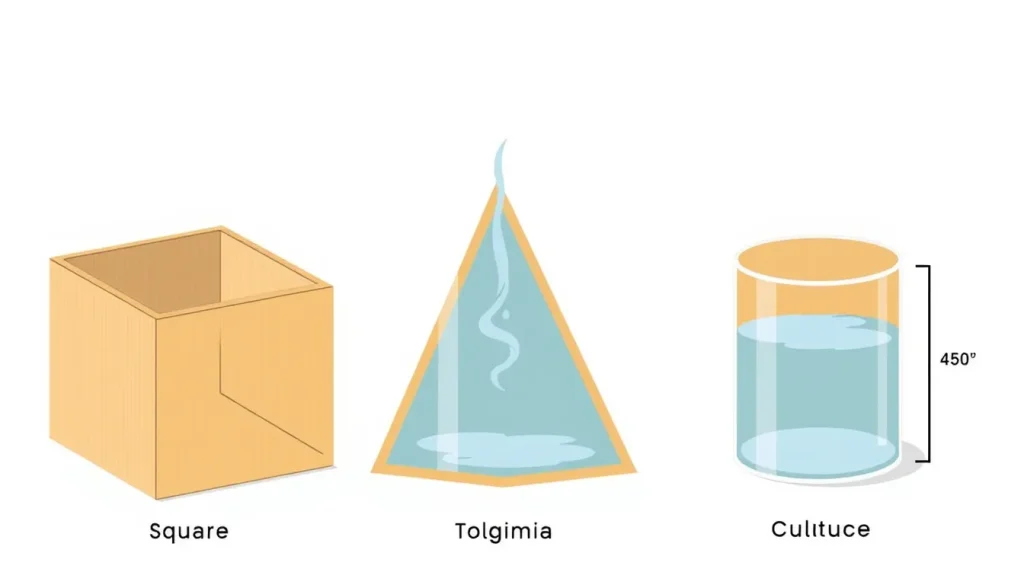
In this hands‑on experiment families can find out which geometric shape—square, triangular or cylindrical—makes a cardboard tube strongest when the tube is filled with water. By keeping the length, wall thickness and amount of cardboard identical, the only change is the cross‑sectional shape. The water inside provides a steadily increasing load, so the tube’s failure point tells us how much weight each shape can support.
Before You Begin
- Choose a well‑ventilated workspace and protect the surface with a plastic sheet or old newspaper.
- Adult supervision is required when cutting cardboard and handling large volumes of water.
- Gather all materials before you start so the procedure remains consistent.
Materials
- Stiff single‑wall cardboard (e.g., a cereal box) – enough for three tubes of equal length (about 30 cm each).
- Ruler or measuring tape.
- Utility knife or scissors (adult use only).
- Masking or duct tape.
- Measuring cup or graduated cylinder (capacity ≥ 2 L).
- Large clear container to catch overflow water.
- Scale (optional) for confirming water weight (1 mL ≈ 1 g).
- Marker for labeling tubes.
Testable Question
Which shape of cardboard tube—square, triangular or cylindrical—can support the greatest weight of water before it buckles?
Hypothesis
Because a cylinder has no flat sides that can bow outward, it should distribute the compressive load more evenly and therefore hold more water than the square or triangular tubes [2].
Variables and Controls
| Variable | Description |
|---|---|
| Independent | Cross‑sectional shape of the tube (square, triangle, cylinder). |
| Dependent | Water volume at the moment the tube collapses (millilitres). |
| Controlled | Cardboard type, tube length (30 cm), wall thickness, fill rate (≈ 100 mL min⁻¹), water temperature (room temperature), and measurement method. |
Steps
- Make the three tube shapes.
- Square tube: Cut a 30 cm × 30 cm square of cardboard, roll it so the edges meet, and tape the seam.
- Triangular tube: Cut an equilateral‑triangle strip whose sides are 30 cm, roll it into a triangle, and tape the seam.
- Cylindrical tube: Roll the cardboard into a tight cylinder about 30 cm long and tape the seam.
Ensure each tube uses the same amount of cardboard (same total surface area). Mark each tube with its shape.
- Set up the test station. Place a sturdy stand (e.g., a wooden block) so the tube’s open ends face upward. Position the measuring cup above the tube.
- Fill the tube. Slowly pour water into the tube at a steady rate (about 100 mL per minute). Keep an eye on the tube as the water rises.
- Record the failure point. When the tube buckles or the walls collapse, stop filling immediately. Note the water volume shown on the cup. If the tube leaks before buckling, record the volume at the first leak.
- Reset and repeat. Empty the tube, dry the cardboard, and repeat the test two more times for the same shape. Then move on to the next shape and repeat the three‑trial sequence.
Repeated Trials
Perform three independent trials for each shape. Averaging the three results reduces random error and gives a more reliable comparison.

Data Table
| Trial | Shape | Length (cm) | Volume at Failure (ml) | Observation |
|---|---|---|---|---|
| 1 | Square | 30 | ||
| 2 | Square | 30 | ||
| 3 | Square | 30 | ||
| 1 | Triangle | 30 | ||
| 2 | Triangle | 30 | ||
| 3 | Triangle | 30 | ||
| 1 | Cylinder | 30 | ||
| 2 | Cylinder | 30 | ||
| 3 | Cylinder | 30 |
What to Observe or Measure
- Exact water volume when the tube first shows a visible bulge or collapse.
- Location of failure (mid‑section, near an end, or at a seam).
- Any cracking or tearing of the cardboard before buckling.
- Whether the tube leaks water before it buckles (indicates a weak seam).
The Science Explained
When a tube is loaded from the top, the water exerts a compressive force on the walls. If the walls are flat (as in a square or triangular tube) they tend to bow outward under the load—a failure mode called buckling. A cylinder’s curved surface resists this sideways deformation because every point on the wall is already oriented to share the load evenly [2]. The same principle was demonstrated in paper‑tube tests, where a cylindrical roll held over a kilogram of water while square and triangular tubes failed at much lower loads [1]. The curvature eliminates flat panels that can act as weak spots, so the cylinder can carry a larger axial load before buckling.
Troubleshooting
- Tube leaks before buckling. Check the seam; reinforce with extra tape or use a thin strip of cardboard to seal.
- Unequal amount of cardboard. Weigh each cut piece before rolling; trim excess so all three tubes have the same mass.
- Water spills onto the floor. Place a tray beneath the stand to catch overflow.
- Rapid filling causes splashing. Reduce the fill rate to about 50 mL min⁻¹ for more precise observations.
Next Steps
After identifying the strongest shape, children can explore design improvements: add internal ribs, increase wall thickness, or use double‑layered cardboard. Comparing the results with those from paper tubes (see sources) reinforces how material and geometry together determine structural strength.
Related terms
- Buckling
- A failure mode where a structural member bends sideways under compressive load, common in slender columns.
- Load distribution
- The way a force is spread across a structure; even distribution reduces stress concentrations.
- Compressive strength
- The capacity of a material or shape to withstand forces that try to crush it.
Sources & references
- Building Bridges – The Science of Beams, https://www.thenakedscientists.com/get-naked/experiments/building-bridges-science-beams
- Which Shape Holds the Most Weight?, https://seriouslyscientific.com/puzzles/which-shape-holds-the-most-weight/
- Strong Paper Structure – DiscoverE, https://discovere.org/engineering-activities/strong-paper-structure/
- Can Paper Hold Your Weight – Science Fun, https://www.sciencefun.org/kidszone/experiments/can-paper-hold-your-weight-engineering-science-experiment/