Overview
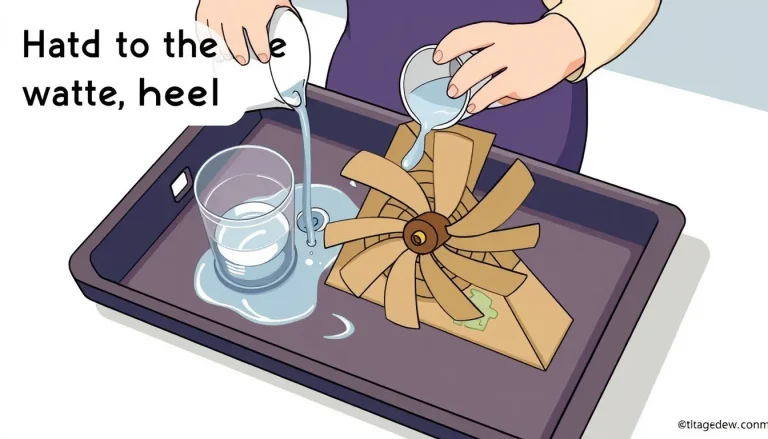
This experiment lets children discover how the shape of a rotor influences the way a paper helicopter falls. By constructing three helicopters that are identical in size, weight, and paper type but have 2, 3, or 4 rotor blades, learners can compare stability – the tendency to spin straight down without wobbling.
Before You Begin
- Choose a well‑ventilated, clutter‑free area where a paper helicopter can fall safely from a height of about 1.5 m (a kitchen counter, stair step, or balcony).
- Adult supervision is required for cutting paper and handling scissors.
- Gather a timer (phone timer works) and a ruler for measuring drop height.
Materials
- Standard printer paper or newspaper (A4 or Letter size) – 3 sheets per helicopter design.
- Three small paper clips (or binder clips) – one per helicopter to act as a weight.
- Scissors (child‑safe if needed).
- Pencil or pen for marking circles.
- Ruler (centimetre markings).
- Stopwatch or phone timer.
- Sticky‑backed tape or a small piece of cardboard to mark a consistent drop point.
Step‑by‑Step Procedure
- Draw the rotor body. Using a pencil and ruler, draw a 6 cm outer circle on a sheet of paper. Inside it, draw a 2 cm centre circle. Cut out the shape.
- Repeat three times – one for each blade count.
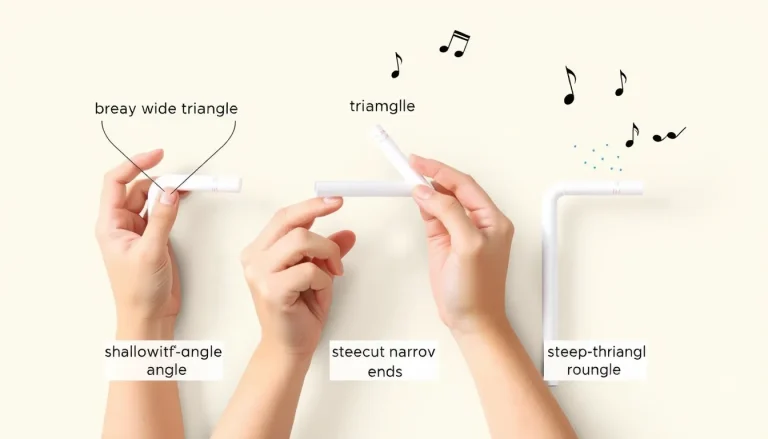
- Create the blades. From the outer edge to the centre circle, cut straight “spokes” that become blades. Make:
- Two evenly spaced blades (120° apart).
- Three evenly spaced blades (120° apart).
- Four evenly spaced blades (90° apart).
Keep each blade the same width (≈1 cm) and length so the total material is comparable.
- Fold the blades slightly. Fold each blade upward about 2 mm to give it a slight camber. This encourages spinning.
- Attach the weight. Slip one paper clip onto the centre circle of each helicopter. Make sure the clip hangs straight down and does not touch the blades.
- Label the helicopters. Write “2‑blades”, “3‑blades”, and “4‑blades” on the back of each for easy identification.
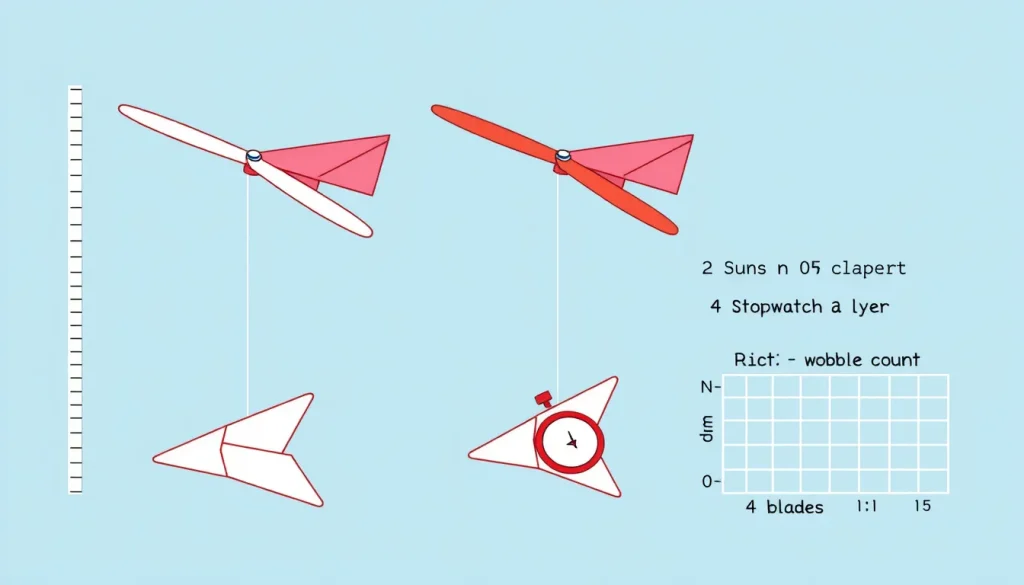
- Set up the drop. Measure a vertical drop height of 150 cm from a stable surface. Mark the release point with a small piece of tape.
- All three helicopters must be released from the same height.
- Perform a trial. Hold a helicopter just above the marked point, release it without pushing, and start the timer.
- Observe the descent for wobble, sideways drift, and overall straightness.
- Stop the timer when the helicopter touches the floor.
- Record observations. Use the data table below to note:
- Descent time (seconds).
- Number of visible wobble cycles (count each side‑to‑side swing).
- Horizontal drift (measure distance from a vertical line drawn on the floor, in cm).
- Repeat. Perform at least three trials for each blade count, re‑folding the blades each time to ensure consistency.
- Analyze. Average the measurements for each design and compare stability indicators.
What to Observe or Measure
Stability can be expressed with three simple metrics:
- Descent time – longer times often indicate smoother, more stable spin.
- Wobble count – each complete side‑to‑side swing is a wobble. Fewer wobbles mean greater stability.
- Horizontal drift – measure how far the landing point is from the vertical line directly under the release point. Smaller drift equals higher stability.
Testable Question
How does increasing the number of rotor blades (2, 3, 4) affect the stability of a paper helicopter as measured by wobble count, drift distance, and descent time?
Hypothesis
Because additional blades create more aerodynamic surface area, the helicopter should generate more lift and spin more evenly. Therefore, the 4‑blade design is expected to have the longest descent time, the fewest wobble cycles, and the smallest horizontal drift.
Variables and Controls
| Variable | Type | How It Is Handled |
|---|---|---|
| Number of blades | Independent | 2, 3, 4 blades per design |
| Descent time, wobble count, drift | Dependent | Measured with timer and ruler |
| Paper type, size, weight | Controlled | Same sheet, same cut dimensions for all helicopters |
| Weight (paper clip) | Controlled | One identical clip per helicopter |
| Drop height | Controlled | Fixed at 150 cm for every trial |
| Release technique | Controlled | Gentle hand release without push |
Repeated Trials
Repeating each design three times reduces random error and shows whether any observed pattern is consistent. Record each trial separately before calculating averages.
Data Table (blank for use)
| Trial | Blade Count | Descent Time (s) | Wobble Cycles | Drift (cm) |
|---|---|---|---|---|
| 1 | ||||
| 2 | ||||
| 3 | ||||
| 4 | ||||
| 5 | ||||
| 6 |
Graphing Your Results
Two simple bar graphs work well:
- Average Descent Time vs. Blade Count – X‑axis: blade count (2, 3, 4); Y‑axis: seconds.
- Average Wobble Count vs. Blade Count – same axes, Y‑axis showing wobble cycles.
Plotting drift distance on a separate graph helps visualise sideways stability.
The Science Explained
When a paper helicopter falls, two forces act on it:
- Gravity pulls it straight down.
- Air resistance (drag) pushes upward on the rotating blades.
Each blade works like a tiny wing. As the helicopter spins, the air hits the blade surfaces at an angle, creating lift that opposes gravity. More blades mean more surface area for lift, which can slow the fall and smooth the spin. However, adding blades also adds weight (if the paper mass changes) and can increase turbulence, potentially causing wobble if the blades are not perfectly balanced.
In a perfectly balanced rotor, the lift from each blade is equal, producing a steady, straight descent. If one blade is slightly larger or folded differently, the lift becomes uneven, and the helicopter begins to wobble or drift sideways. By keeping the size of each blade identical and the paper weight constant, the experiment isolates the effect of blade count alone.
Troubleshooting
- Helicopter spins too fast and crashes quickly. Try folding the blades a little more (increase camber) or add a slightly heavier paper clip.
- Excessive wobble on a particular design. Check that all blades are cut to the same length and folded equally. Small differences cause imbalance.
- Helicopter drifts far from the drop line. Ensure the release is vertical; a push in any direction will add horizontal velocity.
Next Steps
After analysing the data, children can extend the investigation by changing other variables – blade width, overall rotor diameter, or the weight of the paper clip. Comparing results helps solidify the idea that stability is a balance of lift, drag, and mass.
For more ideas on paper helicopter designs, see the Royal Air Force Museum’s helicopter templates and the Little Bins for Little Hands guide, which also discuss how blade shape influences flight time.
Sources & references
- Paper Rotor Blade Count Test | Kids Activity | Southfolk, https://southfolk.com.au/activity/paper-rotor-blade-count-test/
- Paper Helicopter STEM Activity (2 Flying Designs + Template), Little Bins for Little Hands, https://littlebinsforlittlehands.com/paper-helicopter/
- Paper Helicopters, Royal Air Force Museum, https://www.rafmuseum.org.uk/documents/Cosford/Educational-Visits/Online_Resources/FamilyResources/RAFMHelicopters.pdf