Orientation
This project lets children explore how the shape of a boat’s hull determines how much cargo it can carry. Using only kitchen aluminum foil, scissors, a water container, and small metal weights (pennies or paper clips), learners design three different hulls, test their load capacity, and explain the results.
Before You Begin
- Choose a clean, flat work surface and protect it with newspaper or a disposable tablecloth.
- Gather a small clear container (a glass or plastic tub) that can hold at least 1 L of water.
- Adult supervision is needed for cutting foil and handling any sharp objects.
Materials
- Aluminum kitchen foil – 3 sheets, each about 30 cm × 30 cm (one per hull design).
- Scissors.
- Ruler (optional, for measuring dimensions).
- Clear shallow container or tub (≈20 cm × 20 cm × 10 cm).
- Water.
- Pennies, metal washers, or paper clips – enough for at least 30 g of weight.
- Science notebook or worksheet for recording data.
Design Constraints and Success Criteria
Constraints
- Only the provided foil may be used for the hull; no additional supports (e.g., tape) are allowed.
- Each boat must be built from a single 30 cm square of foil.
- The boat must sit upright in the water without tipping over before any cargo is added.
Success Criteria
- Boat stays afloat after being placed in the water.
- Boat carries the greatest possible weight (measured in pennies) before sinking or capsizing.
- Learner can explain why one shape performed better than the others.
Steps (Engineering Challenge Procedure)
- Predict: Before building, discuss with the child which hull shape might hold the most pennies and why.
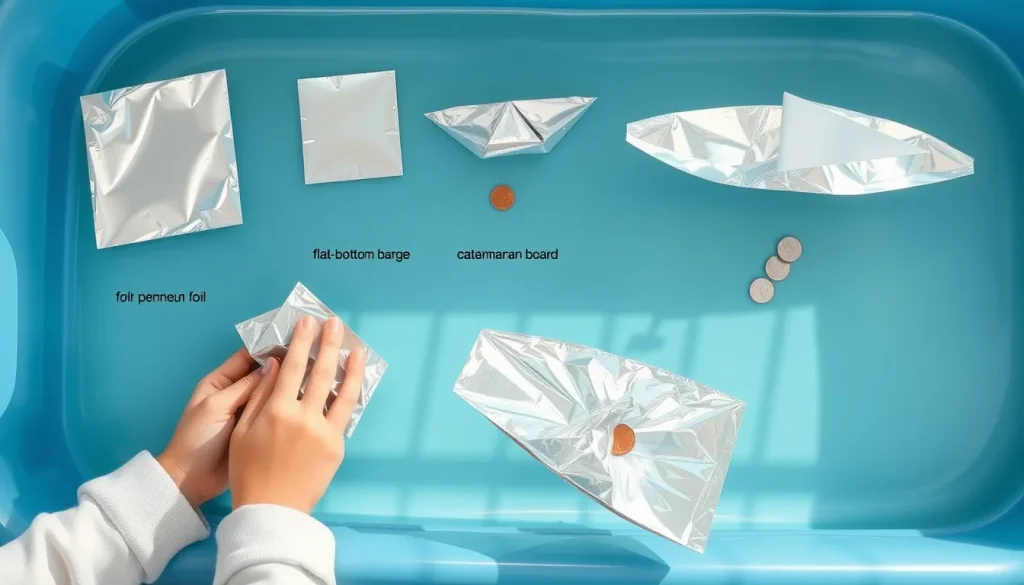
- Build three hulls using the same foil size:
- Flat‑bottom barge: Fold the foil into a rectangular box with low walls (≈2 cm high) and a wide floor (≈12 cm × 12 cm).
- Deep narrow hull: Fold a longer, narrower box with higher walls (≈4 cm high) and a smaller floor area (≈8 cm × 8 cm).
- Catamaran: Fold two parallel narrow hulls connected by a thin deck, resembling a twin‑hull boat.
These shapes follow the examples described by NOAA and HiWave makers, which show that hull geometry changes capacity and stability[1][2].
- Label each boat with a marker or a tiny piece of tape so you can track results.
- Test flotation: Gently place each boat in the water. If a boat sinks immediately, reshape it to meet the upright constraint.
- Load cargo: Starting with the flat‑bottom barge, add pennies one at a time to the center of the boat. After each addition, watch the water level and note any tilting.
- Record the number of pennies the boat carries before it begins to sink or tip.
- When the boat fails, gently remove the last penny that caused failure and note the total successful load.
- Repeat the loading process for the deep narrow hull and the catamaran, using a fresh set of pennies for each.
- Perform at least two trials per hull shape to see how consistent the results are.
- Record data in the table below (see “Data Table” section).
- Analyze: Compare the maximum loads for each shape. Discuss why the flat‑bottom barge usually carries the most weight, why the deep hull may sink earlier, and why the catamaran stays stable but may hold less cargo.
- Redesign (optional): Using the observations, modify one hull to improve its performance and retest.
What to Observe or Measure
- Number of pennies carried – count each penny added before failure.
- Boat behavior – note whether the boat sinks, fills with water, or capsizes (rolls over).
- Draft – optional measurement of how deep the hull sits in water after each penny (use a ruler).
All observations should be written in the notebook with the hull name, trial number, and any qualitative comments (e.g., “water leaked into side wall”).
Data Table
| Hull Shape | Trial # | Pennies Carried (g) | Failure Mode | Notes |
|---|---|---|---|---|
| (Enter your data here) | ||||
The Science Explained
Buoyancy is the upward force that water exerts on an object. An object floats when the weight of the water it displaces equals its own weight. The amount of water displaced depends on the submerged volume of the hull. A wide, flat‑bottom hull displaces a large volume of water even when only a little weight is on board, so it can support more cargo before sinking[1].
Stability concerns whether a boat stays upright. A deep, narrow hull may have a low center of gravity but a small surface area, so it can tip more easily when weight is added off‑center. A catamaran has two separate hulls; the distance between them provides a wide “beam,” which resists rolling, but each hull is small, limiting total displacement[2].
These principles explain the patterns you will see: the flat‑bottom barge often carries the most pennies, the deep hull may fill with water or sink quickly, and the catamaran stays level but holds less total weight.
Troubleshooting
- Boat sinks immediately: Check for holes or sharp creases that let water in. Smooth out any sharp folds and ensure walls are sealed.
- Boat capsizes when a penny is added: Place the penny in the center of the boat. If it still tips, the hull may be too narrow; try widening the deck or adding a small “keel” (a thin strip of foil along the bottom).
- Weight count seems inconsistent between trials: Make sure each trial starts with a fresh, dry boat and that the water level is the same each time.
Try Another Version
After mastering the three basic shapes, challenge the child to create a hybrid hull (e.g., a shallow barge with a small raised keel) or to experiment with different foil thicknesses. Record whether the new design improves load capacity or stability.
Cleanup and Disposal
- Collect all foil pieces and recycle them if your local program accepts metal‑coated paper.
- Dispose of used pennies in a coin jar; they can be returned to circulation.
- Wipe the water container and work surface with a damp cloth.
Next Steps
Use the data to create a simple bar graph comparing the three hulls, or write a short report describing which design you would choose for a real‑world boat and why. This extends the engineering challenge into a communication exercise, reinforcing both scientific reasoning and writing skills.
Related terms
- Buoyancy
- The upward force that a fluid exerts on an object, equal to the weight of the fluid displaced by the object.
- Displacement
- The volume of water pushed aside by an object when it is placed in the water.
- Stability
- The ability of a boat to remain upright and resist rolling or capsizing when weight is added.
Sources & references
- National Oceanic and Atmospheric Administration, “Build a boat,” https://www.noaa.gov/office-education/outreach-communication/hands-on-science-activities/build-a-boat
- HiWave Makers, “Boat Hull Design Experiment: Which Shape Carries More,” https://hiwavemakers.com/blog/hull-shapes-which-boat-carries-the-most-cargo/
- BestExperimentIdeas, “Does the shape of a boat hull change how much cargo it carries?” https://bestexperimentideas.com/projects/does-the-shape-of-a-boat-hull-change-how-much-cargo-it-carries