Overview
Many children wonder whether adding a little sugar to a seed’s water will make it grow faster. The idea sounds plausible—plants need energy, and sugar is a source of that energy. In reality, the effect depends on the amount of sugar and how it changes the water’s ability to move into the seed. This project lets you and your child test the question with a controlled experiment.
Testable Question
Does the concentration of sugar in water affect how quickly a seed germinates?
Hypothesis
Write a prediction before you begin. For example: “I think a low concentration of sugar (2 % w/v) will make seeds sprout faster than plain water, but a high concentration (6 % w/v) will delay germination because the solution will be too salty for the seed to absorb water.”
Before You Begin
- Choose a quiet, well‑lit workspace where the trays can stay undisturbed for several days.
- Adult supervision is needed for measuring and handling hot water (if you choose to dissolve sugar in warm water).
- Gather all materials before starting so you can keep conditions consistent across treatments.
Materials
- Seeds – 20 – 30 of the same type (e.g., chia, radish, or bean). Small, fast‑germinating seeds work best for a short project.
- Distilled or tap water.
- Granulated white sugar (sucrose).
- Measuring cup or graduated cylinder.
- Digital kitchen scale (optional, for precise sugar amounts).
- Four shallow transparent dishes or petri dishes (one for each sugar concentration).
- Paper towels (plain, unbleached). Cut to fit the bottom of each dish.
- Permanent marker and labels.
- Ruler or caliper (for measuring radicle length, optional).</n
- Notebook or printable data sheet (see below).
Materials (Taxonomy)
For the project’s classification, the core materials are Seeds, Water, and Paper.
Steps
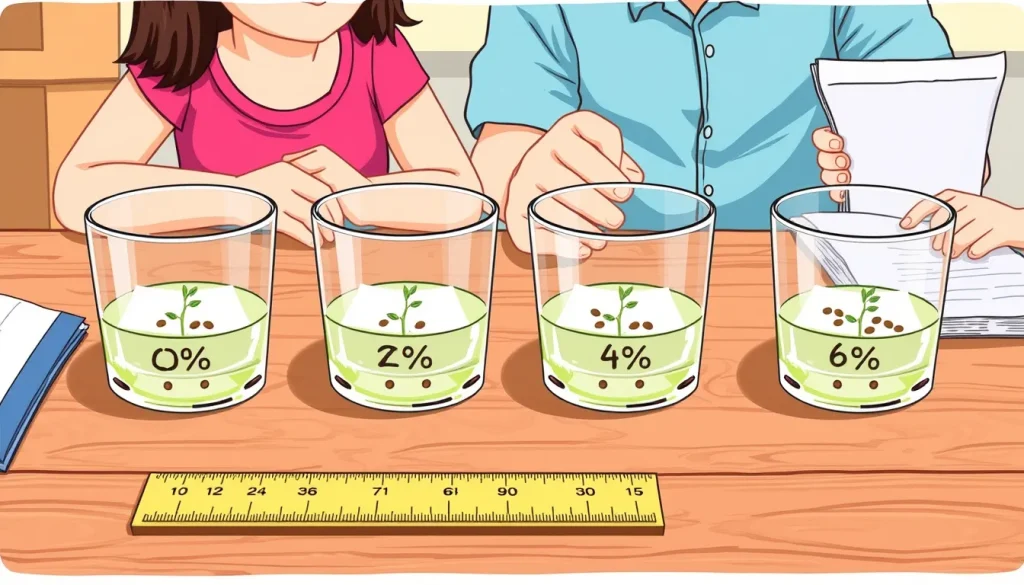
- Prepare sugar solutions. Fill four identical dishes with 100 mL of water each. Add sugar to three dishes to make 0 % (no sugar), 2 % (2 g sugar per 100 mL), 4 % (4 g/100 mL), and 6 % (6 g/100 mL) solutions. Stir until dissolved. Use warm water to speed dissolution, then let the solutions return to room temperature.
- Label the dishes. Write the concentration on the outside of each dish (e.g., “0 %”, “2 %”, “4 %”, “6 %”).
- Lay the paper towels. Place a single layer of paper towel in each dish, making sure it contacts the liquid.
- Place the seeds. Evenly distribute the same number of seeds (e.g., five) on each paper towel. Try to spread them out so they don’t touch each other.
- Cover (optional). If you live in a dry climate, loosely cover each dish with a clear plastic lid or another dish to reduce evaporation while still allowing light.
- Record the start time. Note the date and time you began the experiment.
- Observe daily. Each day, check the seeds and record any that have produced a visible radicle (the first root). Note the time (in days) when each seed first shows a radicle.
- Maintain moisture. If the paper towel looks dry, add a few drops of the same sugar solution to keep it moist—but do not flood the seeds.
- Finish the trial. Continue observations for at least 10 days or until all seeds have germinated or clearly stopped growing.
- Clean up. Dispose of the used paper towels in the compost or trash, rinse dishes, and store any remaining sugar solution for later use.
Variables and Controls
- Independent variable: Sugar concentration in the water (0 %, 2 %, 4 %, 6 %).
- Dependent variable: Time (in days) until each seed shows a radicle – i.e., germination time.
- Controlled variables: Seed species and batch, number of seeds per dish, temperature (room temperature, ~20‑22 °C), light exposure, amount of water, and type of paper towel.
- Control group: The 0 % sugar dish provides the baseline for comparison.
Repeated Trials
To reduce random error, repeat the whole setup at least once more (a total of two independent experiments). Each repeat should use fresh seeds and freshly prepared solutions. Consistent results across repeats strengthen the conclusion.
What to Observe or Measure
- Germination day: Record the day number when each seed first shows a radicle.
- Percentage germinated: After 10 days, calculate the proportion of seeds that germinated in each treatment.
- Radicle length (optional): Use a ruler to measure the length of the emerging root; this can indicate vigor.
Data Table
| Trial | Dish (Sugar %) | Seed # | Germination Day | Radicle Length (mm) (optional) |
|---|---|---|---|---|
| 1 | 0 % | 1 | ||
| 1 | 0 % | 2 | ||
| 1 | 0 % | 3 | ||
| 1 | 0 % | 4 | ||
| 1 | 0 % | 5 | ||
| 1 | 2 % | 1 | ||
| 1 | 2 % | 2 | ||
| 1 | 2 % | 3 | ||
| 1 | 2 % | 4 | ||
| 1 | 2 % | 5 | ||
| 1 | 4 % | 1 | ||
| 1 | 4 % | 2 | ||
| 1 | 4 % | 3 | ||
| 1 | 4 % | 4 | ||
| 1 | 4 % | 5 | ||
| 1 | 6 % | 1 | ||
| 1 | 6 % | 2 | ||
| 1 | 6 % | 3 | ||
| 1 | 6 % | 4 | ||
| 1 | 6 % | 5 |
Graphing Your Results
When the data are collected, create a bar chart that shows the average germination day for each sugar concentration. The x‑axis will list the four concentrations (0 %, 2 %, 4 %, 6 %). The y‑axis will show “Average Days to Germination”. Error bars (standard deviation) can be added if you have multiple trials.
The Science Explained
Seeds begin germination through imbibition – the rapid uptake of water. Water moves into the seed because the inside of the seed has a lower water potential than the surrounding solution. Adding sugar to the water lowers the solution’s water potential (it makes the water “less thirsty”). At low sugar levels the change is small, so water can still enter the seed, and the sugar can serve as an immediate carbon source once the seed’s metabolism activates. At higher sugar levels the water potential may become so low that water cannot enter the seed efficiently, delaying or even preventing germination.1
Research on chia seeds showed that a 2 % sucrose solution sometimes speeds germination compared with plain water, whereas 6 % sucrose slowed it down dramatically because the solution became too hypertonic2. Another study on a tropical grass (Brachiaria) reported that certain sugar priming concentrations improved early seedling vigor, but the effect depended on the species and the exact concentration4. The UCSB Science Line answer similarly notes that high sugar concentrations can inhibit sprouting by reducing water potential1. In short, a little sugar may help, but too much can hinder the seed’s ability to take up water.
Troubleshooting
- No seeds germinate in any dish: Check that the seeds are viable (try a fresh batch). Ensure the paper towel stays moist and that the room temperature is within the optimal range for the species.
- Only the 0 % dish shows germination: The sugar solutions may be too concentrated. Prepare a new set with lower concentrations (e.g., 1 % and 3 %).
- Fungal growth on paper towels: Use sterilized paper towels or add a few drops of a mild antifungal (e.g., a dilute hydrogen peroxide solution). Keep dishes covered but with airflow.
- Uneven seed spacing: Seeds that touch each other can compete for water, making timing harder to compare. Gently spread them apart before the solution is added.
Cleanup and Disposal
Dispose of used paper towels in the compost bin if they contain only seed and sugar residue, or in regular trash if compost is not available. Rinse dishes with water and set them aside for future use. Store any leftover sugar solution in a sealed container for up to a week, or discard it down the drain.
Next Steps
After completing this experiment, try varying another factor, such as temperature, light exposure, or using a different type of sugar (e.g., honey or corn syrup). Comparing those results can deepen understanding of how seeds sense and respond to their environment.
Related terms
- Imbibition
- The process by which a dry seed absorbs water, swelling and activating metabolic processes.
- Water potential
- A measure of the tendency of water to move from one area to another; lower (more negative) potential means water moves less readily.
- Radicle
- The first part of a seedling's root that emerges during germination.
Sources & references
- UCSB Science Line. "Does sugar inhibit seed sprouting?" https://scienceline.ucsb.edu/getkey.php?key=1346
- Cheung, M., Payombarnia, A., Shadravan, S. "Using Sugar as a Germination and Growth Promoter of Salvica Hispanica Seeds". The Expedition. https://ojs.library.ubc.ca/index.php/expedition/article/view/195676
- Barbosa Batista, T., Duarte Cardoso Binotti, E., et al. "Priming of Brachiaria Seeds with Different Sugar Sources and Concentrations". SciELO Brazil. http://www.scielo.br/j/rcaat/a/kRBK6vmMMFQCfNrgTLBV9wL/?lang=en