Overview
Cardboard is a cheap, everyday material that many of us use for boxes, crafts, and even makeshift coolers. Because it contains a lot of trapped air, cardboard slows the flow of heat. In engineering, the same idea is used in insulated containers, building walls, and clothing. This experiment asks a simple, testable question: How does the thickness of cardboard affect its ability to keep a hot bottle warm? By wrapping a bottle of hot water with one, two, three, or more layers of cardboard and measuring how quickly the water cools, children can see the physics of heat transfer in action.
Before You Begin
- Adult supervision: Handling very hot water (around 80 °C/176 °F) can cause burns. An adult should heat the water, pour it, and supervise the whole activity.
- Workspace: Use a stable table, a heat‑resistant mat, and keep the area free of clutter.
- Safety gear: Have a kitchen towel or heat‑proof gloves handy for moving the bottle.
Materials
- One reusable plastic or stainless‑steel bottle (500 mL–1 L) with a tight‑fitting lid.
- Hot water (about 80 °C). Boil water on the stove or in an electric kettle, then let it sit a minute before pouring.
- Cardboard sheets of different thicknesses:
- Single‑ply corrugated (≈2 mm)
- Double‑ply (≈4 mm)
- Triple‑ply or two sheets glued together (≈6 mm)
- Scissors or a craft knife.
- Measuring tape or ruler.
- Masking tape or rubber bands to hold the cardboard in place.
- Digital thermometer or a temperature sensor that can record in °C (a Vernier sensor works well, as used in Vernier’s insulated bottle experiment).
- Stopwatch or a phone timer.
- Notebook or spreadsheet for recording data.
Testable Question
How does the number of cardboard layers (thickness) affect the rate at which a hot bottle of water loses heat?
Hypothesis
Because thicker cardboard provides more material for heat to travel through, we predict that each additional layer will slow the cooling rate, so the bottle wrapped in three layers will stay hotter longer than the one with one layer.
Variables and Controls
| Variable | Details |
|---|---|
| Independent | Number of cardboard layers (1, 2, 3, …) |
| Dependent | Temperature change of the water over time (°C) |
| Controlled |
|
Procedure (Steps)
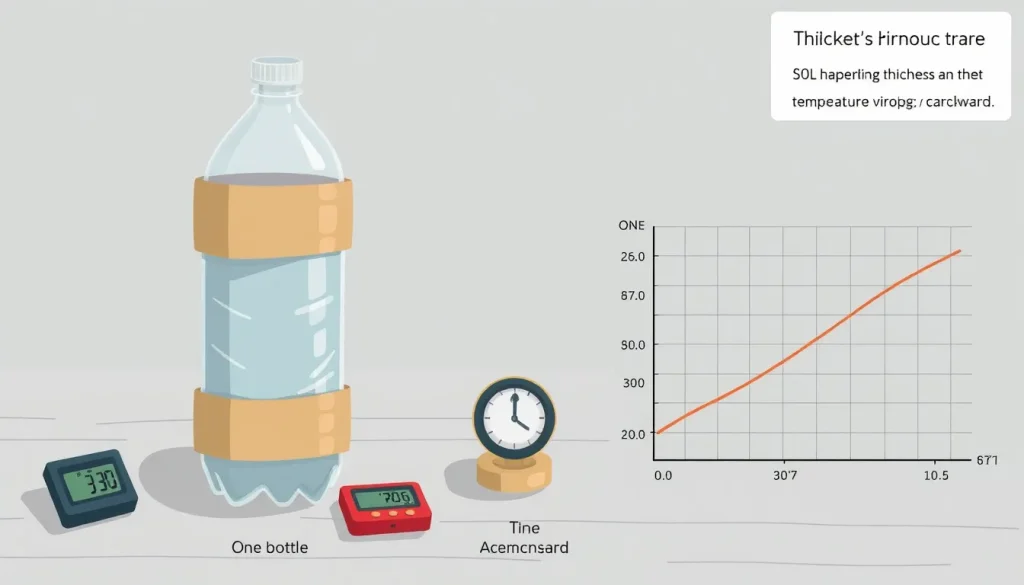
- Label three cardboard pieces as “1‑layer,” “2‑layers,” and “3‑layers.” Cut each piece so it can fully wrap the bottle with a little overlap.
- Measure 500 mL of water and heat it to about 80 °C (use a kitchen thermometer).
- Quickly pour the hot water into the bottle, seal the lid, and record the exact temperature (T₀).
- Wrap the bottle with the designated cardboard layer(s). Secure the wrap with tape or a rubber band so it stays in place but does not compress the cardboard (compression would change thickness).
- Start the timer. Record the water temperature every minute for 15 minutes (or until the temperature drops by at least 20 °C). Write the time‑temperature pairs in your notebook.
- After the trial, let the bottle cool to room temperature, then discard the cardboard (or reuse for the next trial). Repeat steps 2‑5 for each thickness, performing at least three independent trials per thickness to capture variability.
What to Observe or Measure
- Start temperature (°C) for each trial.
- Temperature at 1‑minute intervals for the full observation period.
- Any noticeable gaps, air pockets, or compression in the cardboard wrap.
Repeated Trials
Perform a minimum of three trials for each cardboard thickness. Repeating the test reduces random error (such as slight differences in initial temperature) and lets you calculate an average cooling curve for each condition.

Data Table (Blank)
| Trial | Layers | Time (min) | Temperature (°C) |
|---|---|---|---|
| 1 | 1 | 0 | |
| 1 | 1 | 1 | |
| … | … | … | |
| 1 | 3 | 15 | |
| 2 | 1 | 0 | |
| 2 | 1 | 1 | |
| … | … | … | |
| 3 | 3 | 15 |
Graphing Your Results
Use a line graph:
- X‑axis: Time (minutes)
- Y‑axis: Temperature (°C)
- Plot a separate line for each cardboard thickness. The steeper the line, the faster the cooling.
- Optionally, add error bars that show the standard deviation of the three trials.
Comparing the slopes lets you see quantitatively how each extra layer slows heat loss.
The Science Explained
Heat moves from a hot object to its cooler surroundings by three mechanisms: conduction (through solid material), convection (through moving air or liquid), and radiation (infrared energy). In this experiment, the dominant path is conduction through the cardboard and the thin layer of air trapped inside it. Fourier’s law of conduction states that the heat‑flow rate (Q) is inversely proportional to the material’s thickness (L):
Q = k·A·(ΔT)/L
where k is the material’s thermal conductivity, A the area, and ΔT the temperature difference between the hot water and the room air. As L (the total cardboard thickness) increases, the denominator grows, so fewer joules of heat escape each second. This relationship is exactly what the GCSE lesson on insulation thickness demonstrates [3]. Cardboard’s low conductivity (mainly because it is full of air pockets) makes it a decent insulator, but adding more layers simply adds more air‑filled distance for the heat to cross.
Vernier’s “Insulated Cola Bottle” activity also asks students to compare materials and layer numbers, reinforcing that thicker insulation reduces the temperature change [2]. The “Keep It Hot!” activity from Teach Engineering notes that engineers use similar principles when designing thermos bottles, houses, and appliances [1]. Your experiment is a miniature model of those real‑world designs.
Troubleshooting
- Temperature drops too quickly: Check for gaps or loose tape; any exposed area lets heat escape faster.
- Inconsistent initial temperatures: Use the same kettle and let the water sit the same amount of time before each pour.
- Thermometer drift: Calibrate the sensor against ice water (0 °C) and boiling water (100 °C) before starting.
Try Another Version
Once you have the cardboard data, extend the investigation by swapping one of the layers for a different material—aluminum foil, Styrofoam, or a thin fabric. Compare how a reflective surface (foil) or a very low‑conductivity foam changes the cooling curve. This mirrors the multi‑material comparison in the Vernier experiment.
Cleanup and Disposal
- Recycle the cardboard according to local guidelines.
- Wipe the thermometer with a soft cloth and store it safely.
- Empty any remaining water from the bottle and let the bottle air‑dry.
Next Steps
Discuss how the principle you observed applies to everyday life: insulated lunch boxes, building insulation, and even space suits. You could also calculate the thermal resistance (R‑value) of each cardboard thickness using the slope of your cooling curves, linking the experiment to real engineering design calculations.