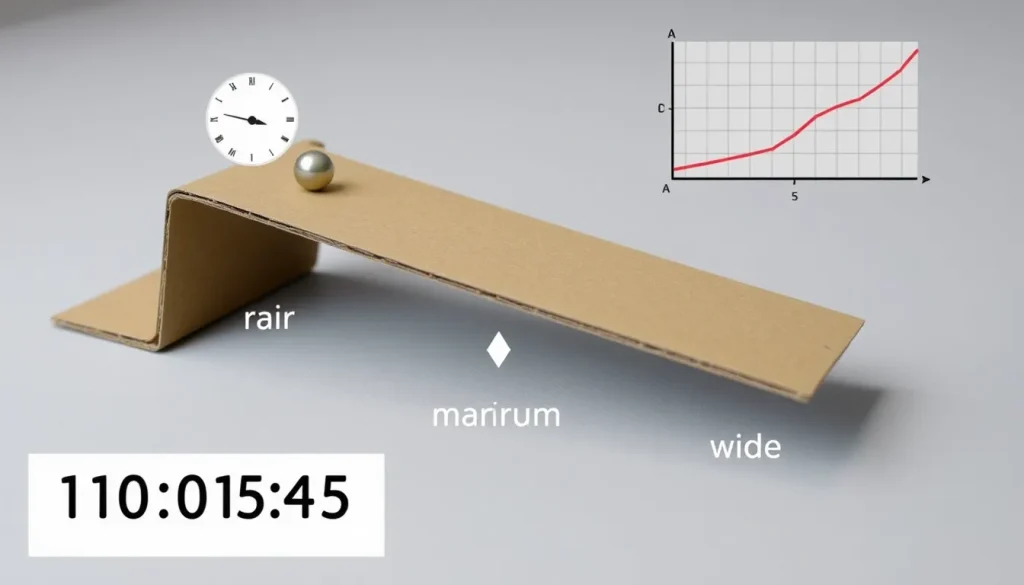
This experiment lets kids discover whether a wider or narrower cardboard ramp makes a ball roll faster. By changing the distance between the side rails of an inclined track, they can see how the geometry of the path influences rolling speed, and they practice measuring, graphing, and explaining the results.
Testable Question
How does the width of a cardboard ramp affect the speed of a rolling metal ball measured at the bottom of the ramp?
Hypothesis
Because a narrower ramp restricts the ball’s side‑to‑side motion, it should experience less wobble and lower rolling resistance, resulting in a higher speed at the bottom. Conversely, a very wide ramp may let the ball wobble or bounce, reducing speed.
Materials
- Sturdy cardboard sheet (minimum 60 cm × 30 cm)
- Two wooden or thick paper strips (5 cm × 30 cm) to act as side rails
- Metal ball or marble (diameter 1–2 cm)
- Protractor or angle‑measuring app
- Ruler or tape measure
- Stopwatch (smartphone timer works)
- Binder clips or tape to hold the rails in place
- Notebook or worksheet for recording data
Before You Begin
- Clear a flat work surface and protect it with a sheet of newspaper.
- Adult supervision is recommended for cutting cardboard and handling clips.
- Check that the ball rolls freely on a flat surface before starting.
Variables and Controls
- Independent variable: Width of the ramp (distance between side rails). Test at least three widths, e.g., 4 cm, 8 cm, and 12 cm.
- Dependent variable: Time for the ball to travel a fixed 30‑cm segment measured at the bottom of the incline.
- Controlled variables: Ramp angle (keep constant), ball type, surface texture of the cardboard, ambient lighting (so the timer can see the ball), and release method (hold the ball at the same starting line each trial).
Procedure (Steps)
- Set the cardboard on a sturdy table and prop one end with a stack of books so the incline angle is about 20° (measure with a protractor).
- Attach the two side rails with binder clips or tape, leaving a measured gap between them (the first width you will test).
- Mark a start line 5 cm up the ramp and a finish line 35 cm down the ramp – the distance between them is 30 cm.
- Place the ball behind the start line, hold it gently, and release without pushing.
- Start the stopwatch as the ball passes the start line and stop it when the ball crosses the finish line. Record the time to the nearest 0.01 s.
- Repeat steps 4–5 three times for the same width and calculate the average time.
- Increase (or decrease) the rail gap to the next test width, re‑secure the rails, and repeat steps 3–6.
- After all widths are tested, compile the average times for each width.
What to Observe or Measure
- Measured time (seconds) for the 30‑cm segment.
- Any wobbling, slipping, or jumping of the ball as it rolls.
- Consistency of the release point – note if the ball starts higher or lower than intended.
Repeated Trials
Perform three trials per width and use the average to reduce random error. If the three times differ by more than 0.2 s, repeat until the data are consistent.

Data Table
| Ramp Width (cm) | Trial 1 (s) | Trial 2 (s) | Trial 3 (s) | Average (s) |
|---|---|---|---|---|
Graphing Your Results
Create a simple line graph:
- X‑axis: Ramp width (cm)
- Y‑axis: Average time (s) – lower values mean higher speed.
- Connect the points to see the trend. A downward‑sloping line would support the hypothesis that a narrower ramp yields faster motion.
The Science Explained
When a ball rolls without slipping, its kinetic energy is divided between translation (moving forward) and rotation (spinning). The relationship is
v = r ω, where v is linear speed, r the ball radius, and ω the angular speed.
Friction between the ball and the surface provides the torque that makes the ball spin. If the ball wobbles side‑to‑side, extra friction is generated, converting translational energy into heat and slowing the ball.
Research on a similar “multi‑slotted” track found that the width of the slot (analogous to our ramp width) directly influences the ball’s speed at the lower part of the track, with narrower slots producing higher speeds because the ball stays centered and experiences less lateral motion [1]. The same principle applies here: a tighter side‑rail spacing keeps the ball’s path straight, reducing rolling resistance.
Conversely, a very wide ramp allows the ball to drift, increasing the chance of slipping or bouncing, which dissipates energy. This effect is consistent with classic observations that balls on an incline can roll, slide, or skip depending on surface constraints [2].
Troubleshooting
- Ball slips instead of rolls: Reduce the incline angle or use a smoother cardboard surface.
- Inconsistent times: Ensure the release point is the same each trial; use a small piece of tape to mark the exact start position.
- Ball jumps off the rails: Decrease the ramp angle or choose a slightly narrower width to keep the ball guided.
Next Steps
Kids can extend the investigation by varying the ramp angle, trying balls of different sizes or materials, or measuring the distance traveled after the ball leaves the ramp (projectile motion). Each extension adds a new independent variable and deepens the connection between geometry, friction, and motion.
Related terms
- inclined plane
- A flat surface tilted relative to the horizontal, used to study how gravity causes objects to roll or slide down.
- rolling resistance
- The frictional force that opposes the rolling motion of a wheel or sphere, often caused by deformation of the surface or the object.
- rotational kinetic energy
- The energy an object has because it is spinning, calculated as (1/2) I ω² where I is the moment of inertia.
Sources & references
- Marín Ladino, L. A. (2020). Rolling sphere along an inclined multi‑slotted track. Physics Education. https://doi.org/10.1088/1361-6552/ab6e02
- Gluck, P. (2005). Balls on an incline roll, slide and skip. Physics Education, 40, 206. https://doi.org/10.1088/0031-9120/40/3/f03