Overview
Radishes ( Raphanus sativus ) are fast‑growing root vegetables that respond quickly to changes in soil moisture. Because they sprout in just a few days, they are ideal for classroom or home investigations that last one to two weeks. This project asks a simple, testable question: How does the amount of water given each day affect the growth rate of radish seedlings? By comparing three watering regimes—low, medium, and high—students can see quantitative differences in shoot length, leaf count, and overall health.
Before You Begin
- Age range: 6 – 14 years (younger children should have adult help with measuring water and handling sharp tools).
- Time frame: About 10 days of observation after seed germination, plus 30 minutes of set‑up.
- Workspace: A sunny windowsill or a grow‑light area with a flat surface for the trays.
- Safety: Use child‑safe scissors or a hobby knife to cut cardboard containers. Wash hands after handling soil.
Materials
| Item | Quantity / Size |
|---|---|
| Radish seeds (Cherry Belle or similar) | 1 packet (≈30 g) |
| Water | 1 liter (for measuring) |
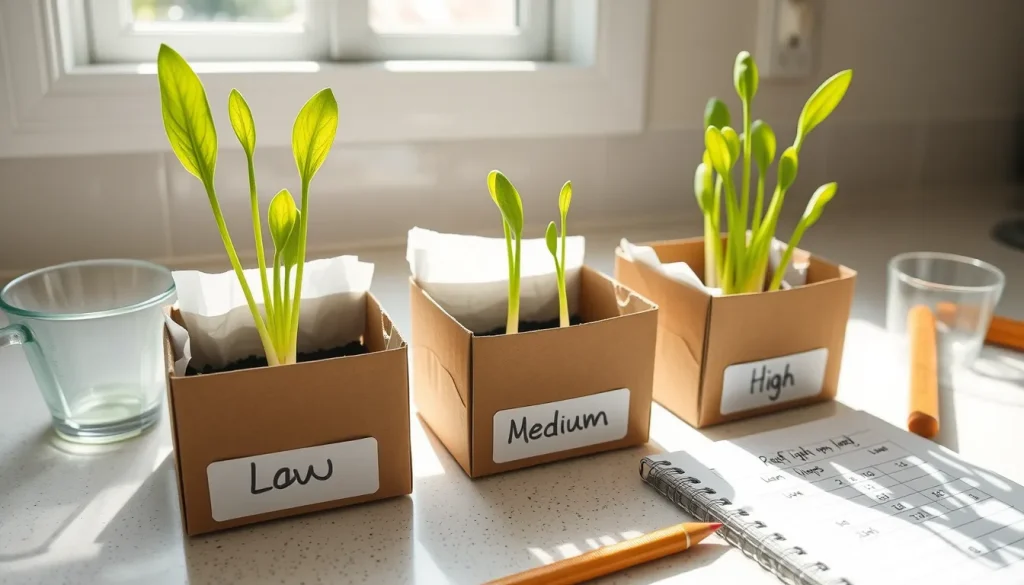
| Cardboard boxes or trays (e.g., shoe boxes) | 3 units, each ≈15 cm × 10 cm × 5 cm |
| Paper towels or newspaper (for lining) | Enough to line each box |
| Potting soil or garden compost | ~2 L total |
| Measuring cup or graduated cylinder | 10 mL increments |
| Ruler or measuring tape (cm) | 1 unit |
| Label stickers or masking tape | 3 pieces |
| Notebook or data sheet | 1 per group |
All items are everyday household or classroom supplies. Cardboard and paper are listed in the taxonomy as the primary reusable materials.
Testable Question
What is the effect of daily water volume on the growth rate (shoot length) of radish seedlings over a 10‑day period?
Hypothesis
Because plants need water to transport nutrients but can suffer from both drought and water‑logging, we predict that a moderate amount of water each day will produce the tallest and healthiest seedlings, while the low‑water group will be stunted and the high‑water group may show wilting or slower growth due to excess moisture.
Variables and Controls
- Independent variable: Daily water volume (e.g., 5 mL, 15 mL, 30 mL per pot).
- Dependent variable: Shoot length measured in centimeters each day.
- Controlled variables: Seed variety, soil type, pot size, light exposure, ambient temperature, and the number of seeds per pot (use three seeds per container and thin to the strongest seed after germination).
- Control group: The medium‑water treatment (often close to the amount recommended for radish seedlings) serves as the baseline for comparison.
Procedure (Steps)
- Prepare containers: Line each cardboard box with a sheet of paper towel to reduce water loss. Label the boxes “Low”, “Medium”, and “High”.
- Fill with soil: Add potting soil to a depth of 5 cm, lightly tamping to remove large air pockets.
- Sow seeds: Place three radish seeds evenly spaced on the soil surface of each box. Cover with a thin layer (≈1 cm) of soil.
- Initial watering: Give each box 10 mL of water to moisten the soil evenly. This is not counted as a treatment dose.
- Set daily watering schedule: Using the measuring cup, add the assigned water volume to each box every 24 hours. Record the date, time, and exact volume in the data sheet.
- Maintain environment: Place the boxes on a sunny windowsill where they receive 6–8 hours of light daily, or use a grow‑light set to a 14‑hour photoperiod.
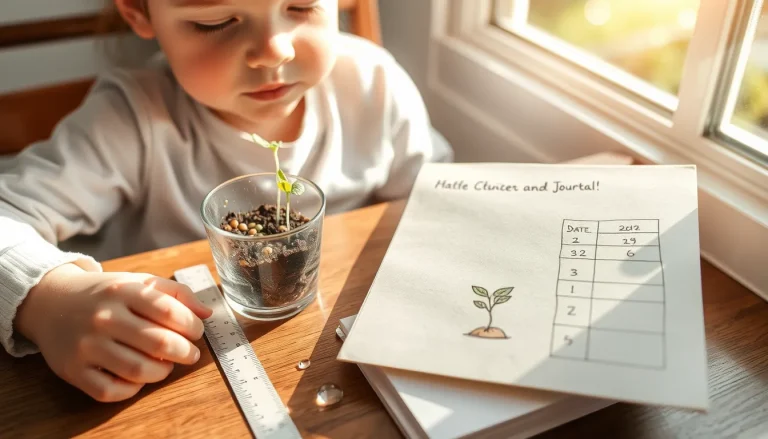
- Observe and measure: Starting on Day 3 (when seedlings are visible), measure the tallest shoot in each box with a ruler. Record the length to the nearest millimeter.
- Thin seedlings (optional): If more than one seedling emerges, keep the strongest and gently remove the others to keep plant density consistent.
- Continue for 10 days: Repeat watering and measurement each day. Note any visual signs of wilting, yellowing, or fungal growth.
- Wrap up: On Day 10, take a final measurement, photograph each box, and compare the three treatments.
What to Observe or Measure
- Shoot length (cm): Measure from the soil surface to the tip of the longest leaf.
- Leaf count: Count the number of true leaves on the tallest seedling.
- General vigor: Note any signs of drooping, discoloration, or mold.
- Soil moisture feel: Gently press the soil; it should feel moist but not soggy in the medium group.
Repeated Trials
To capture natural variation, repeat the entire experiment at least once with a new set of seeds. Each trial should use fresh soil and the same watering volumes. Comparing two or three trials will reveal whether patterns are consistent or if outliers occurred.
Recording Data (Data Table)
| Day | Low (5 mL) – Length (cm) | Medium (15 mL) – Length (cm) | High (30 mL) – Length (cm) |
|---|---|---|---|
| 1 | |||
| 2 | |||
| 3 | |||
| … | |||
| 10 |
Leave the cells blank for students to fill in during the experiment.
Graphing Your Results
When the data are complete, create a line graph:
- X‑axis: Day (1–10).
- Y‑axis: Shoot length (cm).
- Plot three separate lines, each labeled with its water treatment.
- Look for trends: steeper slopes indicate faster growth.
Bar charts can also be used to compare final shoot lengths across treatments.
The Science Explained
Water is the medium through which nutrients travel from soil to plant cells. When soil moisture is low, the plant experiences drought stress: the relative water content (RWC) of leaves drops, photosynthesis slows, and growth is inhibited. Zhang et al. (2009) showed that radish seedlings reduce chlorophyll and respiration when soil water falls below a critical threshold, yet they can tolerate a modest drought of 20‑25 % relative moisture【2】. Conversely, excess water can fill soil pores with air‑displacing water, limiting oxygen to roots and encouraging fungal growth. The medium‑water treatment usually supplies enough water to keep leaf water potential (ψw) within a range that supports normal cell expansion, while the low and high treatments push the plant toward stress conditions.
Temperature also interacts with water availability. Recent modeling work by Khan et al. (2022) used hydro‑thermal time equations to predict radish germination under varying water potentials, confirming that below a base water potential (ψb) germination slows dramatically【4】. Although our experiment focuses on seedling growth rather than germination, the same principle applies: adequate water potential is required for cell elongation.
Troubleshooting
- Seedlings not sprouting by Day 3: Check that the soil is moist enough after the initial watering. If dry, add a small amount of water (≈5 mL) to each box.
- Wilting in the high‑water group: Reduce the daily volume by 5 mL or improve drainage by poking a few holes in the bottom of the cardboard box.
- Mold on the soil surface: Remove the moldy top layer with a clean spoon and decrease watering frequency.
- Inconsistent measurements: Measure the same seedling each day and use the same ruler edge (e.g., the 0 cm mark on the table).
Extending the Project
Older students can explore additional variables such as:
- Different soil types (sand vs. compost).
- Adding a small amount of biochar, as studied by Botts (2015), to see if water retention changes growth patterns【1】.
- Temperature variations using a simple heating mat.
These extensions turn the activity into a multi‑factor experiment, suitable for a science fair.
Cleanup and Disposal
When the investigation ends, compost the used soil and plant material if a compost bin is available; otherwise place them in the green waste bin. Cardboard containers can be recycled. Rinse measuring tools and store them for future projects.
Next Steps
Encourage children to compare their findings with published data on radish water needs, discuss why the medium water amount performed best, and brainstorm how the same principle applies to garden vegetables or houseplants.
Related terms
- Relative Water Content (RWC)
- The amount of water in a leaf compared to its fully hydrated state; lower RWC indicates drought stress.
- Water Potential (ψ)
- A measure of the energy status of water in soil or plant tissue; water moves from higher to lower ψ.
- Hydro‑thermal Time Model
- A mathematical model that predicts seed germination timing based on temperature and water potential.
Sources & references
- Botts, D. (2015). An Assessment into the Effect of Water and Biochar on the Growth of Cherry Belle Radishes. University of Missouri. https://wakefieldbiochar.com/wp-content/uploads/2020/06/Assessment-of-Water-and-Biochar-on-Cherry-Belle-Dakota-Botts.pdf
- Zhang, L. et al. (2009). The Effects of Soil Moisture Content on Physiological Characteristics of Radish Seedling Leaves. Northern Horticulture. https://en.cnki.com.cn/Article_en/CJFDTOTAL-BFYY200904025.htm
- All‑Science‑Fair‑Projects.com (n.d.). Radish Growth and Daily Water Volume. https://www.all-science-fair-projects.com/project1263_details.html
- Khan, J. et al. (2022). Modeling the upshots of induced temperature and water stress on germination and seedlings length of radish via hydrothermal time model. https://air.unimi.it/retrieve/e6d0bc2c-9324-4ab7-b9d0-9c44e36e6c24/s42535-022-00490-4.pdf