Focused introduction
Parents, teachers, and homeschool families often ask, “Can I use kitchen liquids instead of plain water to grow seedlings?” The answer is that most seeds need plain water to germinate well; many common kitchen liquids either delay germination or stop it entirely. This article explains the science behind seed germination, offers a safe, low‑cost experiment using everyday liquids, and shows how to record and interpret the results.
Essential concept: What seed germination really needs
Germination is the process by which a viable seed awakens, absorbs water, and begins to grow a root and shoot. Water is the key trigger because it softens the seed coat, activates enzymes, and creates the turgor pressure needed for the embryo to push through. While water is essential, the quality of the liquid matters. Salts, sugars, acids, and alcohols can change the osmotic balance, damage cell membranes, or create a hostile chemical environment, all of which can inhibit germination.
In horticulture, growing plants in liquid without soil is called hydroponics. For a short germination test, we are not trying to grow a mature plant, just to see whether a seed will sprout in the given liquid.[1]

Practical method: Setting up the kitchen‑liquid germination test
- Gather materials (all are household items):
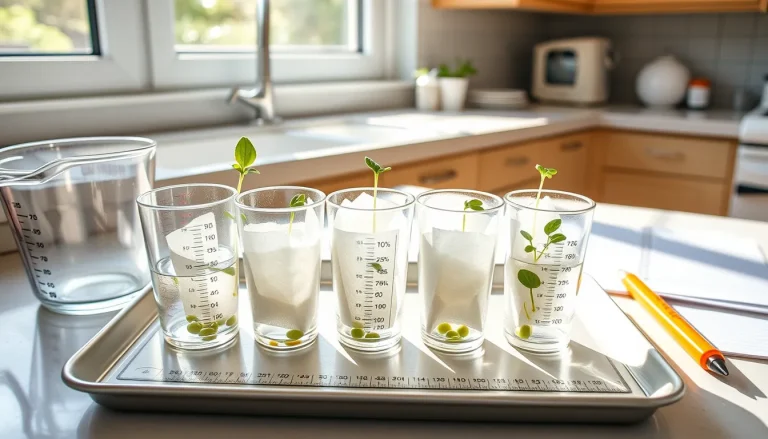
- Four small clear plastic cups or jars (identical size).
- Paper towels or cotton balls (to hold the seed).
- Four identical seeds – radish, bean, or lettuce work well because they sprout quickly.
- Four kitchen liquids:
- Tap water (control).
- Salt water (1 teaspoon table salt dissolved in 250 ml water).
- Carbonated water or soda (no added caffeine; use plain club soda).
- Fruit juice (100 % orange or apple, no added sugar).
- Permanent marker for labeling.
- Ruler and notebook for daily measurements.
- Prepare the liquids. Measure 100 ml of each liquid into a separate small container. The salt solution should be fully dissolved; the other liquids can be used as‑is.[2]
- Set up the germination stations:
- Place a folded paper towel or a cotton ball inside each cup.
- Moisten the towel/ball with 20 ml of the assigned liquid. The material should be damp but not dripping.
- Place one seed on the surface of the moist material.
- Label each cup with the liquid name.
- Create a consistent environment. Put the cups in a warm spot (20‑25 °C) with indirect sunlight. A windowsill or a light‑filled countertop works well.
- Observe daily for 7‑10 days.
- Record whether the seed has split (radicle emergence), the length of the root, and any visible changes.
- Keep the paper towel/ cotton damp by adding a few drops of the same liquid if it dries out.
- Analyze the data.
- Compare the germination rate (how many seeds sprouted) and average root length across liquids.
- Graph the results using a simple bar chart: X‑axis = liquid type, Y‑axis = average root length (mm).
Worked example: Radish seeds in four kitchen liquids
Imagine you follow the steps above with radish seeds. Your notebook might look like this (illustrative numbers only):
| Day | Water (control) | Salt water | Soda | Juice |
|---|---|---|---|---|
| 1 | Damp, no change | Damp, no change | Damp, bubbles | Damp, sweet smell |
| 3 | Radicle 2 mm | No visible change | Radicle 0.5 mm | Radicle 1 mm |
| 5 | Radicle 6 mm, cotyledons emerging | Still no radicle | Radicle 2 mm, stunted | Radicle 3 mm, slightly yellow |
From this mock data you can see that plain water produced the fastest, healthiest seedlings, while salt water prevented germination entirely. Soda and juice allowed germination but resulted in slower growth and subtle discoloration—likely due to acidity and dissolved sugars affecting osmotic pressure.[3]
Common mistakes and how to avoid them
- Using too much liquid. Over‑filling the cup can drown the seed and create an anaerobic environment. Keep the paper towel just damp.
- Mixing liquids unintentionally. Label each cup clearly and keep containers separate.
- Neglecting the control. Without plain water as a baseline, you cannot tell if a liquid is helping or harming the seed.
- Choosing seeds with very different moisture needs. Stick to one species for a fair comparison.
Troubleshooting: When seeds don’t sprout
If none of the seeds germinate, consider these checks:
- Seed viability – try a fresh seed from a reputable source; old seeds may be dead.
- Temperature – seeds typically need 20‑25 °C; a colder room slows metabolism.
- Moisture level – the paper towel should stay moist but not soggy. Add a few drops of the same liquid if it dries out.
- Liquid concentration – high salt or sugar concentrations create osmotic stress. Dilute the solution (e.g., half‑strength salt) and repeat.
If only the control water works, you have a clear demonstration that the other liquids are inhibitory.
Limitations and interpretation
This short test tells you whether a liquid is compatible with the earliest stage of plant life. It does not predict how the same liquid will affect a mature plant, nor does it account for long‑term nutrient needs. Also, the experiment uses a single seed per liquid; for more robust conclusions, repeat with multiple seeds and calculate an average germination rate.
Next action
Gather the materials, set up the four‑liquid experiment, and let your children record daily observations. After the results are in, discuss why plain water performed best and how the chemical makeup of each kitchen liquid impacted the seeds. This conversation reinforces concepts of control, variable, and fair testing—core skills for any budding scientist.
FAQ
Can I use other kitchen liquids like vinegar or milk?
Yes, but strong acids (vinegar) or high‑protein liquids (milk) can be harmful. A 10 % vinegar solution usually stops germination, while diluted milk may allow limited growth. Test them in separate cups if you want to explore further.
How many seeds should I test per liquid?
For reliable results, use at least three seeds per liquid and calculate the average germination rate. More seeds reduce the impact of a single outlier.
Do I need special equipment to measure root length?
A simple ruler or a metric measuring tape is sufficient. Record the length in millimeters for easy comparison.
Related terms
- Germination
- The process by which a seed absorbs water, activates enzymes, and begins to grow a root and shoot.
- Hydroponics
- Growing plants in a nutrient‑rich liquid solution instead of soil.
- Control (experiment)
- A standard condition (plain water) used for comparison with experimental variables.