Children quickly learn that science is about asking questions, trying things out, and seeing what happens. The most powerful way to turn curiosity into reliable knowledge is a fair test – an investigation where only one factor is changed while everything else stays the same. This article explains the idea of a fair test, shows how to identify and control variables, and provides a complete, hands‑on activity that families can do with items found at home.
What Is a Fair Test?
A fair test is a systematic way of finding out how one specific change influences an outcome. By keeping all other conditions identical, the result can be attributed to the single factor that was altered. The UK National Curriculum describes a fair test as “changing one variable at a time, keeping everything else the same”[3]. When the test follows this rule, the data are easier to compare and the conclusions are more trustworthy.
Why Controlling Variables Matters
Variables are anything that can be changed, measured, or kept constant in an experiment. The BBC defines three types of variables: independent (the factor you change), dependent (the result you measure), and controlled (the aspects you deliberately keep the same)[1]. If more than one variable changes at once, you cannot tell which one caused the observed effect, and the test is no longer fair.
Designing Your Own Fair Test
Before diving into the hands‑on activity, follow this planning workflow. It mirrors the scientific method and helps children see the logical structure of an experiment.

1. Choose a Testable Question
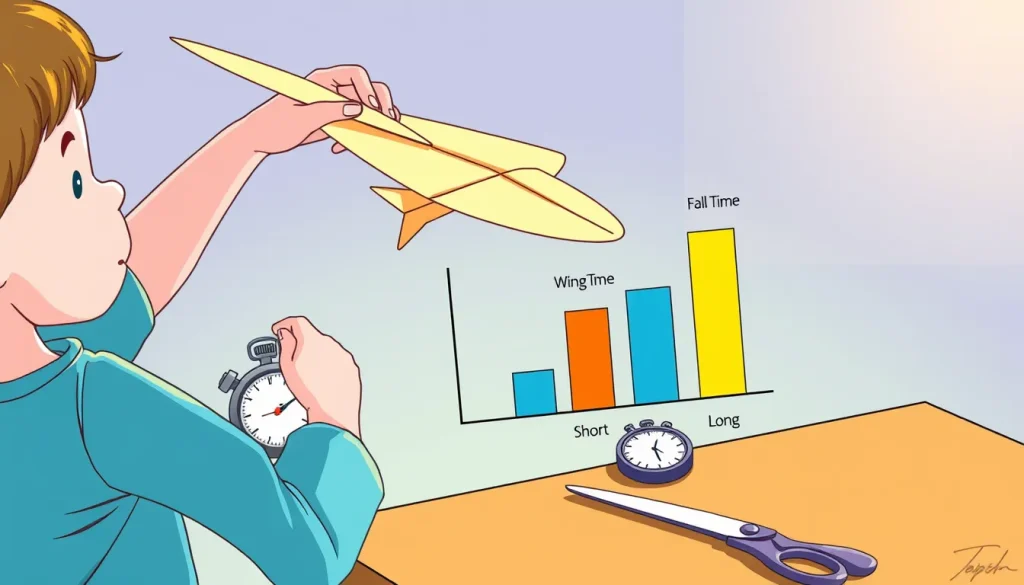
Start with a clear, answerable question that involves a measurable outcome. Example: “How does the length of a paper helicopter’s wings affect the time it takes to fall to the floor?”
2. Form a Hypothesis
Encourage the child to predict what will happen and why. A good hypothesis links the independent variable to the expected change in the dependent variable, e.g., “Longer wings will catch more air and therefore fall more slowly.”
3. Identify Variables
- Independent variable: wing length (short, medium, long).
- Dependent variable: fall time (seconds).
- Controlled variables: type of paper, number of paperclips used for weight, drop height, indoor draft, and the way the helicopter is released.
4. Decide on a Control Group (Optional)
If you want a baseline, keep one helicopter at a standard wing length and compare the others to it. The control helps highlight how much the independent variable changes the result.
Example Activity: Paper Helicopter Fall‑Time Test
This experiment uses ordinary printer paper, scissors, a ruler, and a stopwatch – all items most families already have. It follows the fair‑test principles described above and lets children see a direct cause‑and‑effect relationship.
Before You Begin
- Choose a quiet, draught‑free room with a hard floor.
- Gather an adult to help with cutting and timing.
- Explain the safety rule: scissors are for cutting only; never point them at anyone.
Materials
- 3 sheets of A4 or letter‑size printer paper (same brand and weight).
- Scissors.
- Ruler (15 cm or longer).
- 2 small paperclips (to add a little weight).
- Stopwatch or a phone timer.
- Marker for labeling (optional).
- Flat surface about 1 m high from the floor (a table works well).
Steps
- Fold each sheet of paper in half lengthwise, then unfold – this crease will help you cut straight.
- Measure and cut three wing lengths:
- Short: 5 cm from the fold outward.
- Medium: 7.5 cm.
- Long: 10 cm.
Use the ruler for accuracy and label each piece.
- Attach two paperclips to the centre of each helicopter’s body (the folded edge). This keeps the weight consistent.
- Set the drop height: place the table edge exactly 1 m above the floor. Use a tape measure to verify.
- Hold a helicopter at the same starting point – the tip of the body, not the wing – and release it without pushing.
- Start the stopwatch the moment you let go.
- Stop it when the helicopter touches the floor.
Record the time in seconds.
- Repeat the drop three times for each wing length, resetting the helicopter to the same starting position each time.
- Write all times in the data table provided below.
What to Observe or Measure
The dependent variable is the fall time, measured in seconds to the nearest tenth. Qualitative notes – such as “spins a lot” or “wiggles sideways” – are optional but help develop observation skills.
Data Table
| Wing Length | Trial 1 (s) | Trial 2 (s) | Trial 3 (s) | Average (s) |
|---|---|---|---|---|
| Short (5 cm) | ||||
| Medium (7.5 cm) | ||||
| Long (10 cm) |
Repeated Trials and Why They Matter
Repeating each drop three times reduces the influence of random factors such as a slight hand movement or a brief draft. By averaging the three times, children learn how scientists treat variability and improve the reliability of their conclusions.
Graphing Your Results
When the table is filled, draw a simple bar graph:
- X‑axis: Wing length (short, medium, long).
- Y‑axis: Average fall time (seconds).
- Each bar shows the mean time for that wing length.
A visual comparison makes the trend – longer wings = longer fall time – easy to see.
Troubleshooting Common Problems
| Symptom | Possible Cause | Check / Fix |
|---|---|---|
| Times vary wildly between trials | Inconsistent release point or hidden draft | Mark a release spot on the table and ensure the room is still. |
| Helicopter lands on its side | Uneven weight distribution | Make sure both paperclips are attached symmetrically. |
| Wings bend during the fall | Paper too thin or wet | Use fresh, dry paper of the same type for all three. |
Common Misconceptions
Extending the Investigation
Once the basic question is answered, children can explore new variables while still practising fair testing:
- Change the type of paper (e.g., construction vs. printer).
- Add or remove a paperclip to vary weight.
- Alter the drop height to see how gravity interacts with wing size.
Each new question should follow the same planning steps: write a fresh testable question, identify the single independent variable, keep everything else constant, and record the results.
Next Steps
After the data are collected and graphed, guide the child through a short discussion:
- What pattern did you observe?
- Did the results match the hypothesis? Why or why not?
- What sources of error might have affected the numbers?
- How could you improve the experiment next time?
Document the answers in a simple report or a slide deck. Sharing findings with siblings, classmates, or a family science night reinforces the communication aspect of the scientific method.
Summary
Designing a fair test is a foundational skill for any budding scientist. By deliberately changing only one variable, keeping all others constant, and recording repeated measurements, children learn how reliable evidence is built. The paper‑helicopter activity demonstrates these ideas with everyday materials, clear steps, and room for creative extensions. Use the planning workflow, data table, and troubleshooting guide to turn curiosity into confident, evidence‑based conclusions.
FAQ
Can I use a different kind of paper for the helicopter?
Yes, but you must keep the paper type the same for all three helicopters. Changing paper type would introduce a new variable.
Do I need a digital timer?
A phone stopwatch works well. If you use a manual stopwatch, make sure to start and stop it as consistently as possible.
What if the room has a slight breeze?
Close windows and doors, and perform the drops away from fans or air vents. A draft would affect the fall time and break the fair‑test condition.
Related terms
- Independent variable
- The factor that the experimenter deliberately changes.
- Dependent variable
- The outcome that is measured to see the effect of the independent variable.
- Controlled variable
- Any factor that is kept the same in all trials to ensure a fair comparison.
- Control group
- A set of trials that uses the standard condition, providing a baseline for comparison.
Sources & references
- BBC Bitesize – Planning experiments and variables – https://www.bbc.co.uk/bitesize/articles/zssccmn
- BBC Bitesize – How do you make sure a test is fair? – https://www.bbc.co.uk/bitesize/articles/z69qwnb
- Primary Connections – Conducting fair test investigations – https://primaryconnections.org.au/pedagogical-tools/conducting-fair-test-investigations