Overview
Our solar system spans billions of kilometres, yet the planets themselves are tiny compared with the Sun. A scale model squeezes these extremes into a size that can be walked, measured, and explored in a backyard, hallway, or schoolyard. The activity is a demonstration: it shows the relative sizes and distances, but it does not test a hypothesis or measure a variable.
Before You Begin
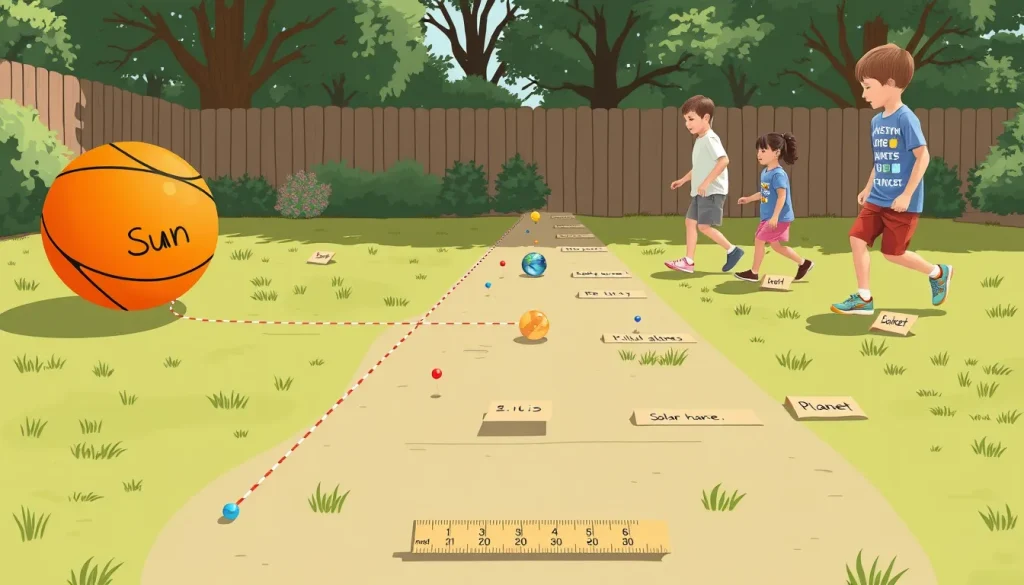
1. Choose a scale. Decide how big you want the Sun to be and calculate the corresponding sizes and distances for the planets. A common and manageable choice is 1 cm on the model = 1 million km in space. With a 24 cm (≈9‑inch) basketball representing the Sun, Earth ends up about 2.5 m (8 ft) away, and Neptune about 45 m (150 ft) away.
The NASA JPL guide uses the same kind of reasoning and suggests a basketball‑size Sun for a backyard model [1].
2. Decide on the level of detail. For younger children (6‑8 yr) you may model only the inner planets. For ages 9‑14 you can extend the model to the outer planets and the asteroid belt.
3. Pick a location. A straight‑line path works best – a garden path, a school hallway, or a cleared driveway. Measure the total length you have; if it is shorter than the model’s outermost distance, reduce the scale proportionally.
Materials
- One large sphere for the Sun – a basketball, beach ball, or inflated balloon (≈24 cm diameter).
- Small round objects for planets – beads, pinheads, small plastic balls, or match‑stick heads.
- Measuring tape or a long ruler (metric or imperial).
- String, yarn, or thin rope to mark the orbital line (optional).
- Cardboard sheets or poster board for distance markers (cut into rectangles or triangles).
- Permanent marker or chalk for labeling.
- Scissors, tape, and a pen.
- Adult supervision for cutting, measuring, and handling small objects.
Step‑by‑Step Procedure
- Calculate the model dimensions. Use the chosen scale to convert each planet’s real diameter and orbital radius (average distance from the Sun) into centimetres or metres. A simple spreadsheet or calculator helps.
- Sun: 1 392 700 km → 139 cm (real) → 24 cm (model, chosen).
- Earth diameter 12 742 km → 1.27 cm model.
- Earth orbital radius 149.6 million km → 149.6 cm → 1.5 m on the model.
- Prepare the Sun. Place the basketball at one end of your chosen line. Secure it with tape or a stand so it will not roll.
- Create planet markers. Match each planet to a small object whose size approximates the calculated model diameter. For example, a 2‑mm marble works for Earth, a 0.8‑mm pinhead for Mercury, and a 5‑mm ball for Jupiter.
- Mark distances. Starting at the Sun, measure out the calculated distance for the first planet (Mercury) and place a cardboard marker there. Label the marker with the planet’s name.
Repeat for each subsequent planet, always measuring from the Sun, not from the previous planet. Use the same tape measure for consistency. - Place the planet objects. Gently set each planet marker on its distance card. If you wish to show the orbital path, stretch a piece of string from the Sun to the planet and tape it to the ground.
- Label the model. Write the name of each planet on its distance card. You may also note the real‑world distance (e.g., 150 million km) and the model distance (e.g., 1.5 m).
- Walk the model. Have the children start at the Sun and walk the distance to each planet, noting how long it takes to cover the space. This physical experience reinforces the scale.
- Optional extensions.
- Add a cardboard cut‑out for the asteroid belt between Mars and Jupiter.
- Use different colours of string to represent planetary orbits.
What to Observe or Measure
Ask the participants to record:
- The model distance between the Sun and each planet (in centimetres or metres).
- The time it takes to walk each segment (seconds or minutes). This gives a sense of how much space separates the planets.
- Any surprising size differences (e.g., Earth’s model sphere is only a few millimetres).
Use a simple table to capture the data (you can draw it on a sheet of paper):
| Planet | Real orbital radius (million km) | Model distance (m) | Walk time (s) |
|---|---|---|---|
| Mercury | 57.9 | 0.58 | |
| Venus | 108.2 | 1.08 | |
| Earth | 149.6 | 1.50 | |
| Mars | 227.9 | 2.28 |
The Science Explained
When we look at a picture of the solar system, the planets often appear crowded around the Sun because the picture cannot show the true distances. In reality, the Sun’s diameter is about 1.39 million km, while Earth is 149.6 million km away – more than 100 times the Sun’s own width. By shrinking everything by the same factor, the model preserves the *ratio* of sizes and distances, letting the eye and the body experience the vastness of space.
Key concepts:
- Scale factor: a constant that converts real values to model values. In our example, 1 cm = 1 million km.
- Astronomical Unit (AU): the average distance from Earth to the Sun (≈150 million km). On the model, 1 AU ≈ 1.5 m.
- Proportional reasoning: If the Sun is reduced to 24 cm, every other measurement must shrink by the same proportion to stay accurate.
Seeing the model helps learners understand why space missions take years to travel between planets and why telescopes need huge mirrors – the distances are enormous compared with the objects they observe.
Model Limitations
Every model simplifies reality. This demonstration:
- Shows only a single line (a two‑dimensional slice) of a three‑dimensional system. In space, planets orbit in slightly different planes.
- Uses average orbital radii; actual distances vary because orbits are elliptical.
- Does not represent orbital speed or the Sun’s gravity; it is a static snapshot.
- Relies on the chosen scale; different scales will alter the walking distances but keep the ratios the same.
Understanding these limits prevents misconceptions such as “planets are lined up in a straight line” or “the Sun is a solid ball that planets sit on.”
Try Another Version
If you lack a large open space, you can make a “compact” version using a hallway or a classroom floor:
- Choose a smaller scale, e.g., 1 cm = 5 million km. The Sun becomes a 5‑cm ball, and Earth is only 3 cm away.
- Mark distances with chalk on a floor or with taped cardboard strips.
- Use coloured paper circles for planets instead of beads if the smallest objects are hard to see.
Even a compact model still illustrates the disproportionate spacing, and it can be set up in a single class period.
Cleanup and Storage
Collect all beads, pins, and string pieces and store them in a small box. If you used cardboard markers, fold them flat and keep them in a folder. The large Sun ball can be deflated or stored in a sports‑equipment bin. Dispose of any broken pins safely in a puncture‑proof container.
Related terms
- Astronomical Unit (AU)
- The average distance between Earth and the Sun, about 150 million kilometres.
- Scale model
- A physical representation that preserves the proportion of sizes and distances of the real object.
Sources & references
- NASA JPL Education, “Make a Scale Solar System – Math Project”, https://www.jpl.nasa.gov/edu/resources/project/make-a-scale-solar-system/
- BBC Sky at Night Magazine, “Make a scale model of the Solar System and show where the planets really are in relation to the Sun”, https://www.skyatnightmagazine.com/advice/diy/make-scale-solar-system-model
- Double Helix, “Make a solar system to scale”, https://blog.doublehelix.csiro.au/make-a-solar-system-to-scale/